
Measuring the color temperature range and accuracy of COB LED strip lights sounds simple until two "identical" 3000K rolls look different on a wall color binning standards 1. I have watched that ruin projects, so our team built a strict verification routine.
To measure color temperature range and accuracy of COB LED strips, use a calibrated spectroradiometer or integrating sphere after 30–60 minutes of warm-up. Record CCT at warm, mid, and cool settings, then compare readings against the claimed tolerance band, SDCM rating, and Duv value.
That is the short answer. Below, I will walk through the tools, the batch checks, the installation pitfalls, and the certifications you should demand before paying a deposit.
What Tools Do I Need to Accurately Measure Color Temperature on COB LED Strips?
A client once tested our samples with a phone app and got readings 400K off. That moment taught me to always explain the instrument question first.
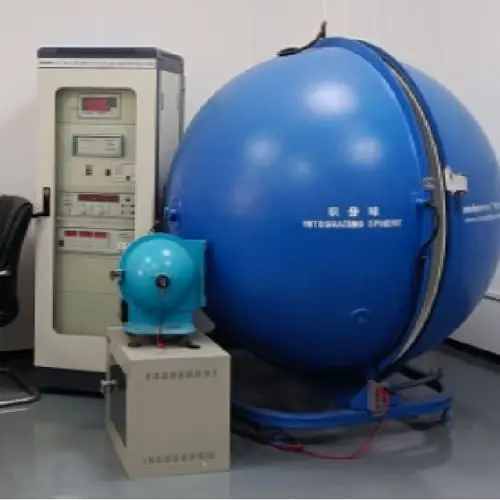
You need a calibrated spectroradiometer for accurate Correlated Color Temperature readings, an integrating sphere for total-flux lab validation, and a stable power supply. A handheld colorimeter works for quick field checks, but only a spectrometer reveals CRI, Duv value, and tint shift.
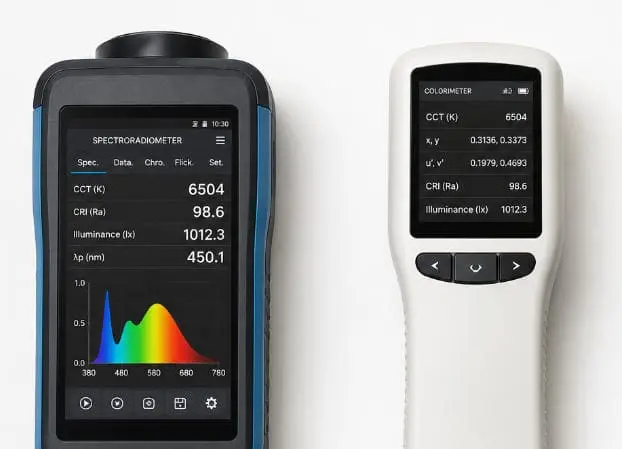
Let me break down what each tool actually does, because buyers often overspend on lab gear they do not need, or trust cheap meters they should not.
Spectroradiometer vs. Colorimeter vs. Integrating Sphere
A spectroradiometer captures the full spectral power distribution 2 of the light. From that data, you get Correlated Color Temperature in Kelvin, the Color Rendering Index, R9 for saturated reds, and even the Melanopic/Photopic ratio if you are specifying human-centric lighting. A colorimeter uses filters instead of full spectral capture, so it is faster and cheaper but less complete. An integrating sphere collects light from the entire strip section, so the reading reflects total luminous flux rather than one hot spot on the phosphor coating.
| Tool | Best For | What It Measures | Limitation |
|---|---|---|---|
| Spectroradiometer | Field and bench accuracy checks | CCT, CRI, R9, Duv value, TM-30-15 data | Needs calibration and fixed distance |
| Colorimeter | Quick consumer-level checks | Approximate CCT and illuminance | Cannot detect subtle tint shift |
| Integrating sphere | Formal lab validation | Total flux, averaged CCT, efficacy | Expensive; lab access required |
| Reference white target | Visual side-by-side comparison | Perceived tint difference | Subjective, not quantified |
The Measurement Workflow We Use
When we validate samples before shipping, we follow a fixed sequence. First, power the strip with the rated driver and let it run 30 to 60 minutes to reach thermal equilibrium. LEDs shift as the junction heats up, so early readings mislead you. Second, measure the warmest setting at a fixed distance. Third, measure the midpoint, then the coolest setting. Fourth, record whether each reading sits inside the claimed tolerance. Finally, check the Duv value, because a strip can hit 3000K exactly yet still look green or magenta if it sits far off the blackbody locus. For tunable-white COB strips, also sweep the dimming range from 1% to 100% to catch color shifts caused by PWM or CCR dimming.
How Can I Verify Color Consistency Across Different Batches of COB LED Strips?
Batch consistency is the issue I care about most. Common COB strips now cover 2700K to 6500K, but in my projects, range matters far less than repeatability between rolls.
Verify batch consistency by requesting the supplier's LED binning records, specifying SDCM ≤ 3 in your purchase contract, and spot-measuring strips from each batch under identical warm-up and power conditions. Compare readings on a MacAdam Ellipse chart to confirm all samples fall within the same zone.
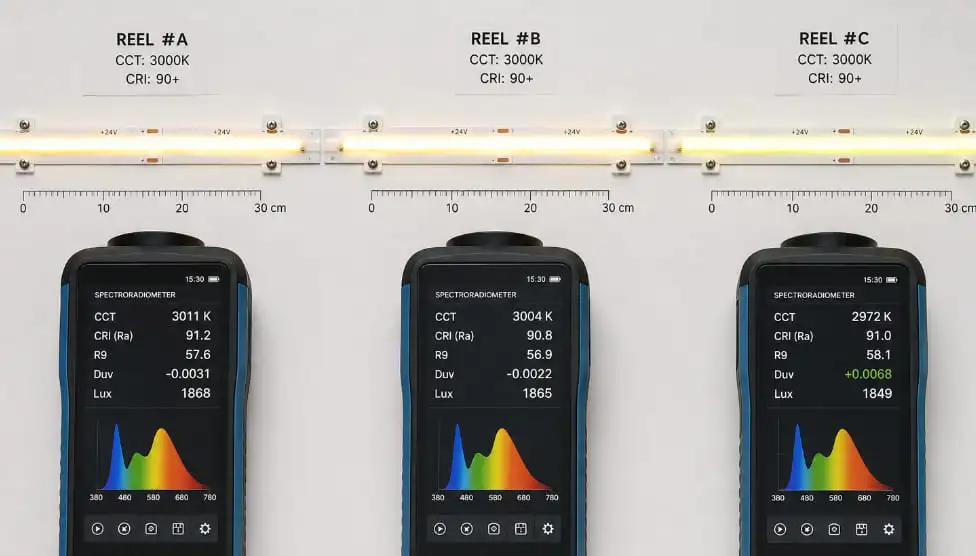
Here is my honest position, learned the hard way on real installations. Two rolls can both read "3000K" on the label, yet one leans yellow and the other leans white. Joined on a coffered ceiling, the seam is obvious to anyone standing in the room. That is why I would rather work with a factory that controls color temperature tightly than accept a cheaper quote with loose binning. Once the strips are glued into an aluminum channel and the ceiling is closed, there is basically no way to fix a color mismatch without tearing out work.
Understand SDCM Before You Order
SDCM, the standard deviation of color matching 3, is measured in MacAdam Ellipse steps. It quantifies how far individual LEDs or strips deviate from a target chromaticity point. Lower is tighter.
| SDCM Value | Visual Result | Suitable For |
|---|---|---|
| ≤ 2 steps | No visible difference to most observers | Museums, retail feature walls, luxury hospitality |
| ≤ 3 steps | Barely perceptible difference | Most commercial and residential projects |
| 4–5 steps | Noticeable tint variation side by side | Budget signage, hidden cove areas |
| ≥ 6 steps | Obvious mismatch when strips are joined | Not acceptable for continuous runs |
One supplier guideline I agree with recommends specifying SDCM ≤ 3 to cut down complaints about green or pink tint. For long continuous runs, we push our partner factories toward 2 steps.
Practical Batch Checks You Can Run
Do not rely on paperwork alone. Cut a 30cm sample from three random reels in each incoming batch. Run all three from the same driver, side by side on a white board, after full warm-up. Then measure each with the same spectroradiometer at the same distance. If the CCT spread exceeds your tolerance, or the Duv values diverge, reject the batch before installation, not after. Weak LED binning control is the root cause of most batch drift, so ask your supplier to lock a bin code for the life of your project and reserve chips for repeat orders.
Why Does My COB LED Strip Show Color Temperature Deviation After Installation?
An Australian distributor once sent me photos of a "faulty" 4000K run that looked warm at one end. The strips were fine. The installation was the variable.
Post-installation color deviation usually comes from heat buildup, voltage drop along long runs, PWM dimming artifacts, or viewing-angle shift from the phosphor coating. Poor thermal management raises junction temperature, which shifts the spectrum, so proper aluminum channels and stable drivers prevent most drift.
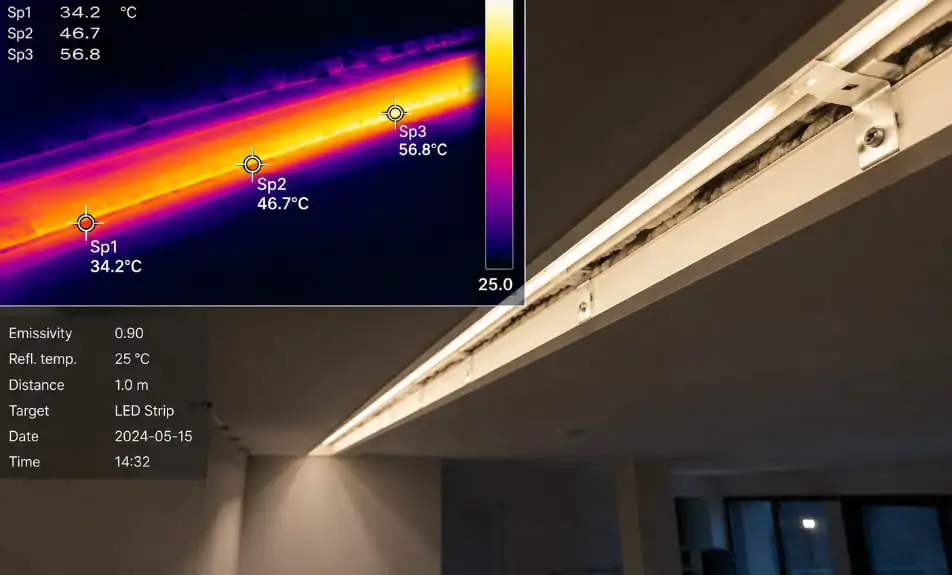
Understanding the failure modes helps you diagnose problems fast instead of blaming the product or the installer without evidence. In our experience supporting contractors in Germany and Australia, deviation after installation almost always traces back to one of four physical causes.
The Four Common Causes of On-Site CCT Drift
First, heat. LED phosphors and chips shift color as junction temperature rises. One source suggests high-CRI tunable strips should stay below about 35°C to reduce color shift. Mounting a COB strip directly onto MDF or inside a sealed pocket traps heat. An aluminum profile acts as a heatsink and stabilizes the spectrum. If you want lab-grade confirmation, the Forward Voltage Method estimates real-time junction temperature and lets you correlate it with instantaneous spectral drift.
Second, voltage drop. On long 24V runs, the far end receives less voltage and current. Brightness falls, and on some designs the chromaticity moves too. This is why we recommend 48V or constant-current long-run designs for continuous installations beyond typical limits.
Third, dimming behavior. Measure CCT linearity across the full 1% to 100% dimming range. PWM dimming at low frequencies and CCR dimming at deep dim levels can both push the color point around, especially on tunable-white strips where two channels mix.
Fourth, viewing angle. The continuous phosphor layer on COB strips can produce Color-over-Angle shift. Light measured at 0° may differ from light viewed at 60°. In a cove, the audience sees the strip at an angle, so CoA testing before specification avoids surprises.
Quick Diagnostic Checklist
- Measure CCT at both ends of the run after full warm-up.
- Check surface temperature; above roughly 35°C on high-CRI strips is a warning sign.
- Test at 100%, 50%, and 5% dim levels and log the readings.
- View the strip at 0°, 30°, and 60° to spot angle-dependent tint.
- Confirm the driver output voltage at the far end of the run.
Which Certifications Should I Request to Confirm CCT Accuracy Before Placing an Order?
Before we onboard any partner factory, our small team requests test reports first and price lists second. Paperwork quality predicts product quality surprisingly well.
Request an IES LM-79 photometric report from an accredited lab such as UL or Intertek, stating measured CCT, CRI, Duv value, and test conditions. Add binned SDCM documentation, TM-30-15 color fidelity data for premium projects, and physical samples measured at both range endpoints.
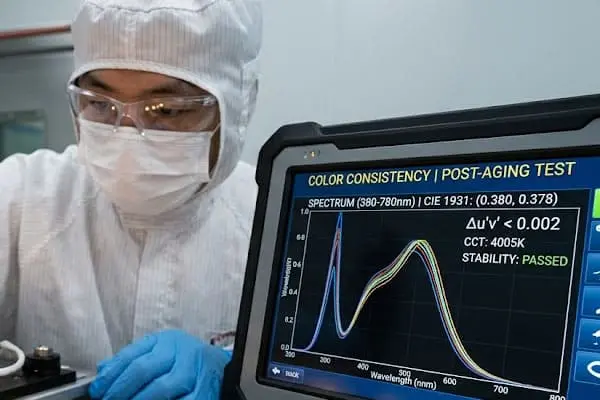
A spec sheet claim is marketing. A third-party report is evidence. The difference matters most when your project has to pass approval by a designer, an engineer, or a government tender panel. Distributors bidding on projects in Germany tell us that having the right documents ready cuts weeks off approval timelines.
What Each Document Actually Proves
An IES LM-79 report 4 is the gold standard for photometric verification. It is produced in an accredited lab using an integrating sphere or goniophotometer, and it states measured CCT, luminous flux, efficacy, CRI, and chromaticity coordinates under defined conditions. For a claimed 1800K–4000K tunable strip, the measured warm end should land around 1800K–2000K and the cool end near 3800K–4000K. If a supplier cannot produce this report, or only offers an unbranded internal PDF, treat the claimed accuracy as unverified.
For color quality beyond basic CRI, ask for TM-30-15 data. It reports fidelity and gamut 5 across 99 color samples, which exposes weaknesses that a single CRI number hides. Also confirm R9, since saturated red rendering is where many budget COB strips fail even at "CRI 90+."
| Claim on the Spec Sheet | Document That Verifies It |
|---|---|
| "2700K–6500K tunable white" | LM-79 report with measured CCT at warm, mid, and cool points |
| "CCT tolerance ±100K" | Binning records showing tolerance per target (e.g., ±150K at 2700K, ±350K at 6000K) |
| "CRI 90+ / 97+" | LM-79 CRI data plus R9 value and TM-30-15 report |
| "High consistency" | SDCM ≤ 3 statement with MacAdam Ellipse bin documentation |
| "Stable across dimming" | Dimming linearity test data from 1% to 100% |
Tolerance Is Part of the Specification
Insist that tolerance appears in writing. Industry examples run around ±150K at 2700K, ±200K at 3000K, ±250K at 4000K, and ±350K at 6000K, because tolerance naturally widens at cooler temperatures. A capable factory should hold roughly ±100K at warm white and ±300K at cool white. A narrow tolerance claim without stated test conditions and third-party verification is just a sentence on a brochure. When we quote project-grade strips, we attach the tolerance, the bin code, and the report reference so the buyer's engineer can audit everything.
Conclusion
Vague spec sheets cost projects real money. Measure CCT with calibrated tools after warm-up, demand SDCM and LM-79 evidence, control heat on site, and choose consistency over cheap.
Footnotes
- Updated DOE resource covering LED color quality, CCT, and chromaticity binning standards. ↩︎
- Technical overview of spectral power distribution, which is captured by spectroradiometers to determine color properties. ↩︎
- Explains the scientific basis for SDCM and how color deviation is measured in lighting. ↩︎
- Official site for the IES LM-79 standard, the primary method for photometric testing of LED products. ↩︎
- Department of Energy resource explaining the TM-30-15 metrics for color fidelity and gamut. ↩︎


 English
 Spanish
 German
 Russian
 Arabic
 French
 Portuguese