
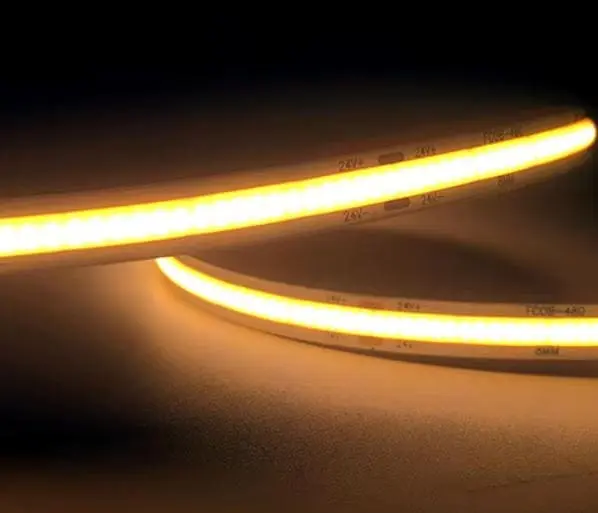
Buyers keep asking me about the luminous efficacy of COB LED strip lights, because inflated spec sheets have burned them before, and our lab tests confirm those doubts are justified.
Well-made COB LED strip lights typically deliver 100–140 lm/W, with mainstream products clustering around 90–110 lm/W. Decorative low-power strips may sit near 50–80 lm/W, while premium strips reach 130–140+ lm/W. Figures above that are usually lab data, not real installed performance.
That range is wide. So let me break down what drives it, how it affects your costs, and how to verify claims before you commit to a bulk order.
How does luminous efficacy affect my long-run LED strip project's energy costs?
A German contractor once sent me his electricity budget for a 400-meter hotel corridor job. The efficacy gap between two quoted strips changed his ten-year running cost more than the strips themselves cost.
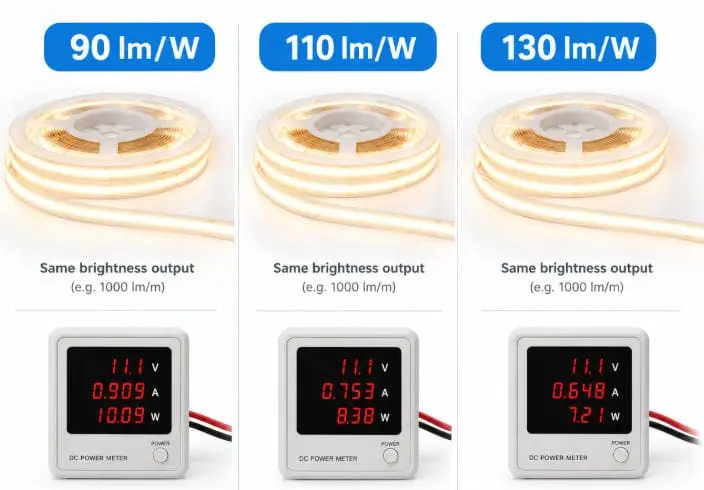
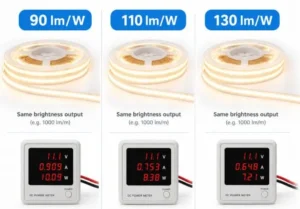
Luminous efficacy directly sets how many watts you burn for a target brightness. On long runs, a jump from 90 lm/W to 120 lm/W cuts power consumption per meter by roughly 25% at equal lumen output, which compounds across hundreds of meters and years of operation.
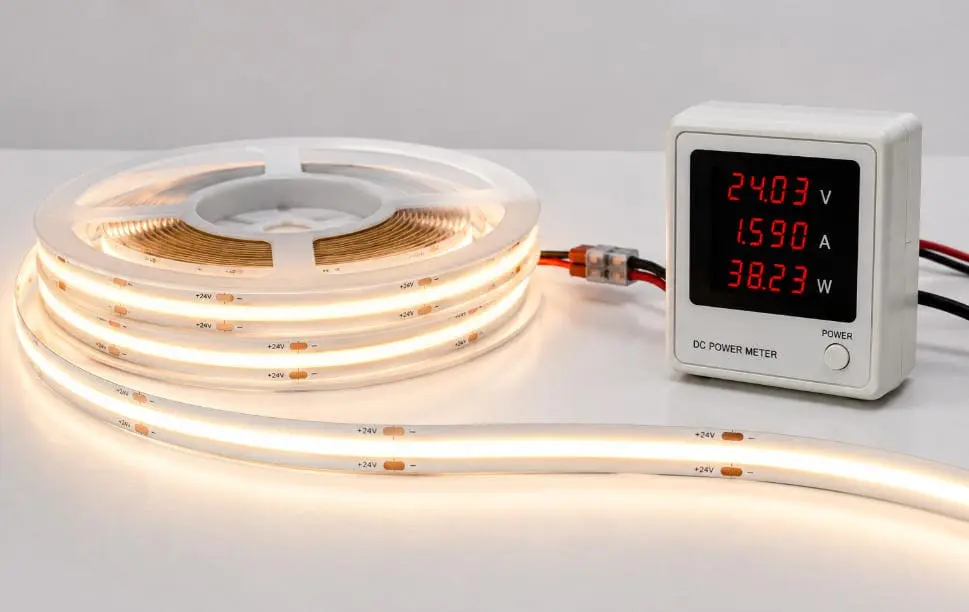
Efficacy is simply lumens per watt: visible light out, divided by electrical power in. On a single 5-meter accent strip, the difference between 90 and 120 lm/W is trivial. On a project with kilometers of dot-free linear lighting running 12 hours a day, it is real money.
A simple worked example
Say your lighting designer specifies 900 lm per meter for a retail cove. Here is what that demand looks like at three efficacy levels:
| Strip efficacy | Power consumption per meter | Power for 300 m | Approx. energy per year (12 h/day) |
|---|---|---|---|
| 90 lm/W | 10.0 W/m | 3,000 W | ~13,140 kWh |
| 110 lm/W | 8.2 W/m | 2,455 W | ~10,750 kWh |
| 130 lm/W | 6.9 W/m | 2,077 W | ~9,100 kWh |
The higher-efficacy strip also produces less waste heat. That reduces the load on your heat dissipation design 1 and slows lumen maintenance decline over time. Less heat means the phosphor and chips age more slowly, so year-five brightness stays closer to year-one brightness.
But there is a second-order effect people miss: voltage drop. A lower-wattage strip draws less current, so a long-run installation 2 loses less brightness at the far end. In our project work for Australian clients, we often pair higher-efficacy COB with 24V or 48V designs specifically to keep long runs uniform. Efficacy is not just an energy number. It shapes your driver sizing, your cable gauge, and your thermal management plan all at once.
What lm/W range should I expect when comparing COB strips to standard SMD strips?
Comparison requests land in my inbox weekly, usually framed as a simple SMD vs COB comparison. The honest answer I give clients is that the architecture matters less than the product class.
Expect mainstream COB strips at 90–110 lm/W and premium COB at 120–140+ lm/W, while quality SMD strips span a similar 90–150 lm/W range. Top-tier SMD can edge out COB on peak efficacy, but COB wins on seamless, dot-free light uniformity.
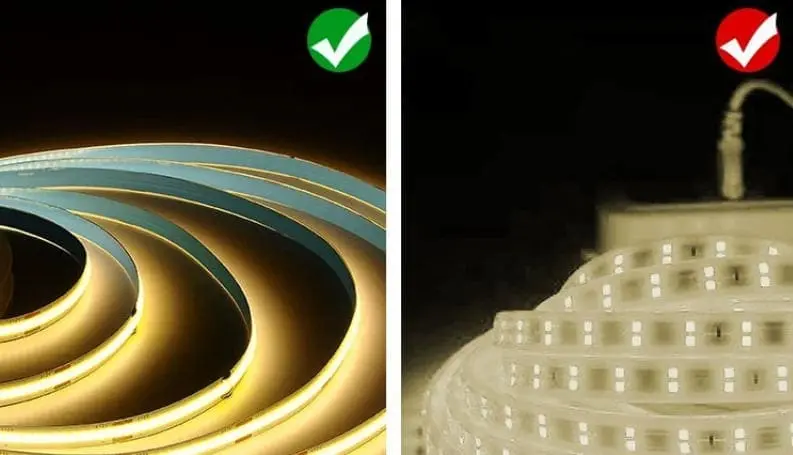
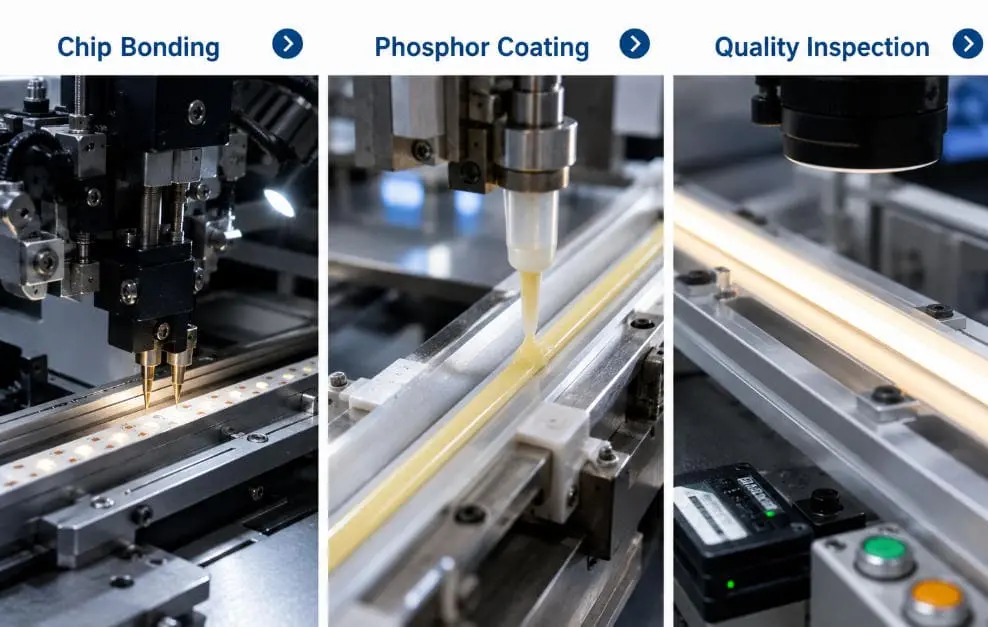
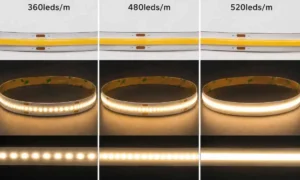
COB describes a package architecture, not a fixed efficiency level. In a COB strip, high-density LED chips 3 are bonded directly to the board and covered with a continuous phosphor layer. That is what creates the dotless line of light. But that thick silicone-phosphor mix also traps a share of photons — an "optical tax" that typically limits COB efficacy to roughly 90% of the raw chip's potential. Discrete SMD packages avoid some of that loss, which is why the very highest lm/W claims usually belong to SMD products.
Realistic ranges by product class
| Product class | Typical efficacy | Best suited for |
|---|---|---|
| Decorative / low-power COB | 50–80 lm/W | Accent lines, furniture edges |
| Mainstream white COB | 90–110 lm/W | Coves, under-cabinet, retail |
| Premium COB | 120–140+ lm/W | Long-run commercial, energy-critical projects |
| High-efficiency SMD | 130–150+ lm/W | Raw output where dots are hidden |
| CSP linear arrays (emerging) | 160–180 lm/W (claimed) | Next-generation dotless formats |
Real product data confirms the spread. One listed COB strip works out to about 94 lm/W (800 lm at 8.5 W), another claims 138.9 lm/W, and some decorative strips sit at just 53 lm/W. All are "COB." That is why I tell buyers to ignore the label and compute lm/W from lumens per meter and watts per meter.
Two more variables shift the number. Color temperature (CCT) matters: cool white 6000K strips are generally 10–15% more efficient than warm white 2700K. And Color Rendering Index (CRI) matters even more: moving from CRI 80 to CRI 90+ typically costs 15–20% of lm/W output. A "140 lm/W" strip at 6500K CRI 80 and a "105 lm/W" strip at 3000K CRI 95 may be built on the very same chips.
Which factors in Glowin's production process influence the efficacy of my custom COB order?
During a custom development round last year, a wholesaler asked our team to squeeze 10 more lm/W out of a 2700K CRI 90 strip. We could — but only by trading away things he actually needed.
Efficacy on a custom COB order is set by chip binning, drive current, phosphor formulation for the target CRI and CCT, PCB copper weight for heat dissipation, and driver efficiency. Each choice trades efficacy against color quality, lifespan, or cost.
When we co-develop a strip with a client, efficacy is not one dial. It is the sum of several engineering decisions made in sequence. Here is how we walk buyers through it.
The decision chain, step by step
- Chip selection and binning. We source blue chips in tight efficacy and voltage bins. Better bins cost more but lift the ceiling for everything downstream. Flip-chip designs remove wire bonds, which cuts electrical resistance and improves heat transfer into the substrate — a genuine efficacy gain, not a spec-sheet trick.
- Phosphor blend. This locks in your CCT and CRI. A CRI 90+ blend converts more blue light into red wavelengths, which is less efficient. We ask clients to confirm CRI requirements first, then set efficacy expectations honestly.
- Drive current. Underdriving chips raises lm/W; overdriving raises brightness per meter but lowers efficacy and accelerates lumen depreciation. Some factories overdrive to hit a brightness number, then quietly quote lab efficacy measured at a gentler current. We refuse to mix those two conditions on one datasheet.
- PCB and thermal design. COB strips concentrate heat, so we specify high-conductivity copper PCBs sized to the actual wattage. Poor thermal management can erase 10% or more of rated output within months.
- Voltage architecture. For long-run and high-voltage solutions, we design around voltage drop with thicker copper, dual-end injection layouts, or constant-current schemes so installed efficacy matches tested efficacy.
My own position, shaped by years of QC on project-grade orders: I would rather ship a strip rated an honest 110 lm/W that holds its color and brightness for years than chase a 150 lm/W headline achieved by sacrificing CRI or overdriving the chips. Stable and durable beats spectacular on paper — especially when your name goes on the private label.
How do I verify that a supplier's stated lm/W matches actual performance before bulk ordering?
The hard lesson from our early trading years: a spec sheet is a claim, not a measurement. One batch we audited for a client read 130 lm/W on paper and tested at 96 lm/W installed in an aluminum channel.
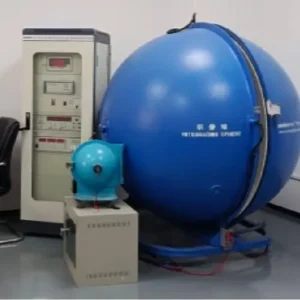
Verify efficacy by requesting an integrating-sphere test report at the actual drive current, then confirm it yourself: measure the strip's real wattage and lumen output on a sample, check whether the figure is chip-level or system-level, and test at operating temperature.
Numbers above 140 lm/W are not impossible, but in my experience they are very often lab data — a bare chip at low current, at 25°C, before the phosphor layer, driver losses, and heat take their share. Your job as a buyer is to close the gap between that number and the strip that goes on the wall.
A practical verification checklist
| Check | What to ask for | Red flag |
|---|---|---|
| Test report | Integrating-sphere (IES LM-79 style) report for the finished strip | Report covers the bare LED, not the strip |
| Test conditions | Drive current and temperature matching the datasheet | Efficacy measured at lower current than rated wattage |
| Level of measurement | Whether lm/W is per chip, per module, or per meter of strip | Vendor cannot say which level the number refers to |
| CRI and CCT match | Report at your ordered CRI/CCT, not a cool-white CRI 80 version | 6000K CRI 80 report supplied for a 2700K CRI 90 order |
| Thermal reality | Data after warm-up, ideally mounted in a channel | Only cold-start readings provided |
| Sample validation | Pre-production samples you can meter yourself | Supplier resists sending samples before MOQ commitment |
Then do your own arithmetic. Take the claimed lumens per meter and divide by measured watts per meter — a plug-in power meter costs almost nothing and exposes inflated claims in minutes. If a strip claims 1,400 lm/m but draws 14 W/m on your meter, that is 100 lm/W regardless of what the box says.
We support this process deliberately. Because we run low-MOQ rapid prototyping, contractors and distributors can test real samples — for efficacy, color consistency between batches, and lumen maintenance under heat — before committing to a container. For project bids in Germany and Australia, we also align test documentation with the certification paperwork the tender requires, so the verified numbers and the compliance file tell the same story.
Conclusion
Chasing headline lm/W figures risks wasted budgets and disappointing installs. Expect 100–140 lm/W from good COB strips, verify claims with real tests, and prioritize stable, honest performance.
Footnotes
- Detailed explanation of thermal management techniques required to maintain LED efficiency and prevent heat-related performance degradation. ↩︎
- Comprehensive overview of LED strip light technology, including common form factors, power requirements, and installation standards. ↩︎
- Authoritative guide on LED construction, explaining how phosphor layers convert blue light into broad-spectrum white light. ↩︎

 English
 Spanish
 German
 Russian
 Arabic
 French
 Portuguese