
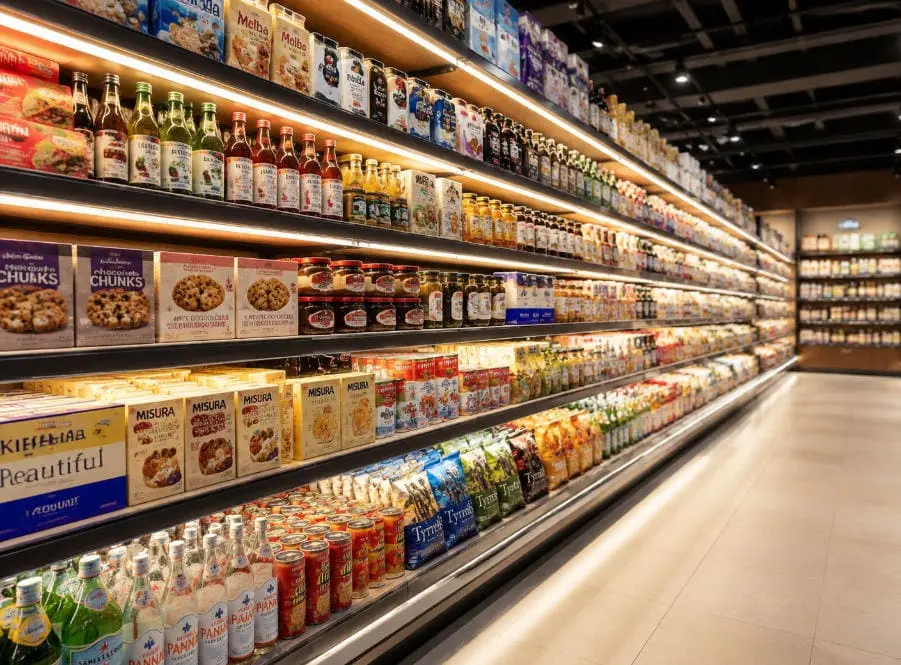
I've watched dozens of supermarket retrofit projects shift away from T5 and T8 tubes — not because those tubes stopped working, but because COB LED strip lights 1 solve problems tubes never could.
COB LED strip lights outperform traditional tubes for supermarket shelf lighting because they deliver seamless, dot-free uniform illumination, fit any shelf dimension without bulky fixtures, cut long-term maintenance costs, and maintain consistent color rendering across every aisle for superior product presentation.
Below, I break down the four biggest reasons retail buyers and contractors are making the switch — and what the real-world differences look like on the shelf.
A distributor in Australia once sent me photos of his client's dairy aisle — the SMD strips behind the shelf lips created a row of bright dots reflected in every yogurt lid, and the store manager was furious seamless, dot-free uniform illumination 2.
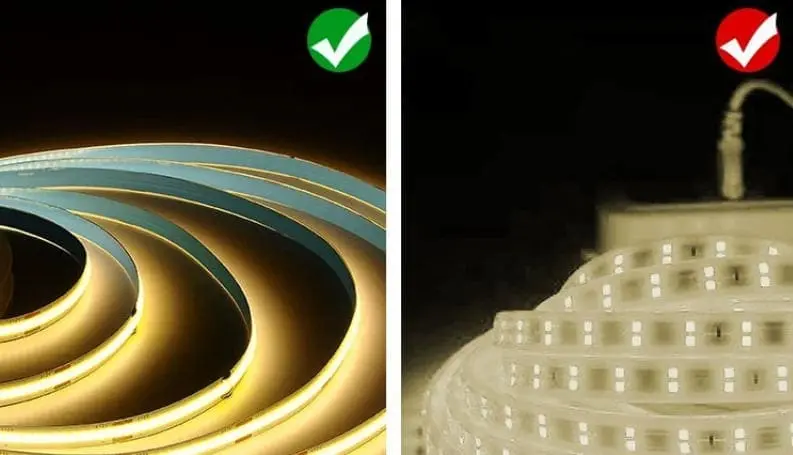
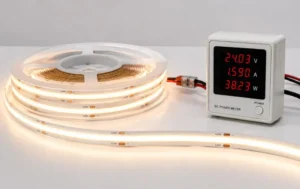
To eliminate the "dot" effect, use COB LED strips that pack hundreds of tiny chips per meter into a single, continuous light source, producing a smooth, gap-free line of light that removes hotspots and shadows from your shelf display.
Why Dots and Hotspots Hurt Sales
When individual LED chips are spaced apart — as they are on standard SMD strips — each chip acts as a tiny point source. Light fans out from each point, but between them you get dimmer zones. On a supermarket shelf, this creates a repeating bright-dark pattern. Products in the bright zones look fine. Products in the gaps look dull or shadowed. Customers might not consciously notice, but they instinctively reach for the brighter item. That means your slower-moving SKUs get even less attention.
Traditional fluorescent tubes avoid the dot issue but introduce their own problems: a fixed length that rarely matches the shelf, a bulky profile that steals vertical space, and a light output that degrades unevenly over time, leaving one end of the tube dimmer than the other.
How COB Technology Creates a Continuous Line
COB stands for Chip on Board 3. Instead of mounting individual LED packages several millimeters apart, the manufacturing process bonds bare LED dies directly onto a flexible circuit board 4 at extremely high density — often 480 or even 720 chips per meter. A phosphor layer is then applied over the entire array. The result is a single, unbroken ribbon of light with no visible individual points.
On our production line, we test every reel under a diffuser-free condition specifically to confirm zero dot visibility. If you can see a single chip boundary with the naked eye at 300 mm distance, the reel does not ship.
Quick Comparison: Light Source Types on a Shelf
| Feature | Traditional Tube (T5/T8) | SMD LED Strip (e.g., 2835) | COB LED Strip |
|---|---|---|---|
| Visible dots/hotspots | No dots, but uneven ends | Yes — clear dot pattern | No — seamless line |
| Light uniformity | Moderate | Low to moderate | High |
| Profile height | 20–30 mm with bracket | 2–4 mm | 2–3 mm |
| Flexibility | Rigid, fixed lengths | Flexible, cut points every 25–50 mm | Flexible, cut points every 25–50 mm |
| Glare reduction | Low (bare tube glare) | Moderate with diffuser | High (inherently soft output) |
For premium product presentation — think organic produce, skincare, or imported wine — the seamless light from COB strips makes colors look richer and packaging look sharper. The customer sees the product, not the light source. That is exactly what good display lighting should do.
Can I easily customize COB strip lengths to fit my unique shelf dimensions without the bulk of traditional tubes?
One trade-off I weigh on almost every supermarket project is whether to spec standard 600 mm or 1200 mm tubes — or just run a single COB strip cut to the exact millimeter the shelf needs.
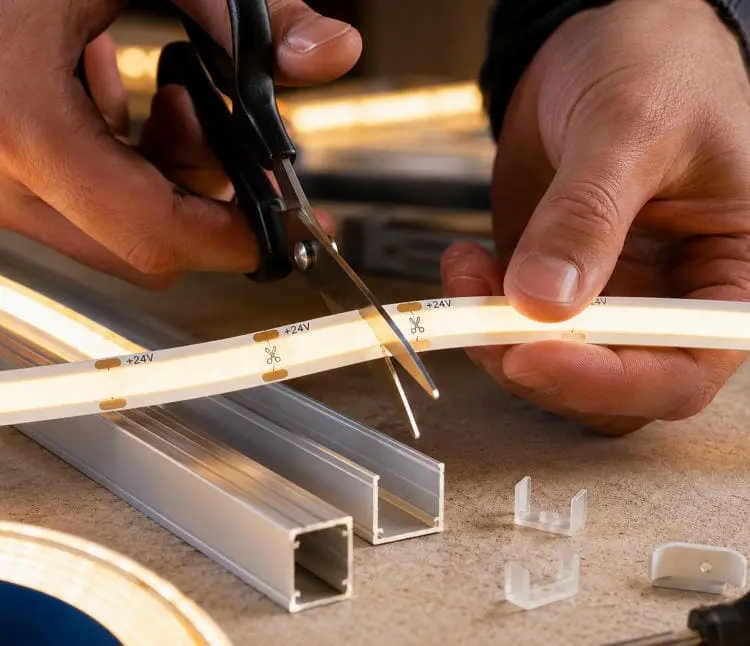
Yes. COB LED strips can be cut at marked intervals as short as every 25 mm, then connected with solderless clips, so you can match any shelf length precisely — no gaps, no overhangs, and no bulky end caps that tubes require.
The Tube-Length Problem
Standard fluorescent and LED tubes come in fixed sizes: 300 mm, 600 mm, 900 mm, or 1200 mm. A typical supermarket gondola shelf might be 1000 mm wide. With a 900 mm tube, you have 50 mm of darkness on each side. With a 1200 mm tube, it simply does not fit. Contractors end up shimming, cutting brackets, or leaving awkward gaps. Multiply that by hundreds of shelves in a single store, and installation time — and frustration — add up fast.
How Cutting and Connecting Works
COB strips have clearly marked cut lines printed on the flexible PCB. Depending on the product and voltage, these cut points repeat every 25 mm to 50 mm. You measure the shelf, find the nearest cut point, and snip with ordinary scissors. To connect strips around corners or across shelf dividers, you use solderless snap connectors or a short jumper wire. No special tools. No electrician-level soldering.
For projects we supply through Glowin, we also offer pre-cut and pre-soldered reels matched to a client's shelf plan. The contractor receives labeled bags — Shelf A, Shelf B, Shelf C — and just peels the adhesive backing, sticks, and connects. One of our German buyers cut his crew's installation time by roughly a third after switching from tubes to pre-cut COB reels.
Shelf-Fit Scenarios
| Shelf Width | Best Tube Option | Gap or Overhang | COB Strip (cut to fit) |
|---|---|---|---|
| 800 mm | 600 mm tube | 100 mm gap per side | 800 mm exact — no gap |
| 1000 mm | 900 mm tube | 50 mm gap per side | 1000 mm exact — no gap |
| 1350 mm | 1200 mm tube | 75 mm gap per side | 1350 mm exact — no gap |
| Curved end-cap shelf | No tube fits | N/A | Bend to follow curve |
Beyond Length: Profile and Mounting
COB strips are only 2–3 mm tall and 8–12 mm wide. They mount with 3M VHB adhesive tape or slide into slim aluminum channels that double as heat sinks. Compare that to a T5 tube assembly that needs a bracket, end sockets, and wiring at both ends. In a retail environment where every millimeter of vertical shelf space translates to revenue, the slim profile of a COB strip means you can add an extra product facing or raise the shelf lip without blocking light.
Waterproof versions with silicone coating or IP67-rated tubing also exist for refrigerated cases, freezer doors, and fresh produce misters — areas where traditional tubes often fog up or corrode at the pins.
Will switching to COB LED strips reduce my long-term maintenance costs and installation complexity for large-scale retail projects?
A lesson I learned early in our export business: the purchase price of the strip is only a fraction of the real cost. Labor, downtime, replacement stock, and energy bills over five years dwarf the initial line item on every quote.
Yes. COB LED strips last over 50,000 hours — roughly five times longer than fluorescent tubes — and consume significantly less energy, so you reduce both replacement labor and electricity costs, making total cost of ownership far lower despite a higher upfront price.
Breaking Down Total Cost of Ownership
To understand the real savings, consider a mid-size supermarket with 500 linear meters of shelf lighting running 14 hours a day, 365 days a year. That is about 5,110 operating hours per year.
| Cost Factor | Fluorescent Tube (T5) | COB LED Strip |
|---|---|---|
| Rated lifespan | ~12,000 hours | ~50,000 hours |
| Years before replacement (14 h/day) | ~2.3 years | ~9.8 years |
| Replacement cycles over 10 years | ~4 full replacements | 0–1 partial touch-ups |
| Typical power per meter | 10–14 W | 8–14 W (same or higher output) |
| Mercury content | Yes — hazardous disposal | None |
| Maintenance labor per cycle | High (remove, dispose, rewire) | Very low (peel and stick) |
Energy Efficiency in Practice
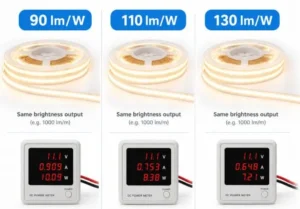
COB strips deliver more lumens per watt 5 than most T5 tubes because the LED dies convert electricity to light with less waste heat. Over 5,110 hours per year across 500 meters, even a modest 2 W/m saving adds up to 5,110 kWh per year. At an average commercial electricity rate, that is a meaningful reduction in reduced operational costs — money that goes straight back to the retailer's bottom line.
Thermal Management Matters
Inside enclosed shelf channels, heat is the enemy of lifespan. Fluorescent tubes generate significant infrared heat. SMD strips concentrate heat at each chip location. COB strips spread heat evenly across the entire board surface, and when paired with a slim aluminum extrusion, they dissipate thermal energy efficiently. This thermal management 6 advantage is why COB strips maintain their rated output far longer than tubes, which lose brightness progressively and often flicker near end of life.
Installation Simplicity at Scale
For a 500-meter supermarket LED retrofit, tubes require an electrician to wire each fixture individually, secure brackets, and test ballast connections. COB strips need a DC power supply (mounted centrally or per aisle), a simple low-voltage bus, and adhesive mounting. One trained installer can cover more linear meters per hour with strips than with tubes. In our experience shipping to Australian contractors, the feedback is consistent: fewer tool changes, fewer trips to the van, and fewer callbacks.
How do I maintain perfect color consistency across all my aisles to ensure my brand's visual identity stays uniform?
A buyer interaction that stuck with me: a procurement manager for a German retail chain rejected an entire batch of LED strips from another supplier because the warm white in aisle 3 looked noticeably yellow compared to aisle 7. His customers noticed. His store manager noticed. And now he was stuck with product he could not use.
To maintain perfect color consistency, specify COB LED strips from a supplier that bins LEDs within a tight color tolerance (≤ 3 MacAdam steps), tests every production reel for color rendering index and correlated color temperature, and guarantees batch-to-batch uniformity across your entire order.

Why Color Drift Happens
Color inconsistency in LED lighting comes from two main sources. First, LED phosphor variation during chip manufacturing means two chips from different wafers may emit slightly different shades of "warm white." Second, different production batches of finished strips may use chips from different wafer lots, compounding the variation. In a small installation — say, a single display case — this is invisible. Across an entire supermarket floor with hundreds of meters of strip, even a subtle shift becomes obvious to the human eye.
Traditional fluorescent tubes also suffer from color drift, but in a different way: their phosphor coating degrades unevenly over time, so a new tube next to a six-month-old tube will look different in color temperature, creating a patchwork effect down the aisle.
How We Control Consistency
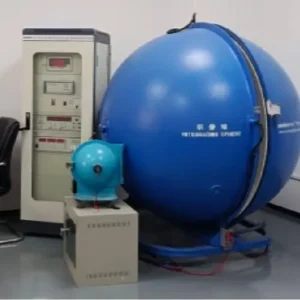
On every order we fulfill, our team requests LED chips from the same bin code and the same wafer lot whenever the quantity allows. We measure correlated color temperature (CCT) and color rendering index 8 (CRI) at multiple points on every reel using an integrating sphere and a spectrometer. The goal is to keep all reels within a 3-step MacAdam ellipse — which is the threshold below which the human eye cannot detect a color difference. MacAdam steps 9
For large supermarket rollouts, we hold back a reference reel sample so that any future reorders — even a year later — can be matched against the original. This is especially important for retailers whose brand guidelines specify a particular light color for their store environment.
Color Consistency Checklist
- Specify CCT tolerance: Ask for ± 50 K or tighter (e.g., 3000 K ± 50 K).
- Specify CRI: CRI 90+ is ideal for food retail; CRI 80+ is the minimum for general merchandise.
- Request same-bin chips: Ensure all reels in a single project come from the same LED bin.
- Check for UV and IR emissions: COB strips with minimal UV and IR output help preserve perishable goods and prevent packaging discoloration.
- Test on-site: Always power up a sample length under actual shelf conditions before approving the full order.
What High CRI Means for Product Display
A high color rendering index means the light source reproduces the natural colors of objects faithfully. Under low-CRI lighting, red meat looks grayish, green vegetables look washed out, and branded packaging loses its punch. Under CRI 90+ COB strips, colors pop the way the product designer intended. This directly influences customer engagement and purchasing decisions — shoppers trust food that looks fresh, and they gravitate toward packaging that looks vibrant.
Smart Integration for Future-Proofing
Many modern supermarkets are beginning to integrate smart lighting controls — dimmable drivers, daylight sensors, and zone scheduling. COB strips work seamlessly with PWM and 0–10 V dimmers, allowing store managers to adjust intensity by aisle or by time of day. During early morning restocking, lights can run at 50 %. During peak hours, they ramp to full. This extends the already long lifespan of the strips and further improves energy efficiency without any hardware change.
Conclusion
COB LED strip lights solve the four biggest pain points in supermarket shelf lighting: they eliminate dots, fit any shelf size, slash maintenance costs, and keep color uniform across every aisle. For contractors and wholesalers planning a retail LED retrofit, COB strips are the smarter long-term investment.
Footnotes
- Found a comprehensive and authoritative article explaining COB LED technology from ViewSonic Library. ↩︎
- Describes how COB technology achieves a smooth, continuous, and dot-free light output. ↩︎
- Provides a clear definition and explanation of Chip on Board technology. ↩︎
- Explains what a flexible circuit board is and its construction. ↩︎
- Explains luminous efficacy, measured in lumens per watt, as a measure of light source efficiency. ↩︎
- Replaced with a general, authoritative definition of Thermal Management from Wikipedia. ↩︎
- Defines Total Cost of Ownership and its importance in business decisions. ↩︎
- Defines Color Rendering Index (CRI) and its significance in accurately revealing colors. ↩︎
- Explains MacAdam ellipses and their role in ensuring LED color consistency. ↩︎


 English
 Spanish
 German
 Russian
 Arabic
 French
 Portuguese