

Too many jewelry retailers install LED strips that wash out the brilliance of their most expensive pieces — and they never realize the lighting is the problem.
COB LED strip lights are an excellent choice for jewelry counter lighting because they deliver seamless light output, high Color Rendering Index (CRI) scores of 90+, and dot-free illumination that accurately reveals gemstone colors and diamond sparkle — but only when you select high-CRI versions specifically engineered for showcase lighting.
This article breaks down every factor you need to consider — from color accuracy and custom sizing to long-term consistency — so you can make a confident decision for your next retail lighting design project.
How can I achieve a seamless, dot-free glow in my jewelry display cases using COB LED strips?
A client in Melbourne once sent us photos of his newly installed display cases. The SMD strips he sourced locally created visible dot patterns on every glass shelf, and his customers noticed.
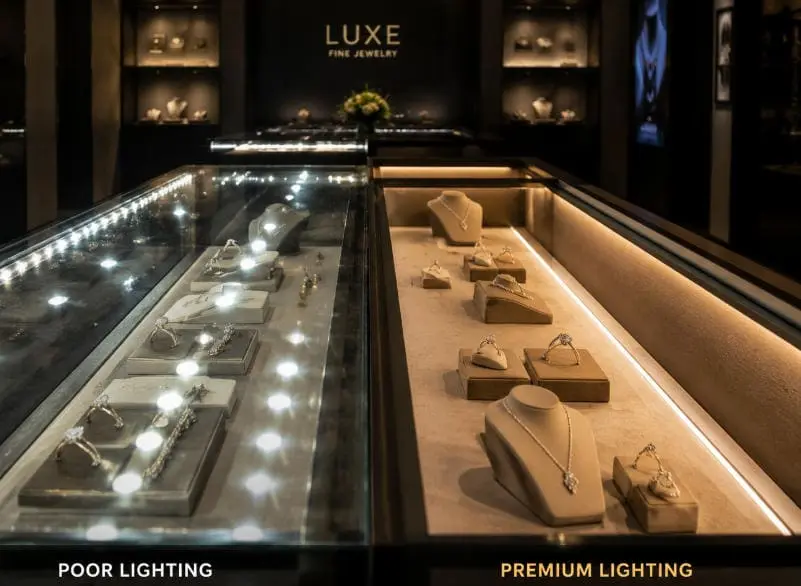
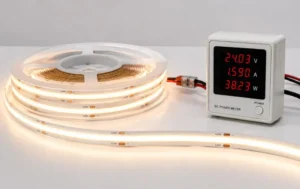
To achieve a seamless, dot-free glow in jewelry display cases, use COB LED strips with densely packed chips embedded directly into the substrate. This Chip-on-Board design eliminates individual LED hotspots and produces a continuous, uniform line of light ideal for glass-enclosed showcases.
Why Dots Matter More Than You Think
Jewelry is almost always viewed through glass. Any inconsistency in the light source — hotspots, shadows, micro-dots — reflects off polished metal and faceted gemstones. The result is visual noise that distracts the customer's eye from the product. In visual merchandising, your lighting should be invisible. The jewelry should do the talking.
Traditional SMD LED strips 1 place individual diodes on a flexible circuit board at fixed intervals. Even high-density versions with 120 or 160 LEDs per meter still show faint dot patterns when viewed at close range or through reflective glass. COB strips solve this by embedding hundreds of tiny chips under a single phosphor layer. The light blends before it leaves the strip surface. Understanding how LED chip density impacts COB LED strip light specifications helps explain why this technology produces such superior uniformity.
COB vs. SMD: A Side-by-Side Look
| Feature | COB LED Strip | High-Density SMD Strip |
|---|---|---|
| Light uniformity | Continuous, dot-free line | Visible micro-dots at close range |
| Typical LED density | 320–528 chips/m | 120–160 LEDs/m |
| Profile thickness | Sub-12 mm | 10–14 mm |
| Hotspot visibility | None | Low to moderate |
| Best use case | Premium showcase lighting | General accent lighting |
Practical Installation Tips for Glass Cases
When we ship COB strips to contractors working on jewelry counters, we always recommend pairing them with slim aluminum extrusion channels. Here is why:
- Heat dissipation. Even though COB LEDs are low heat LED sources compared to halogen, dense chip packing still generates warmth in enclosed cases. Aluminum channels act as passive heatsinks.
- Optical diffusion. A frosted cover on the channel further smooths the light, making the seamless light output even more uniform.
- Mounting precision. Adhesive-backed strips can peel in warm cases. Channels with mechanical clips keep everything locked in place for years.
I always tell our partners: measure your case interior twice, order 5–10% extra length, and use connectors rated for your voltage. This saves headaches on install day.
Will switching to COB lighting improve the color accuracy and sparkle of my high-end jewelry collections?
One lesson our team learned early on is that brightness alone does not sell jewelry. We once supplied a batch of standard COB strips to a wholesaler in Germany. The lumens were high. The color rendering was average. His jeweler client complained that the gold pieces looked flat and lifeless.
Yes, switching to high-CRI COB lighting significantly improves color accuracy and sparkle. COB strips rated CRI 95+ with a strong R9 value render reds, golds, and diamond fire faithfully, making gemstone illumination richer and more lifelike compared to standard LED sources.
Understanding CRI and R9
The Color Rendering Index 2 (CRI) measures how accurately a light source reveals the true colors of objects compared to natural sunlight. A CRI of 80 is acceptable for general use. Jewelry display cases demand CRI 90+ at minimum. For high-end collections — think ruby necklaces, rose gold rings, fancy colored diamonds — CRI 95+ is the target. To understand the practical differences between these ratings, explore how color rendering differs between CRI 90 and CRI 95 COB LED strip lights.
But CRI alone is not the full picture. The R9 value 3 specifically measures red-color rendering. Rubies, garnets, and warm-toned gold all depend on strong R9 performance. Many LED strips advertise CRI 90 but have a weak R9 below 50. That is a problem. In our product development, we specifically test and bin LEDs for R9 values above 70, and our premium line targets R9 above 80.
Color Temperature Selection for Jewelry
Color temperature 4, measured in Kelvin, determines the warmth or coolness of the light. Different jewelry types look best under different temperatures.
| Jewelry Type | Recommended Color Temperature | Why |
|---|---|---|
| Diamonds / Platinum | 5000K–5500K (neutral to cool white) | Enhances brilliance and fire |
| Yellow gold / Rose gold | 2700K–3000K (warm white) | Brings out warmth and richness |
| Mixed collections | 4000K (neutral white) or tunable | Balanced compromise |
| Colored gemstones | 4000K–5000K | Reveals true hues without distortion |
Dual-color COB strips are now available in 2700K and 5600K combinations. These let jewelers adjust the ambiance in real time — cooler for diamond sparkle, warmer for gold — without changing the physical strip. This flexibility is a growing trend in retail lighting design.
The R9 Factor: Why It Cannot Be Ignored
I have seen too many projects where the specifier focused only on CRI and lumens but overlooked R9. The result: a display that looks technically bright and "correct" but feels sterile. Red gemstones appear brownish. Gold looks washed out. The emotional connection between customer and product breaks down.
My advice has always been consistent: jewelry counters can absolutely use COB strips, but you must select high-CRI, high-R9 versions. If the supplier cannot provide R9 test data, walk away. A beautiful seamless glow means nothing if the colors are wrong.
COB strips also emit virtually no UV or IR radiation 5. This matters for antique jewelry and delicate stones like opals or pearls. Long UV exposure can cause discoloration over years. Low heat LED technology combined with zero UV output protects inventory while keeping it beautifully lit.
Can I source custom-length COB strips that fit my specific counter dimensions without sacrificing brightness?
A buyer we work with in Australia designs bespoke jewelry counters. No two are the same length. He used to order standard 5-meter rolls and cut them on site, but he lost usable material at every cut point and wasted hours soldering connections.
Yes, you can source custom-length COB strips cut and terminated to your exact counter dimensions. Reputable suppliers offer OEM cutting services with factory-soldered connectors, maintaining consistent brightness and avoiding the lumen drop or reliability issues caused by field splicing.
Why Standard Rolls Create Problems
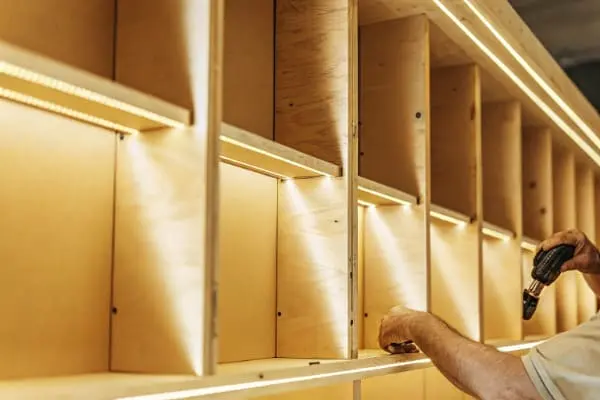
Most COB strips come in 5-meter reels. Jewelry counters vary wildly — 600 mm display trays, 1200 mm showcases, 2400 mm island counters, curved cabinets. Cutting in the field is possible at marked intervals (usually every 50 mm or 100 mm for COB), but it introduces issues:
- Exposed cut points that need soldering or clip connectors, creating potential failure points.
- Wasted material from leftover segments too short to use.
- Inconsistent connections if the installer's soldering quality varies.
When we prepare orders for project-based clients, we cut and terminate strips to the exact millimeter lengths specified on their shop drawings. Each piece ships with pre-soldered leads or plug-and-play connectors. This eliminates field errors and speeds up installation.
What to Specify When Ordering Custom Lengths
Here is a checklist we share with our distribution partners:
- Exact length in millimeters, per piece.
- Quantity per length (e.g., 24 pieces at 580 mm, 12 pieces at 1180 mm).
- Connector type — bare wire, DC barrel plug, or proprietary clip.
- Wire lead length — typically 150–300 mm from the strip end to the power source.
- Color temperature and CRI — locked per order to ensure matching.
Does Cutting Affect Brightness?
This is a common concern. The short answer is no — as long as the cut is made at a designated cut point and the power supply is correctly matched. Each cut segment of a COB strip is an independent circuit. Brightness per meter stays constant regardless of the total strip length.
However, voltage drop 6 becomes a real factor on longer runs. For strips over 3 meters fed from one end, the far end may dim slightly. The solution is either dual-end power injection or selecting a 24V strip instead of 12V for longer runs.
| Scenario | Recommended Voltage | Power Feed Method |
|---|---|---|
| Under 2 m per run | 12V DC | Single-end feed |
| 2–5 m per run | 24V DC | Single-end or dual-end feed |
| Over 5 m per run | 24V DC | Dual-end feed or mid-point injection |
| Multiple short runs | 12V DC | Parallel wiring from one driver |
Our team provides wiring diagrams for every custom order. This is part of the end-to-end technical support we build into every project. The goal is simple: the installer opens the box, follows the diagram, and the counter lights up perfectly on the first try.
Low MOQ and Rapid Prototyping
For design firms and smaller retailers, minimum order quantities can be a barrier. We keep our MOQ low for custom-length COB strips — sometimes as few as 50 meters total across mixed lengths. Rapid prototyping means a sample set can ship within days, not weeks. This lets specifiers verify the color temperature, CRI, and brightness in the actual display case before committing to a full production run.
How do I ensure long-term color consistency across all my retail project installations with COB technology?
Batch-to-batch color variance is the silent killer of multi-location retail projects. I learned this the hard way when a distributor in Germany installed COB strips from two different production batches in adjacent counters. Under daylight, the difference in color temperature was barely visible. Under showroom conditions at night, one counter looked noticeably warmer than the other.
To ensure long-term color consistency, specify COB strips with tight LED binning tolerances (2-step or 3-step MacAdam ellipse), request same-batch supply for each project phase, and partner with a supplier who conducts spectral testing and provides batch-matched documentation for every shipment.
What Is LED Binning and Why Does It Matter?
LED chips are manufactured in large quantities, and no two chips are perfectly identical. After production, chips are sorted — or "binned" — by color temperature, brightness, and forward voltage. LED binning 7 The tighter the bin, the more consistent the final product.
For jewelry showcase lighting, a 3-step MacAdam ellipse 8 is the standard. This means the human eye cannot detect color differences between any two strips from the same bin. A 5-step ellipse — common in budget strips — allows visible variation that becomes obvious when two strips are side by side in a glass case.
A Practical Process for Multi-Store Rollouts
When we supply COB strips for chain retail projects — say, 15 stores opening over six months — we follow a specific protocol:
- Lock the LED reel lot. We reserve enough raw LED material from a single production lot to cover the entire project.
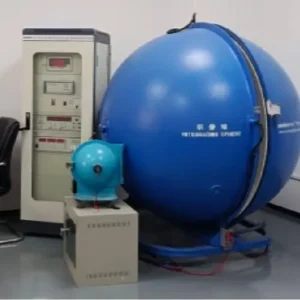
- Spectral test every reel. Each finished reel is tested on an integrating sphere. We record CRI, CCT (correlated color temperature), R9, and luminous flux.
- Provide batch reports. Every shipment includes a test report so the client can verify consistency before installation.
- Store backup inventory. We hold 10–15% extra stock from the same lot for warranty replacements or future store additions.
This process costs a bit more upfront in planning and inventory. But it prevents the nightmare scenario of mismatched counters across locations.
Common Causes of Color Inconsistency
| Cause | Impact | Prevention |
|---|---|---|
| Different LED bins across batches | Visible CCT shift between strips | Request same-bin, same-lot supply |
| Inconsistent phosphor thickness | CRI variation, especially in R9 | Choose suppliers with in-line phosphor QC |
| Voltage drop on long runs | Warmer tint at far end of strip | Use proper voltage and power injection |
| Aging at different rates | Gradual color shift over years | Specify strips with matched driver current |
| Mixing suppliers mid-project | Obvious mismatch on adjacent counters | Single-source the entire project |
The Role of the Supplier Relationship
Color consistency is not just a product specification. It is a supply chain commitment. A supplier who ships whatever is in stock that week cannot guarantee batch matching. Our approach is to assign a dedicated project coordinator who tracks bin codes, production dates, and test data across every shipment. This level of attention to detail is what separates a transactional purchase from a true project-based partnership.
For accent lighting in a living room, small color variations are forgivable. In a jewelry counter where a customer is comparing a $10,000 ring under one light to a $15,000 ring under another, even a 100K shift in color temperature can influence the purchase decision. Consistency is not optional. It is the foundation of credible retail lighting design.
Conclusion
COB LED strip lights 9 are the superior choice for jewelry counter lighting — but only when you select high-CRI, high-R9, tightly binned versions and partner with a supplier committed to consistency, custom sizing, and technical support.
Footnotes
- Explains Surface Mounted Device (SMD) LED technology. ↩︎
- Wikipedia provides a comprehensive and authoritative explanation of Color Rendering Index. ↩︎
- Defines the R9 value and its critical role for red color accuracy. ↩︎
- Defines color temperature and its measurement in Kelvin. ↩︎
- Authoritative source explaining LED emission across UV, visible, and IR spectrums and associated health effects. ↩︎
- Explains voltage drop in LED strips and its implications. ↩︎
- Describes the LED binning process for consistent LED characteristics. ↩︎
- Explains MacAdam ellipse and its importance for LED color consistency. ↩︎
- Provides a technical overview of Chip-on-Board (COB) LED technology. ↩︎

 English
 Spanish
 German
 Russian
 Arabic
 French
 Portuguese