
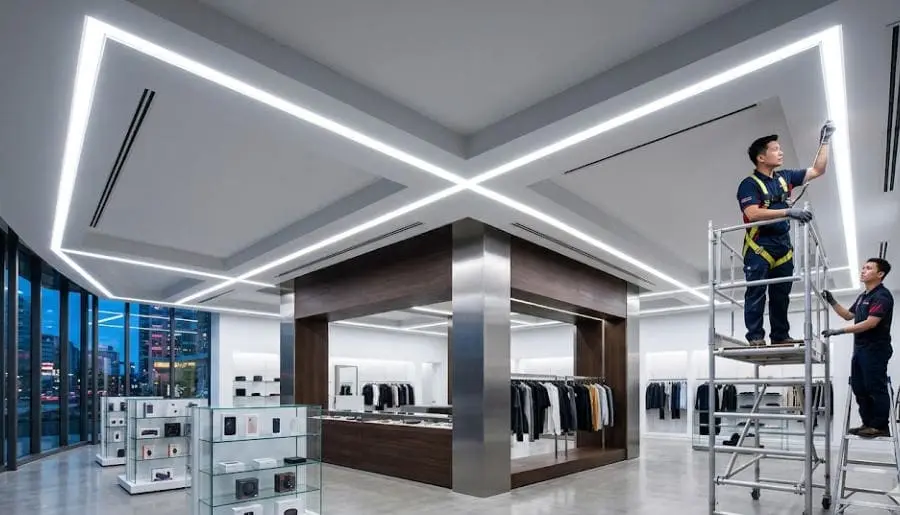
I've seen fitting rooms ruin perfectly good clothing sales — harsh overhead light, yellow skin tones, and colors that look nothing like they do on the shop floor.
COB LED strip lights are highly effective for clothing store fitting room lighting because they deliver dot-free, uniform illumination with CRI 95+ accuracy and warm-neutral color temperature, flattering skin tones while rendering garment colors true to life, directly boosting customer confidence and purchase rates.
The fitting room is where a customer decides to buy or walk away. In this guide, I'll break down exactly why COB technology outperforms standard LED strips in this critical retail space, and how to specify, install, and source them correctly.
How can I achieve dot-free lighting in my fitting rooms using COB LED strips?
One lesson we learned early on our production line is that even a high-lumen LED strip can fail in a fitting room if you can see individual diode dots 1 reflecting in the mirror — it cheapens the entire space instantly.
To achieve dot-free lighting, use COB LED strips that pack thousands of micro-emitters under a continuous phosphor layer, producing a seamless, uniform line of light even in shallow aluminum channels without heavy diffusers, eliminating the hotspot "dotting" effect common with traditional SMD strips.
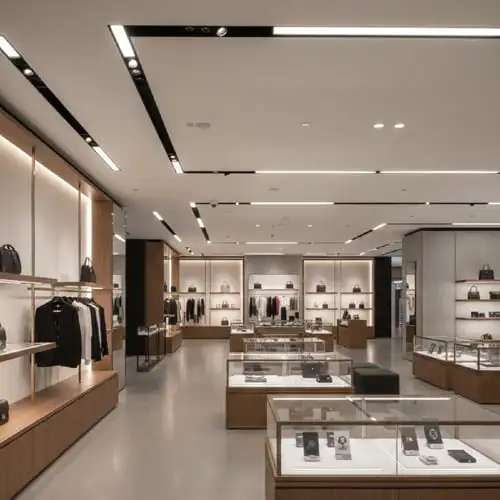
Why Dots Are a Problem in Fitting Rooms
Standard SMD LED strips space individual diodes every 5–10 mm apart. Each diode creates a visible bright spot. In a fitting room, the mirror amplifies these spots. Customers see a striped pattern on their skin and clothing. This is distracting. It also creates uneven illumination across the garment surface.
COB (Chip-on-Board) technology solves this. Instead of discrete diodes, COB strips embed hundreds of tiny chips per meter under a single phosphor coating. The result is a continuous blade of light. No dots. No hotspots. Just smooth, even illumination.
COB vs. SMD: A Direct Comparison
| Feature | SMD 2835 Strip | SMD 5050 Strip | COB LED Strip |
|---|---|---|---|
| LED Density (per meter) | 60–120 | 30–60 | 320–528 |
| Dot Visibility | Clearly visible | Very visible | Invisible (dotless) |
| Diffuser Required | Yes (heavy opal) | Yes (heavy opal) | Optional (light frosted) |
| Minimum Channel Depth | 15–20 mm | 15–20 mm | 7–10 mm |
| Light Uniformity | Moderate | Low–moderate | Excellent |
| Typical CRI Available | 80–90 | 80–85 | 90–97 |
Choosing the Right Channel and Diffuser
Even though COB strips are inherently dotless, I still recommend pairing them with a shallow aluminum profile and a light frosted diffuser. This softens the light further and protects the strip from dust and accidental contact. In fitting rooms, space is tight. Customers brush against walls. A profile adds durability.
Deep channels (20 mm+) are unnecessary with COB. That's an advantage when you're retrofitting existing fitting rooms where wall depth is limited. We regularly cut and ship custom profile lengths for contractors who need exact dimensions — no waste, no awkward joints.
Placement for Maximum Dot-Free Effect
Mount COB strips vertically on both sides of the mirror. This creates even, frontal illumination. The light wraps around the customer's face and body. Shadows disappear. The dotless output means the mirror reflects a clean wash of light, not a row of bright points.
For overhead accents, a single horizontal COB strip recessed into the ceiling edge can add fill light. But the primary illumination should always come from the sides. This is the foundation of flattering lighting in any retail fitting room.
Will the CRI of these COB strips be high enough to showcase my clothing colors accurately to customers?
A buyer in Australia once told me his client returned an entire batch of blouses because "the red looked completely different at home." The problem wasn't the fabric. It was fitting room lights with a Color Rendering Index 2 of 78.
Yes — high-quality COB LED strips routinely achieve CRI 90 to 97, which is more than sufficient to showcase clothing colors accurately. For fashion retail, specifying CRI 95+ ensures garment hues, skin tones, and fabric textures appear natural and true to daylight conditions.
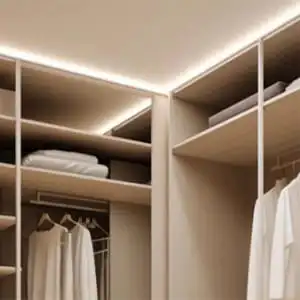
What CRI Actually Means for Clothing Retail
The Color Rendering Index measures how accurately a light source reveals the true colors of objects compared to natural sunlight 3 (CRI 100). A CRI below 80 noticeably distorts reds, greens, and skin tones. A CRI of 90+ reproduces colors faithfully. At 95+, the difference between artificial light and daylight becomes almost imperceptible.
In a fitting room, this matters enormously. Customers judge garments by what they see in the mirror. If the light shifts a navy blazer toward gray, or makes a coral dress look salmon, the customer either doesn't buy — or buys and returns it later. Both outcomes hurt the retailer.
CRI Tiers and Their Retail Impact
| CRI Range | Color Accuracy | Fitting Room Suitability | Typical Source |
|---|---|---|---|
| 70–79 | Poor — colors look washed out | Not recommended | Budget fluorescent, cheap LED |
| 80–89 | Acceptable — slight distortion | Minimum for general retail | Standard SMD LED strips |
| 90–94 | Good — natural appearance | Recommended for fitting rooms | Mid-range COB LED strips |
| 95–97 | Excellent — near-daylight fidelity | Ideal for fashion retail | High-end COB LED strips |
Pairing CRI with the Right Color Temperature
CRI alone isn't enough. You also need the right color temperature 4. Our experience shipping to German and Australian markets has shown that 3000K–3500K works best for most clothing stores. This warm-neutral range makes skin look healthy and radiant. It also renders fabric colors accurately without the clinical feel of 5000K+ daylight.
For youth-focused or streetwear brands, 4000K can work. It feels more modern and energetic. But going above 4000K risks making skin look pale and unflattering. The sweet spot for most retail fitting rooms sits firmly between 3500K and 4000K.
Tunable white LEDs offer flexibility here. A single COB strip with adjustable color temperature lets the retailer dial in the perfect look — or even let customers switch between "daylight preview" and "evening preview" modes. We've seen growing demand for this feature from design firms specifying lighting for premium retail chains.
The Business Case: Fewer Returns, More Sales
Poor fitting room lighting causes a measurable increase in product returns. When a customer sees accurate colors in the fitting room, the garment looks the same at home, at the office, and outdoors. Returns drop. Customer satisfaction rises. The cost difference between a CRI 80 strip and a CRI 95+ strip is minimal — but the impact on the retailer's bottom line is significant.
How do I ensure color consistency across all my store locations when sourcing COB LED strips?
When we calibrate production runs on our line, one of the tightest tolerances we hold is color consistency — because a 3-step MacAdam ellipse deviation 5 is invisible to the eye, but a 7-step shift between two fitting rooms in the same chain is a branding disaster.
To ensure color consistency across locations, specify COB LED strips within a 3-step MacAdam ellipse (SDCM ≤ 3), require bin-matched reels from a single production batch, and work with a supplier who provides spectral test reports for every shipment, guaranteeing uniform color temperature and CRI across all deliveries.
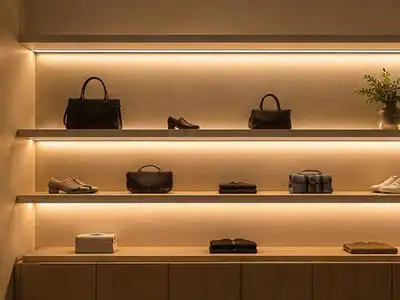
Why Color Consistency Breaks Down
Color inconsistency between store locations typically comes from three sources:
- Phosphor variation — Different LED chips or phosphor batches produce slightly different white tones, even at the same rated CCT.
- Bin mixing — Suppliers combine LEDs from different production bins to fill orders, resulting in visible color shifts within a single reel or between reels.
- Driver and voltage differences — Inconsistent power supply output can shift the apparent color temperature of the same LED strip.
For a clothing chain with 10 or 50 locations, these differences accumulate. A customer who visits two stores should see the same light. If one fitting room looks warm gold and another looks cool blue-white, the brand experience suffers.
What to Specify in Your Purchase Order
| Specification | Recommended Value | Why It Matters |
|---|---|---|
| MacAdam Ellipse (SDCM) | ≤ 3 steps | Ensures color variation is invisible to the human eye |
| CCT Tolerance | ± 100K | Keeps all reels within a tight color temperature band |
| CRI Consistency | ± 1 Ra across reels | Prevents noticeable rendering differences |
| Voltage | 24V DC | More stable output over long runs, reducing color shift |
| Binning | Single-bin per order | All LEDs from the same production bin |
How We Handle This in Practice
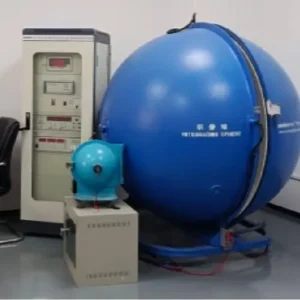
On our end, every reel is tested with an integrating sphere 6 before shipping. We record the exact CCT, CRI, and luminous flux. For project-based orders — like a retail chain rollout — we reserve matched bins from the same production run. If the project spans multiple shipments, we hold inventory from that bin to ensure the second and third deliveries match the first.
This is not standard practice across the industry. Many suppliers ship whatever bins are available. If you're a contractor or distributor sourcing for multi-location rollouts, ask for spectral test reports. Ask whether your supplier can guarantee single-bin matching. If they can't answer that question clearly, the risk of inconsistency is real.
Long-Term Reorder Strategy
LED phosphors age. Over years, the color temperature of installed strips may drift slightly. When you reorder replacement strips two years later, the new production batch may not match the originals exactly. The solution is to establish a baseline specification document with your supplier at the start. Record the original bin codes, CCT, and CRI values. When reordering, the supplier references that baseline and matches as closely as possible. We keep these records for our long-term partners specifically for this reason.
Can I customize the length and brightness of COB LED strips to fit my unique fitting room dimensions?
A lighting designer in Germany once sent us a fitting room sketch with an oddly shaped mirror alcove — 1,137 mm on the left side, 1,042 mm on the right, and a curved overhead segment. Standard off-the-shelf strips would have meant ugly joints and wasted material.
Yes — COB LED strips can be cut at frequent intervals (typically every 25–50 mm), and reputable suppliers offer custom-length reels, tailored brightness levels, and specific wattage-per-meter configurations to match any fitting room dimension, eliminating waste, visible joints, and the need for on-site modification.

How Cutting and Customization Works
COB LED strips feature cut points at regular intervals — usually every 25 mm or 50 mm depending on the model. This means you can trim a strip to almost any length on site with simple scissors or a blade. For project orders, we pre-cut strips to exact specified lengths, solder connectors, and ship ready-to-install pieces.
This eliminates three common pain points for contractors:
- No wasted strip material
- No visible solder joints in the finished installation
- No need to source connectors separately
Brightness Customization Options
Brightness is controlled by two factors: LED density (chips per meter) and drive current (wattage per meter). Different fitting rooms need different light levels. A compact 1.2 m × 1.2 m room needs less total output than a spacious 2 m × 2 m VIP fitting suite.
Here's a practical guide:
| Fitting Room Size | Recommended Brightness | Suggested COB Strip Spec | Strips Needed (Both Mirror Sides) |
|---|---|---|---|
| Small (1.0–1.3 m wide) | 400–500 lm/m | 10W/m, 320 LEDs/m | 2 strips × 1.8 m |
| Standard (1.3–1.6 m wide) | 500–700 lm/m | 14W/m, 480 LEDs/m | 2 strips × 2.0 m |
| Large / VIP (1.6–2.2 m wide) | 700–1000 lm/m | 18–20W/m, 528 LEDs/m | 2 strips × 2.2 m + 1 overhead |
These are starting points. The actual brightness depends on wall color (dark walls absorb more light), mirror size, and whether there's supplemental overhead lighting.
Dimming for Flexibility
I always recommend specifying dimmable COB strips for fitting rooms. Brightness needs change throughout the day. Morning light flooding through a storefront is different from evening conditions. A simple PWM dimmer 7 or DALI-compatible driver lets staff adjust the fitting room brightness to maintain a consistent customer experience.
Dimming also extends the lifespan of the strips. Running COB LEDs at 70–80% of maximum output reduces thermal stress and can push the operating life well beyond 50,000 hours.
Addressing Energy Efficiency
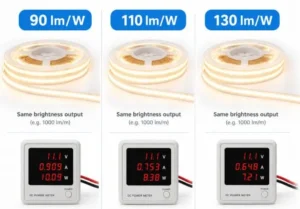
COB LED strips with efficacy around 115 lumens per watt 8 deliver substantial output with minimal power consumption. For a fitting room running two 2-meter strips at 14W/m, total power draw is only 56 watts — less than a single traditional incandescent spotlight. Over a full retail operating schedule, this translates to meaningful energy savings, especially across multiple locations.
One-Stop Sourcing Simplifies Installation
For contractors, sourcing strips, profiles, diffusers, drivers, and connectors from separate vendors creates coordination headaches. We supply complete kits — strip, channel, diffuser, end caps, driver, and wiring — tested together before shipping. This eliminates multi-party coordination and ensures every component is compatible. The contractor receives a box, mounts it, and connects power. The fitting room lights up perfectly the first time.
Conclusion
COB LED strip lights 9 solve the most common fitting room lighting failures — dotting, color distortion, harsh shadows, and inconsistency. Specify CRI 95+, 3000–4000K color temperature, and uniform COB technology to create fitting rooms that sell.
Footnotes
- Describes the visual characteristic of traditional LED illumination. ↩︎
- Replaced with a Wikipedia article providing an authoritative and comprehensive explanation of the Color Rendering Index. ↩︎
- Replaced with an authoritative .gov source from the Department of Energy explaining the basics of solar radiation, also known as sunlight. ↩︎
- Defines color temperature as a key lighting characteristic. ↩︎
- Replaced with a Wikipedia article offering an authoritative explanation of MacAdam ellipses and their relevance to color consistency. ↩︎
- Describes a common instrument for measuring light properties. ↩︎
- Explains a common method for dimming LED lights. ↩︎
- Replaced with a Wikipedia article providing an authoritative definition and explanation of luminous efficacy, commonly known as lumens per watt. ↩︎
- Explains the fundamental technology of COB LEDs. ↩︎

 English
 Spanish
 German
 Russian
 Arabic
 French
 Portuguese