
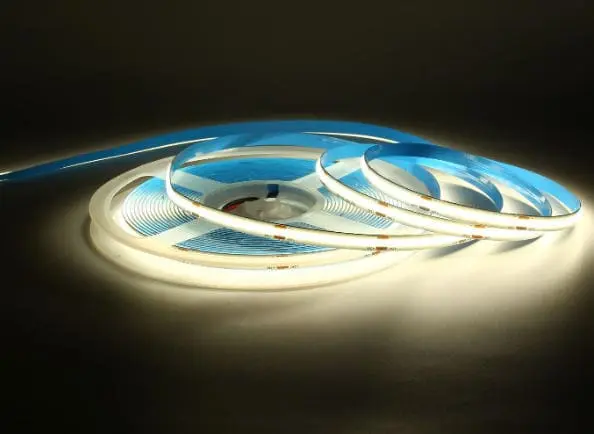
Choosing between single-color and tunable white COB LED strip lights 1 trips up even experienced buyers — I see it weekly in project quotes we prepare.
Single-color COB LED strip lights emit one fixed color temperature CCT, while tunable white COB LED strip lights blend two white LED channels — warm white and cool white — so you can adjust the CCT across a range like 2700K to 6500K using a compatible LED controller.
That one-line answer sounds simple. But the real-world differences in cost, wiring, visual quality, and long-term reliability go much deeper circadian rhythm support 2. Below, I break down every practical detail so you can spec the right strip for your next project.
How do I decide which COB LED strip is best for my specific project application?
A contractor once asked me to quote both single-color and tunable white COB strips for the same hospitality fit-out — then struggled to justify the tunable option to his client's budget. That conversation taught me a lot about how the decision really gets made.
Choose single-color COB LED strips when your project needs stable, consistent white light with minimal complexity; choose tunable white COB strips when the space requires adjustable ambiance, human centric lighting, or circadian rhythm support throughout the day.
Start With the Lighting Goal, Not the Product
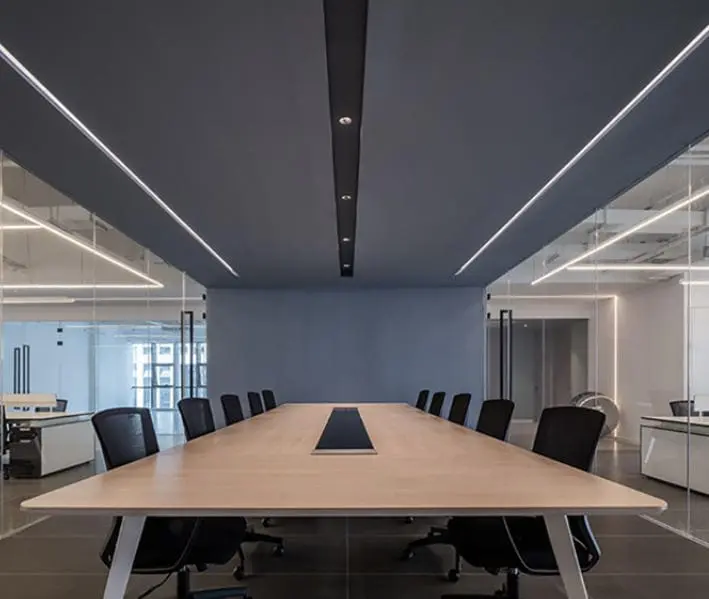
The first question is never "which strip is better?" It is "what does the light need to do in this space?" If the answer is "illuminate evenly and reliably," a single-color COB strip at a fixed CCT 3 — say 3000K warm white for a restaurant, or 4000K neutral white for an office corridor — will do the job well. The system is simple: one LED driver, one dimmer, done.
But if the answer involves phrases like "morning energy," "evening relaxation," or "showcase flexibility," you are looking at tunable white territory. Tunable white COB strips let you shift from a cool white task light during the day to a warm white ambient glow at night. This is what drives the growing interest in human centric lighting 4 for offices, aged-care facilities, and high-end residential projects.
Match the Strip Type to the Room
Here is a practical breakdown we share with our wholesale partners when they are building project quotes:
| Application | Recommended Type | Typical CCT | Why |
|---|---|---|---|
| Under cabinet lighting (residential kitchen) | Single-color | 2700K–3000K | Consistent task light; no need to change tone |
| Open-plan office | Tunable white | 3000K–6500K | Supports circadian rhythm and productivity shifts |
| Hotel room cove lighting | Tunable white | 2700K–5000K | Guests expect adjustable mood lighting |
| Retail shelf accent | Single-color | 4000K | Product colors stay consistent under fixed light |
| Corridor / stairwell | Single-color | 4000K | Simple, reliable, low-maintenance |
| High-end residential living area | Tunable white | 2700K–6500K | Homeowner wants scene control |
The COB Advantage Applies to Both
One thing worth clarifying: COB (Chip-on-Board) technology 5 gives both options a smooth, dotless illumination line. Unlike older SMD LED strip designs where you can see individual diode dots, COB strips pack LEDs so densely — often 480 to 608 LEDs per meter — that the light output looks continuous. This matters a lot in cove lighting, floating shelves, and any application where the strip is partially visible. You get that clean line of light regardless of whether you pick single-color or tunable white.
What About RGB CCT LED Strip Options?
Some buyers confuse tunable white with RGB color-changing. They are not the same. Tunable white only shifts between white tones — warm white to cool white. An RGB CCT LED strip 6 adds red, green, and blue channels on top of the white channels, so you get millions of color options. If you just need white flexibility, tunable white is the right call. RGB CCT adds cost and complexity that most commercial lighting projects do not need.
A Note on Dim-to-Warm
There is also a middle ground called dim-to-warm 7. These strips mimic incandescent behavior: as you dim them, the color temperature drops to a warmer tone automatically. They do not need a separate LED controller for CCT adjustment. If your project wants that candlelight feel at low brightness without the full tunable white system, dim-to-warm is worth considering.
Will choosing tunable white over single-color significantly increase my installation and control costs?
When we quoted a 200-meter tunable white COB run for a German distributor last year, the price gap between single-color and tunable white surprised even their experienced estimator. The strip itself was only part of the story.
Yes, tunable white COB LED strips typically cost 30–60 percent more than single-color strips at the system level, because you need dual-channel wiring, a dedicated CCT controller, and often a higher-wattage power supply to drive both LED channels simultaneously.

Where the Extra Cost Comes From
The strip price difference alone is moderate. Tunable white COB strips contain two sets of LED chips — one warm white, one cool white — on the same flexible board. That means more chip placement, more solder joints, and tighter quality control during production. On our line, the tunable white strips run through an extra color-binning check that single-color strips skip entirely.
But the real cost jump is in the supporting hardware:
| Cost Component | Single-Color COB | Tunable White COB | Notes |
|---|---|---|---|
| LED strip (per meter) | Base price | +20–40% | Dual-chip architecture costs more |
| Power supply | Standard constant-voltage | Same type, but often higher wattage | Both channels may run simultaneously |
| Controller | Basic dimmer or none | Dedicated CCT / tunable white controller | Required for color temperature adjustment |
| Wiring | 2-wire (+ and −) | 3-wire or 4-wire (warm+, cool+, common−) | More cable, more labor |
| Programming / commissioning | Minimal | Moderate | Scene setup, app pairing, zone grouping |
| Total system premium | — | +30–60% over single-color | Varies by project scale and controller choice |
Control Hardware Matters
A dimmable LED single-color strip works with a simple PWM dimmer. Many electricians already have these on hand. Tunable white strips need a controller that can independently adjust the warm and cool channels. This can be a wall-mounted CCT knob, a wireless remote, or a smart-home integration via DMX, DALI, or Zigbee. Each option has a different price point and commissioning complexity.
Labor and Time
Do not underestimate the labor side. Running three or four wires instead of two through tight cove channels or aluminum profiles takes more time. Terminating and testing dual-channel connections adds steps. For a 50-meter residential job, the extra wiring labor might add a couple of hours. For a 500-meter commercial fit-out, it can add days.
When the Premium Is Worth It
The premium pays for itself in spaces where lighting flexibility has measurable value — corporate offices pursuing well-being certifications, hospitality venues that change mood by daypart, or aged-care facilities using circadian rhythm lighting schedules. In those cases, the tunable white system is not an upgrade; it is the spec.
How can I ensure color consistency across my long-run installations with these different strip types?
Color consistency is the issue that keeps me up at night. A buyer in Australia once rejected a 300-meter batch because meter 240 looked slightly pinker than meter 10 under the same profile. That shipment taught us to tighten our binning process permanently.
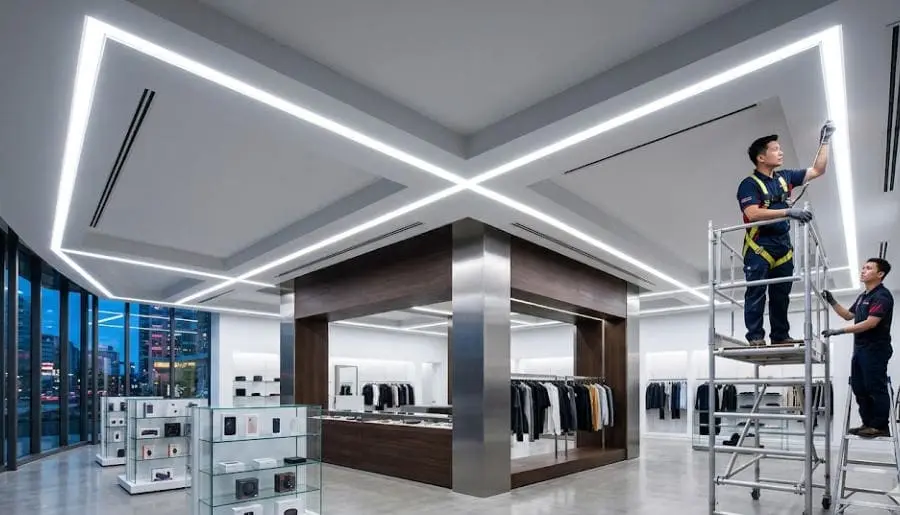
For single-color strips, ensure your supplier uses tight LED binning within a 2-step MacAdam ellipse; for tunable white strips, also verify that both warm and cool channels are independently binned and that the controller blends them smoothly across the entire CCT range.
Why Color Consistency Is Harder Than It Sounds
Every LED chip comes off the production line with slight variations in color temperature, brightness, and forward voltage. Manufacturers sort — or "bin" — chips into groups with matching characteristics. The tighter the bin, the more consistent the light looks when you line up meters of strip side by side.
For single-color COB strips, you are managing one variable: one chip type, one CCT. If the supplier uses a strict 2- or 3-step MacAdam ellipse 8 bin, the human eye will not notice variation across a long run. This is relatively straightforward.
For tunable white COB strips, the challenge doubles. You have two chip populations on the same strip. If the warm white chips are binned tightly but the cool white chips are loose — or vice versa — the blended output at mid-range CCTs (around 3500K–4500K) can look uneven. This is exactly the problem I mentioned at the top: the easiest place for tunable white to "go wrong" is not at the warm or cool extremes, but in the middle of the range, where both channels are partially on and any mismatch becomes visible.
Practical Steps for Consistency
Here is what I recommend to our project partners:
- Request same-batch delivery. For any run over 50 meters, insist that all reels come from the same production batch.
- Ask for binning documentation. A quality supplier will provide bin codes and MacAdam ellipse data for each reel.
- Test mid-range CCTs. For tunable white, do not just check 2700K and 6500K. Check 4000K. That is where blending issues show up.
- Use consistent power supply voltage. Voltage drop 9 over long runs shifts apparent color temperature. Size your wiring and power injection points correctly.
- Install in the same orientation. LED strips can look slightly different if you reverse the direction on alternate runs, because phosphor coating can have directional characteristics.
Single-Color vs. Tunable White Consistency at a Glance
| Consistency Factor | Single-Color COB | Tunable White COB |
|---|---|---|
| Number of chip types to bin | 1 | 2 |
| Risk of mid-range color shift | None (fixed CCT) | Moderate to high if poorly binned |
| Voltage drop impact | Slight brightness change | Brightness and CCT shift possible |
| Same-batch importance | High | Very high |
| Visual inspection difficulty | Lower | Higher (must check multiple CCT points) |
The Role of the Controller
Even if the strip is perfectly binned, a poor-quality LED controller can introduce inconsistency. Cheap controllers sometimes do not ramp the warm and cool channels proportionally, creating a visible "jump" or flicker at certain CCT settings. I always suggest testing the exact controller-and-strip combination together before committing to a large order. We routinely send paired samples — strip plus recommended controller — so our buyers can evaluate real-world blending before final sign-off.
What technical differences in wiring and power supply should I expect for my project?
One lesson I learned early in our export work: an electrician who has wired dozens of single-color LED jobs can still get tripped up the first time they open a tunable white reel and see three solder pads instead of two.
Single-color COB strips use simple 2-wire (positive and negative) connections to one power supply and an optional dimmer, while tunable white COB strips require 3-wire or 4-wire connections — separate positive leads for the warm and cool channels — plus a dedicated dual-channel CCT controller between the power supply and the strip.

The Basic Wiring Difference
A single-color COB strip has two conductors: V+ and V−. You connect them to a constant-voltage LED driver (typically 12V or 24V DC), optionally through a dimmable LED dimmer, and you are done. The circuit is as simple as LED lighting gets.
A tunable white COB strip has at least three conductors. The most common configuration is:
- Common positive (V+): shared power rail
- Warm white negative (WW−): controls the warm channel
- Cool white negative (CW−): controls the cool channel
Some designs use four wires with separate positives. Either way, a CCT controller sits between the power supply and the strip. The controller receives the full DC voltage from the driver and distributes it to each channel based on the user's CCT and brightness settings.
Step-by-Step Wiring Comparison
Here is how the signal chain differs:
Single-color:
AC mains → LED driver (constant voltage) → dimmer (optional) → COB strip (2-wire)
Tunable white:
AC mains → LED driver (constant voltage) → CCT controller (dual channel) → COB strip (3-wire or 4-wire)
Power Supply Sizing
This is where many installers undersize. On a tunable white strip, the maximum power draw happens when both channels run near full brightness — which occurs at certain mid-range CCT blends. If your strip draws 10W per meter on each channel, the combined peak draw could approach 20W per meter. Size your power supply for the worst-case scenario, not just one channel.
For single-color, the math is simpler. One channel, one wattage rating. Add a 20 percent headroom buffer, and you are set.
Voltage Drop and Power Injection
Both strip types suffer from voltage drop on long runs. The light gets dimmer — and sometimes shifts in color — the farther you get from the power feed point. With tunable white, voltage drop can affect the two channels unevenly, meaning the CCT itself drifts along the run. This is why power injection — feeding voltage at multiple points along the strip — is even more critical for tunable white installations.
For runs over 5 meters on 24V strips, I recommend injecting power at both ends or at regular intervals. On our production samples, we mark suggested injection points directly on the reel packaging so the installer does not have to guess.
Choosing the Right Controller Protocol
The LED controller you choose also affects wiring complexity. Simple wall-mounted CCT knobs use low-voltage signal wires. Wireless RF or Bluetooth controllers reduce wiring but need reliable signal coverage. DMX and DALI systems — common in commercial fit-outs — require dedicated data cables but offer precise zone control across hundreds of meters. Each protocol adds its own layer to the wiring plan, so factor it in early during the design phase, not after the cable trays are already installed.
Conclusion
Single-color and tunable white COB LED strip lights each solve different problems. Match the strip type to your project's actual lighting needs, budget, and control complexity for the best result.
Footnotes
- Explains the technology, benefits, and uses of COB LED strip lights. ↩︎
- Details how circadian lighting affects the body's natural rhythms. ↩︎
- Defines Correlated Color Temperature (CCT) and its importance in lighting. ↩︎
- Explains the concept, design, and applications of human centric lighting. ↩︎
- Found an authoritative explanation of Chip-on-Board (COB) LED technology from a major manufacturer. ↩︎
- Differentiates RGB CCT LED strips and explains their functionality. ↩︎
- Explains dim-to-warm LED technology and its operational principles. ↩︎
- Describes the MacAdam ellipse method for ensuring LED color consistency. ↩︎
- Explains the phenomenon of voltage drop in LED strip light installations. ↩︎


 English
 Spanish
 German
 Russian
 Arabic
 French
 Portuguese