
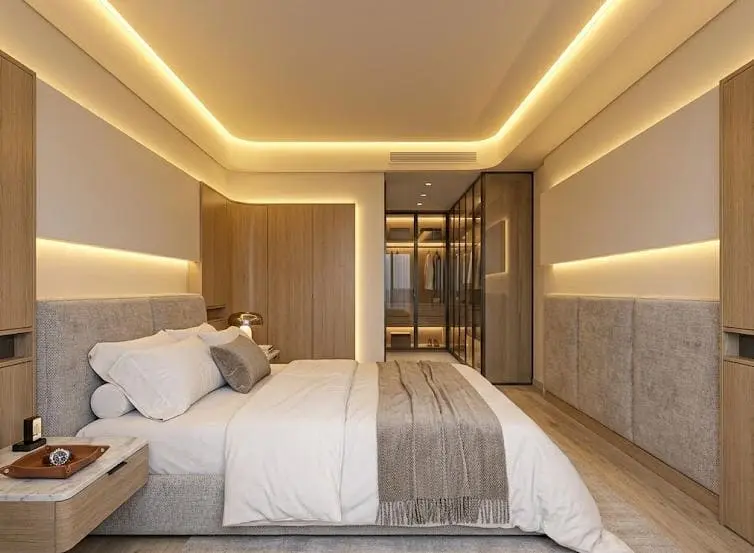
When our team started supplying COB LED strips 1 for hotel projects in Germany and Australia, one challenge kept coming up — designers wanted light that felt invisible, yet transformative.
To design hotel guest room and lobby lighting with COB LED strip lights, use warm-toned (2700K–3000K) COB strips in concealed cove profiles, layer ambient, task, and accent zones, integrate dimmable smart controls, and select high-CRI strips rated IP65+ for wet areas to deliver seamless, luxury-grade illumination throughout the property.
This guide walks through every detail — from achieving dot-free glow in guest rooms to managing voltage drop 2 in long corridor runs. Let's get into the specifics.
How do I achieve a seamless, dot-free glow in my hotel guest rooms using COB LED strips?
A buyer in Australia once sent us photos of a boutique hotel renovation where the old SMD strips left ugly bright spots behind frosted acrylic headboard panels CE and RoHS 3. That single issue triggered a full re-spec of the project, and it's a scenario I've seen repeated across dozens of hospitality lighting design briefs.
COB LED strips achieve a seamless, dot-free glow because their densely packed chips (up to 528 LEDs per meter) sit under a uniform phosphor layer, producing continuous linear light without visible hotspots — ideal for hotel guest room cove lighting, headboard accents, and mirror backlights.
Why COB Beats Traditional SMD in Guest Rooms
Traditional LED strips use individual diodes spaced 5–10 mm apart UL or ETL listing 4. Even with a diffuser, you can still see dots at close range. COB technology places tiny chips side by side on the board, covered by a single phosphor coating. The result is a smooth, continuous ribbon of light. In a guest room, where surfaces are within arm's reach, this difference is immediately visible.
I remember testing two sample reels side by side inside a mock-up headboard slot during a product development round. The SMD 2835 strip, even at 120 LEDs per meter, showed a clear scallop pattern on the wall. The COB strip at 320 LEDs per meter looked like a solid line of light. That's the moment it clicked for our team — COB isn't just an upgrade; it's a different category.
Where to Install COB Strips in a Guest Room
Layered lighting is the backbone of good hotel room design. Here's how COB strips fit into each layer:
| Lighting Layer | Application | Recommended COB Spec |
|---|---|---|
| Ambient | Ceiling cove perimeter, curtain pelmet | 2700K–3000K, 10W/m, CRI 90+ |
| Task | Desk underside, bedside reading niche | 3000K–3500K, 14W/m, dimmable |
| Accent | Headboard backlight, wardrobe interior, under-bed float | 2700K, 8W/m, CRI 90+ |
| Wet-area | Bathroom mirror cabinet, shower niche | 3000K, IP65 or IP67, 10W/m |
For the under-bed floating effect, we typically recommend a recessed aluminum channel with a frosted lens pointing downward. The warm glow on the floor creates depth and makes the room feel larger at night.
Choosing the Right Color Temperature
Color temperature 5 shapes the entire mood. Guest rooms need warmth. Anything above 4000K feels clinical. Stick to 2700K for a residential, cozy feel. If the hotel brand leans modern and crisp, 3000K is the ceiling.
For bathroom vanity mirrors, some designers push to 4000K so guests see themselves more clearly. That's fine, but keep it isolated to the mirror zone only. The ambient lighting in the bathroom should still match the bedroom warmth.
Dimming and Smart Lighting Controls
Guests expect control. A room that's permanently set to one brightness level feels rigid. We always advise specifying dimmable LED strips paired with a PWM or 0-10V dimmer 6. For higher-end properties, integration with smart lighting controls — Crestron, KNX, or Lutron — lets guests adjust scenes from a bedside tablet or a phone app. The strip itself must be flicker-free at all dimming levels. We test every batch down to 1% brightness to confirm this.
How can I ensure consistent color temperature across my entire hotel lobby and common areas?
One trade-off we constantly weigh in our production line is this: tighter color binning means higher material cost and longer lead times, but for hotel lobbies — where dozens of meters of strip light are visible in a single glance — even a slight color shift between reels is unacceptable.
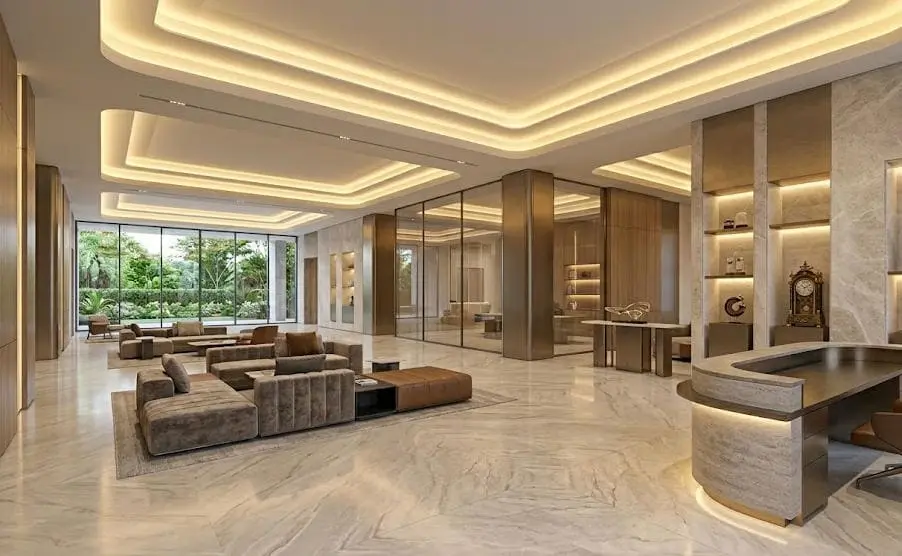
To ensure consistent color temperature across a hotel lobby, specify COB LED strips from a single production bin (±50K tolerance or tighter), request batch-matched reels from your supplier, verify with a spectrophotometer on arrival, and use CCT-tunable strips where multiple zones require blended tones.
Understanding Color Binning
LED chips are manufactured in large wafers, and natural variation means not every chip lands at exactly 3000K. Manufacturers sort chips into "bins" by color temperature and brightness. A 3-step MacAdam ellipse bin 7 is considered tight. A 5-step bin is looser and cheaper. For a hotel lobby where uniform illumination is critical, always request 3-step SDCM or better.
When we prepare orders for hotel projects, we reserve reels from the same chip lot. This is one of the most important quality control steps we perform, and it's something I always flag early in the quoting stage. If a project needs 500 meters, we plan the chip sourcing to come from one batch.
Lobby Zones and Their Color Requirements
A hotel lobby isn't one flat space. It contains several functional zones, each with different lighting needs:
| Lobby Zone | Recommended CCT | Lighting Purpose |
|---|---|---|
| Main reception / check-in | 2700K–3000K | Warm welcome, brand impression |
| Lounge / seating area | 2700K | Relaxed ambient lighting |
| Art walls / feature displays | 3000K, CRI 95+ | Vivid color rendering for artwork |
| Business center / concierge | 3500K–4000K | Alertness, readability |
| Gym / fitness area | 4000K–5000K | Energizing, functional |
| Exterior façade / entrance canopy | 3000K | Architectural lighting, curb appeal |
The key is transition. When a guest walks from the bright entrance into the warm lounge, the shift should feel natural, not jarring. CCT-tunable COB strips — sometimes called "dim-to-warm" or "tunable white" — let you dial in exact temperatures per zone from a single product type.
Backlighting Translucent Features
One growing trend I see in lobby design is backlighting translucent materials — onyx panels behind the reception desk, frosted glass dividers, or resin art walls. COB strips are perfect here because the light must be perfectly even. Any hotspot telegraphs through the translucent surface and ruins the effect.
For these applications, I recommend mounting the COB strip at least 80–100 mm behind the surface, inside a white-painted cavity. This gives the light room to blend before it hits the material. A high Color Rendering Index 8 (CRI 90+) is essential here so the natural veining of stone or the colors of resin art appear true to life.
Practical Verification on Site
Even with perfect binning, verify on site. Bring a handheld spectrophotometer. Check each reel before installation. It takes five minutes per reel and can save days of rework. I've seen projects where a supplier shipped mixed bins and the contractor didn't catch it until the ceiling cove was sealed. The cost of re-opening that cove and replacing the strip was ten times the cost of the strip itself.
How do I manage long-run COB LED installations in hotel corridors without voltage drop?
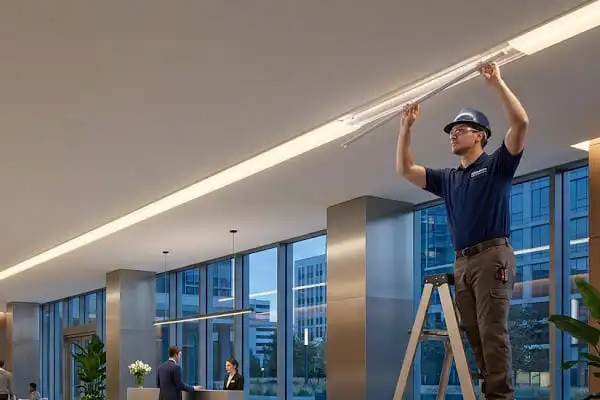
A lesson we learned early when exporting long-run LED strips to Australia is that installers there often deal with corridors exceeding 30 or even 50 meters. One contractor called us after his 20-meter run dimmed noticeably at the far end — the warm white light had shifted to an even warmer, almost amber tone at the tail. That's voltage drop in action.
To manage long-run COB LED corridor installations without voltage drop, use 24V or 48V DC strips, limit each run to the manufacturer's maximum recommended length, inject power from both ends or at mid-points, use adequately sized cables, and place drivers at distributed intervals along the corridor.
What Causes Voltage Drop?
Every strip of copper trace on an LED strip has resistance. The longer the run, the more voltage is lost to that resistance before reaching the far-end LEDs. Those far-end LEDs receive less voltage, so they dim and can shift in color. In a hotel corridor, this means the first meter near the driver looks bright and white, while the last meter looks dim and yellow.
Voltage and Run-Length Guidelines
Higher voltage strips tolerate longer runs because the same wattage draws less current at higher voltage, which means less loss through the trace. Here's a practical reference:
| Strip Voltage | Max Single-Feed Run (typical) | Best Practice for Hotel Corridors |
|---|---|---|
| 12V DC | 5 meters | Not recommended for corridors |
| 24V DC | 10–15 meters | Power inject every 10 m or feed from both ends |
| 48V DC | 15–25 meters | Power inject every 15–20 m |
| 220V / 240V AC (high voltage) | Up to 50 meters | Single run feasible; use with caution for dimming |
For most hotel corridor projects, I recommend 24V DC with power injection every 10 meters. We pre-mark injection points on our reels and provide wiring diagrams for the installer. This eliminates guesswork on site.
Power Injection Methods
There are three common approaches:
- End-to-end feed — Connect the driver to both the start and end of the strip run. Simple, effective for runs up to about 20 meters on 24V.
- Mid-point injection — Run a cable from the driver to a central solder point on the strip. Good for runs where access is available at the midpoint.
- Distributed drivers — Place a separate driver every 10–15 meters along the corridor ceiling void. This is the most reliable method for very long corridors and also provides redundancy — if one driver fails, only one section goes dark.
Cable Sizing Matters
Don't overlook the cable between the driver and the strip. Thin wires add resistance. For runs over 5 meters from driver to strip start, use at least 1.0 mm² (18 AWG) cable. For runs over 10 meters, step up to 1.5 mm² or 2.5 mm². This is especially important in hotel ceilings where cables may run through conduit, adding length.
A Note on High-Voltage AC COB Strips
Some suppliers offer 220V or 240V AC COB strips that can run 50 meters without voltage drop. These are tempting for long corridors. However, they have trade-offs: dimming compatibility is limited, the strip carries mains voltage (a safety concern during maintenance), and the light quality is often lower. For most hotel projects where guest experience and energy efficiency matter, I still prefer low-voltage DC strips with proper power injection.
What certifications do I need for COB LED strips to meet my hotel project's bidding requirements?
When our team prepares documentation packages for project bids in Germany and Australia, certification is often the first filter. A distributor we work with in Melbourne told us bluntly: "If the product doesn't have the right marks, it doesn't matter how good the light quality is — it won't even be considered."
For hotel project bids, COB LED strips typically require CE and RoHS for European markets, SAA and RCM marks for Australia, UL or ETL listing for North America, and IP65/IP67 ratings for wet areas. Fire-rated and low-smoke-halogen-free (LSZH) certifications add further compliance for hospitality interiors.
Market-Specific Certification Requirements
Different markets mandate different marks. Here's a breakdown of what hotel projects commonly require by region:
| Market | Required Certifications | Notes |
|---|---|---|
| Europe (EU) | CE, RoHS, ENEC (optional) | CE is mandatory; RoHS covers hazardous substances |
| Australia / New Zealand | SAA (AS/NZS), RCM, GEMS (energy) | SAA is non-negotiable for electrical products |
| North America (US / Canada) | UL / ETL / CSA listing | Required for code compliance and insurance |
| Middle East (UAE, Saudi) | ESMA, SASO | Growing market with strict import controls |
| General | IP rating (IP20, IP65, IP67, IP68) | Must match installation environment |
Why Certification Is a Gatekeeper
In many hotel projects, the lighting specification is written by an architect or lighting designer and reviewed by an electrical engineer. The spec often includes a line like "all LED fixtures shall be UL listed" or "all products shall carry the SAA mark." If your product can't show that certification, it's excluded at the tender stage. No negotiation.
I've watched promising suppliers lose bids because they only had CE marking when the project required SAA. The lesson is clear: confirm the certification requirements before sampling, not after.
IP Ratings for Different Hotel Zones
IP (Ingress Protection) ratings 9 determine where a strip can be safely installed:
| IP Rating | Protection Level | Suitable Hotel Applications |
|---|---|---|
| IP20 | No water protection | Dry areas: bedroom coves, lobby ceilings, corridors |
| IP54 | Splash-resistant | Covered outdoor areas, above bathroom vanities |
| IP65 | Jet-proof (silicone sleeve) | Bathroom general areas, kitchen undercabinet |
| IP67 | Submersible to 1 m briefly | Shower niches, poolside features |
| IP68 | Continuous submersion | Underwater pool lighting, fountains |
For hotel bathrooms, IP65 is the minimum standard. Shower niches and steam rooms need IP67. We always advise specifying one grade higher than the minimum to build in a safety margin.
Fire Safety and Low-Smoke Requirements
Many hotel building codes require that materials inside ceiling voids and wall cavities meet fire safety standards. Look for:
- LSZH (Low Smoke Zero Halogen) jacket material on the strip and cables.
- CPR (Construction Products Regulation) compliance in Europe, particularly Euroclass B or C ratings.
- Flame retardant PCB material (FR4 or equivalent).
These are often overlooked in standard LED strip specifications but can become deal-breakers during the final electrical inspection of a hotel build.
How We Support Certification Needs
On our end, we maintain current CE, RoHS, and SAA documentation for our core COB strip lines. When a project requires a specific mark we don't yet hold — for example, an ETL listing for a US hotel chain — we work with our testing partners to fast-track the process. We also provide full technical datasheets, IES files, and test reports as part of our bid support package. This saves the specifier time and reduces back-and-forth during the approval cycle.
Conclusion
Designing hotel lighting with COB LED strip lights comes down to invisible fixtures, consistent color, proper engineering for long runs, and the right certifications — get these right, and the guest experience speaks for itself. For similar principles applied to other commercial settings, explore COB LED strip light applications in retail lighting and professional museum and art gallery lighting.
Footnotes
- Explains Chip-on-Board (COB) LED technology and its benefits. ↩︎
- Defines voltage drop and its causes in electrical circuits. ↩︎
- Explains CE marking and RoHS directive for European product compliance. ↩︎
- Compares UL and ETL listings as North American electrical safety certifications. ↩︎
- Defines color temperature (CCT) and its impact on lighting appearance. ↩︎
- Compares PWM and 0-10V dimming methods for LED lighting control. ↩︎
- Describes the MacAdam ellipse and its role in LED color consistency and binning. ↩︎
- Replaced with an authoritative Wikipedia page explaining Color Rendering Index. ↩︎
- Explains Ingress Protection (IP) ratings for protection against solids and liquids. ↩︎
- Details the mandatory SAA certification for electrical products in Australia. ↩︎

 English
 Spanish
 German
 Russian
 Arabic
 French
 Portuguese