

Buyers ask us about COB LED strip light wattage almost daily. Picking the wrong spec causes overheating, early lumen decay, and expensive rework — problems our project team sees far too often.
Common wattage specifications for COB LED strip lights cluster around 5W, 8W, 10W, 12W, 15W, and 20W per meter. Most residential 24V strips fall between 10W/m and 14W/m, while commercial and high-output models reach 20W/m to 40W/m or more.
That is the short answer. But choosing the right wattage for your project takes more thought. Let me walk you through how I guide our clients, step by step.
How do I choose the right wattage for my COB LED strip project based on brightness needs?
Last year, a client insisted on 20W/m for a home cove project. I asked about the installation environment first — a habit I never skip. He ended up choosing 12W/m and thanked me later.
Choose wattage by application: 5W–8W/m for accent and decorative lighting, 10W–15W/m for home coves, under-cabinet, and task lighting, and 20W/m or higher only for commercial displays or general room lighting where maximum output justifies the extra heat.

Many buyers open the conversation by asking whether we stock 20W or 30W per meter. My first question back is always the same: where will it be installed? Higher wattage does not mean better. It only means more heat. If the project is a residential light cove, 10W to 15W per meter is almost always enough. If it is a commercial showcase, then we can talk about higher power. I have reviewed many projects with severe lumen depreciation, and in most cases the strip was fine — the wattage was simply chosen too aggressively at the start.
Match Wattage to the Job, Not the Spec Sheet
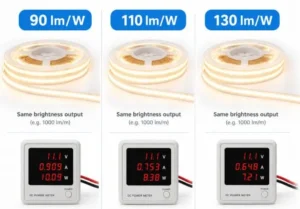
Wattage measures power consumption, not brightness by itself. Actual output also depends on LED density, chip efficacy, color rendering index 1, and thermal design. A well-built 10W/m strip with 480 chips per meter can outshine a poorly made 14W/m strip. So compare lumens per meter, not just watts.
Here is the selection table I share with our contractor clients:
| Application | Recommended Wattage | Typical Lumens per Meter | Notes |
|---|---|---|---|
| Decorative / accent | 5W–8W/m | 400–800 lm/m | Subtle glow, minimal heat |
| Cove and cabinet lighting | 10W–12W/m | 900–1,200 lm/m | The residential sweet spot |
| Task lighting | 12W–15W/m | 1,100–1,500 lm/m | Kitchens, workbenches |
| Commercial display | 15W–20W/m | 1,400–2,000 lm/m | Requires aluminum profiles |
| High-output commercial | 20W–40W/m | 2,000+ lm/m | Specialty projects only |
One more nuance. COB strips carry what some call a phosphor tax. The continuous phosphor coating 2 absorbs some light, so a COB strip may need roughly 10–15% more wattage than an SMD strip to hit the same lumen output. Factor that in when comparing quotes.
What wattage differences should I expect between low-voltage and high-voltage COB LED strips?
When we started supplying long-run and high-voltage solutions to Australian contractors, the wattage question changed completely. Voltage class shapes what wattage specs even make sense for a project.
Low-voltage 24V COB strips commonly run 9.6W/m to 14W/m, with 5V models as low as 5.5W/m. High-voltage strips maintain similar per-meter wattage but support much longer continuous runs, because higher voltage dramatically reduces voltage drop over distance.

Voltage does not directly change how many watts a strip consumes per meter. But it changes everything about how that wattage behaves over distance. Let me break down what our engineers see across the catalog.
Why 24V Dominates the Mid-Range
Most commonly sold COB strips are 24V, and their wattages cluster around 10W/m to 14W/m. Market listings confirm this: 24V products appear at 9.6W/m, 10W/m, 12W/m, and 14W/m across major suppliers. A standard 5m roll at 10W/m totals about 50W, which is why 50W rolls are so common in retail channels. 24V is preferred over 12V because it carries the same wattage at half the current, which cuts voltage drop 3 significantly and extends maximum run length.
| Voltage Class | Typical Wattage Range | Typical Max Run Length | Best Use Case |
|---|---|---|---|
| 5V | 5.5W–8W/m | 1–2 m | USB-powered, small decor |
| 12V | 8W–12W/m | 5 m | Short accent runs, vehicles |
| 24V | 9.6W–20W/m | 5–10 m | Residential and most commercial |
| High-voltage (mains-driven) | 8W–15W/m | 30–50 m+ | Long-run architectural projects |
The Real-World Wattage Gap
Here is a detail worth knowing for power budgeting. On runs over 5 meters, real-world consumption is often 5–10% lower than the theoretical rated wattage. Cumulative trace resistance and voltage drop 4 reduce the actual draw at the far end of the strip. The far end also appears slightly dimmer. High-voltage designs suffer far less from this, which is why we recommend them for facades, perimeter coves, and any continuous run beyond 10 meters. For tunable white CCT strips, also note that the rated wattage is usually a shared limit across both channels — mixing warm and cool does not double the draw.
Can higher wattage COB LED strips cause heat issues in my long-run installations?
A German distributor once returned samples with phosphor browning after six months in an enclosed ceiling detail. The strip was rated 20W/m, mounted on bare plasterboard. That failure taught us to specify thermal management, not just wattage.
Yes. Higher wattage COB strips generate more heat, and thermal saturation occurs quickly in COB designs. Any strip above roughly 14W/m needs an aluminum profile for heat dissipation; without it, phosphor browning and premature lumen failure are likely in long-run installations.

Heat is the hidden cost of wattage. Every watt a strip consumes becomes either light or heat, and COB architecture concentrates that heat along a continuous chip line. Unlike SMD strips with gaps between components, COB strips have nowhere for heat to escape sideways. This is why I always ask about the installation environment before quoting a wattage.
The 14W/m Threshold
Our engineers treat 14W/m as the practical line. Below it, a strip can often survive on a surface with reasonable airflow. Above it, an aluminum profile becomes mandatory, not optional. The profile acts as a heatsink, pulling heat away from the phosphor layer. Enclosed coves, recessed channels, and outdoor IP-rated sleeves all trap heat, so we lower the threshold further for those environments.
What Excess Heat Actually Does
The damage is gradual, which makes it dangerous for project warranties:
- Junction temperature rises above the safe operating range.
- Phosphor efficiency drops, shifting color temperature warmer over time.
- Lumens per meter decay faster than the rated L70 curve predicts.
- In severe cases, the phosphor coating visibly browns and the strip fails.
I have reviewed projects where clients blamed the strip quality for heavy light decay. In most of those cases, the real cause was an aggressive wattage choice at the design stage. A 12W/m strip in a proper aluminum profile will outlast a 20W/m strip on bare drywall — and often look just as bright to the eye once the space is finished. For long runs, heat also compounds: heat plus voltage drop together accelerate uneven aging along the strip, which shows up as visible color inconsistency in renovation projects.
How do I match COB LED strip wattage with the correct power supply for my project?
Undersized drivers cause more warranty claims than the strips themselves in our experience shipping to Germany and Australia. The math is simple, yet it gets skipped constantly during procurement.
Multiply the strip's rated wattage per meter by the total installed length, then add a 20% safety margin. Following this 80% Rule, a 5m strip at 10W/m draws 50W and needs at least a 60W 24V DC power supply.
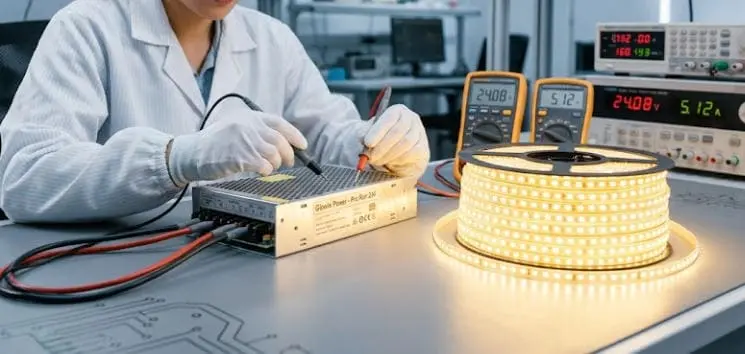
Power supply sizing is where wattage specs turn into real purchasing decisions. Get it wrong in either direction and you pay for it: undersized drivers overheat and fail early, while heavily oversized drivers waste budget and sometimes cause dimming compatibility issues.
The Calculation, Step by Step
- Confirm the strip's wattage per meter from the datasheet — check whether the listing shows watts per meter, watts per foot, or total roll wattage, because manufacturers mix all three.
- Multiply by the total run length to get total load.
- Divide by 0.8 to apply the 80% Rule, so the driver runs at no more than 80% of its capacity.
- Round up to the nearest standard driver size.
For US-facing projects, keep the conversions handy: 10W/m equals about 3.0 watts per foot, 12W/m equals about 3.7W/ft, and 14W/m equals about 4.3W/ft.
| Strip Spec | Run Length | Total Load | Minimum Driver (80% Rule) |
|---|---|---|---|
| 10W/m, 24V | 5 m | 50W | 60W–65W |
| 12W/m, 24V | 5 m | 60W | 75W |
| 14W/m, 24V | 5 m | 70W | 90W–100W |
| 14W/m, 24V | 10 m | 140W | 180W–200W |
| 20W/m, 24V | 10 m | 200W | 250W |
Practical Details Buyers Miss
Also distinguish nominal rating from real draw. Some listings show max output power rather than average consumption, so size against the higher figure to stay safe. If the project needs dimming, specify dimmable LED drivers that match the control protocol from day one — TRIAC, 0-10V, or DALI — because swapping drivers after installation is the single most expensive fix we see. And on multi-color products, budget higher: a 24V RGBW COB roll can total 90W, nearly double a standard white roll. When we co-develop private-label kits for distributors, we pre-pair strip wattage with a tested driver so their installers never have to do this math on site.
Conclusion
Common COB LED strip wattages run 5W–20W per meter, with 10W–14W/m the residential standard. Choose by environment, respect heat limits, and size drivers with a 20% margin.
Footnotes
- Comprehensive technical overview of the color rendering index and its importance in lighting quality. ↩︎
- Explains phosphor materials used in LED coatings that affect light absorption and wattage needs. ↩︎
- Detailed explanation of the voltage drop phenomenon in electrical circuits and its impact on performance. ↩︎
- Background on voltage drop concept explains why higher voltage reduces current and losses over distance. ↩︎



 English
 Spanish
 German
 Russian
 Arabic
 French
 Portuguese