
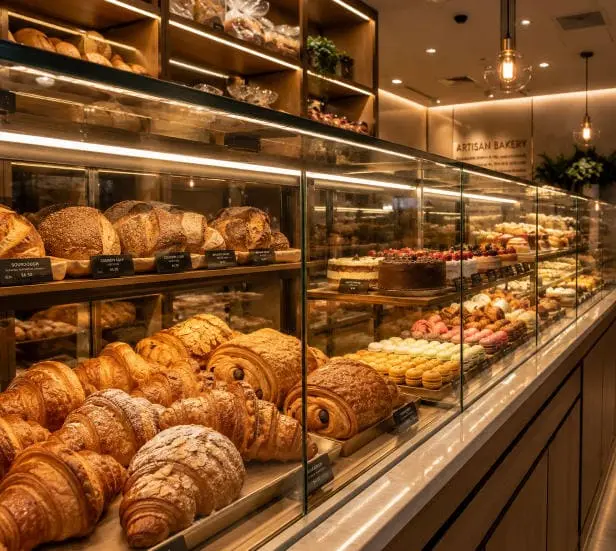
I've seen beautiful pastries look completely lifeless under the wrong lighting — colors washed out, crusts looking dull, and customers walking right past the display case.
When using COB LED strip lights for bakery and food displays, you must prioritize warm white light between 2500K–3000K, a Color Rendering Index above 90, proper heat management with aluminum profiles, appropriate IP ratings for moisture resistance, and consistent color quality across all units to enhance food presentation and extend shelf life.
Each of these factors plays a direct role in how your baked goods look to customers and how long they stay fresh on the shelf warm white light 1. Let me walk you through each consideration in detail.
How do I choose the right color temperature and CRI to make my bakery products look fresh?
A lesson our team learned early on: the two biggest enemies of food lighting are color distortion and excessive heat — get either one wrong, and even the finest croissant looks like it belongs in yesterday's clearance bin.
For bakery products, choose a color temperature between 2500K and 3000K with a CRI of 90 or higher. This warm white light enhances golden crusts, rich chocolate tones, and colorful icings while rendering natural ingredient colors accurately, making baked goods look irresistibly fresh to customers.
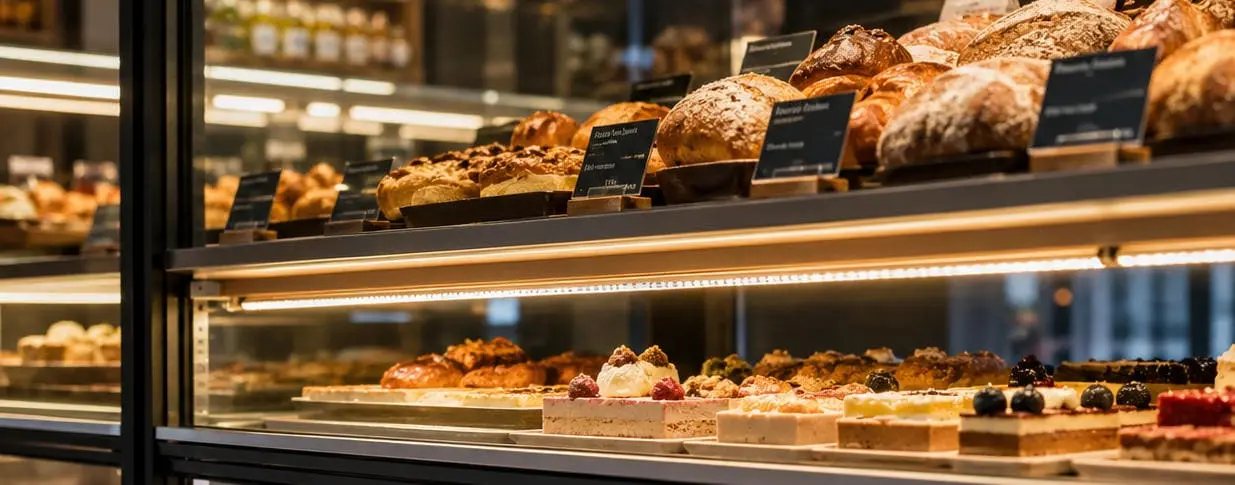
Why Color Temperature Matters for Baked Goods
Color temperature controls the "mood" of your display. A warm tone around 2700K mimics late-afternoon sunlight. It brings out the golden-brown tones in bread crusts and the buttery richness of pastries. Cool white light — anything above 4000K — does the opposite. It makes bread look flat and grayish. Cake frostings lose their vibrancy.
When we help contractors spec lighting for bakery fit-outs in Australia and Germany, the conversation almost always starts here. Bakery owners want their products to look "warm and inviting." That means staying in the 2500K–3000K range.
Here is a quick guide:
| Color Temperature | Best For | Effect on Baked Goods |
|---|---|---|
| 2500K (Very Warm) | Artisan bread, rustic pastries | Deep golden glow, cozy atmosphere |
| 2700K (Warm White) | General bakery displays, cakes | Natural warmth, balanced richness |
| 3000K (Neutral Warm) | Mixed displays with fruits, pastries | Slightly brighter, still appetizing |
| 4000K+ (Cool White) | Not recommended for bakeries | Washes out colors, bread looks stale |
The Role of CRI in Food Presentation
The Color Rendering Index 2 measures how accurately a light source shows the true colors of objects. A CRI below 80 will make red strawberries on a cake look muddy. Chocolate will appear flat. Even white cream can take on a yellowish or grayish cast.
For bakery lighting design, a CRI of 90 is the minimum I recommend. Some premium COB strips now reach CRI 97. The difference is dramatic. We once sent two sample reels to a distributor — one at CRI 80 and one at CRI 95. Under the CRI 80 strip, a fruit tart looked dull. Under the CRI 95 strip, the same tart looked like it belonged in a magazine. The distributor never questioned the price difference again.
Spectral Tuning and Avoiding Damage
Beyond basic color temperature, the spectrum itself matters. Some LED wavelengths can trigger photochemical reactions 3 that cause food dyes to fade and dairy products to degrade faster. Specialized food-grade COB strips minimize UV and infrared radiation 4. This is not just about visual merchandising — it directly affects how long products stay fresh on the shelf. Studies suggest that balanced-spectrum lighting can extend shelf life by up to 50% and prevent discoloration of sensitive ingredients.
Will the heat from high-density COB LED strips affect the shelf life of my food displays?
One trade-off we weigh constantly during product development: higher LED density gives you smoother, dot-free illumination — but it also means more chips packed into a small area, which raises the question of thermal output.
COB LED strips generate significantly less heat than traditional lighting, but heat management still matters. Without aluminum profiles for heat dissipation, even efficient COB strips can warm a display case enough to soften butter, melt chocolate, and accelerate dehydration — shortening shelf life and increasing product waste.
How Much Heat Do COB Strips Actually Produce?
COB strips are far more energy-efficient than halogen or fluorescent alternatives. A typical high-output food-grade strip consumes about 4.9 watts per foot (roughly 16W/m). Most of that energy converts to light, not heat. But "less heat" is not "no heat." In a sealed or poorly ventilated display case, even modest thermal output accumulates over hours.
For refrigerated display lighting, the problem compounds. The refrigeration unit works harder to counteract any added heat. This wastes energy and can create micro-climates inside the case where products near the light source warm up faster.
Installation Strategies for Thermal Control
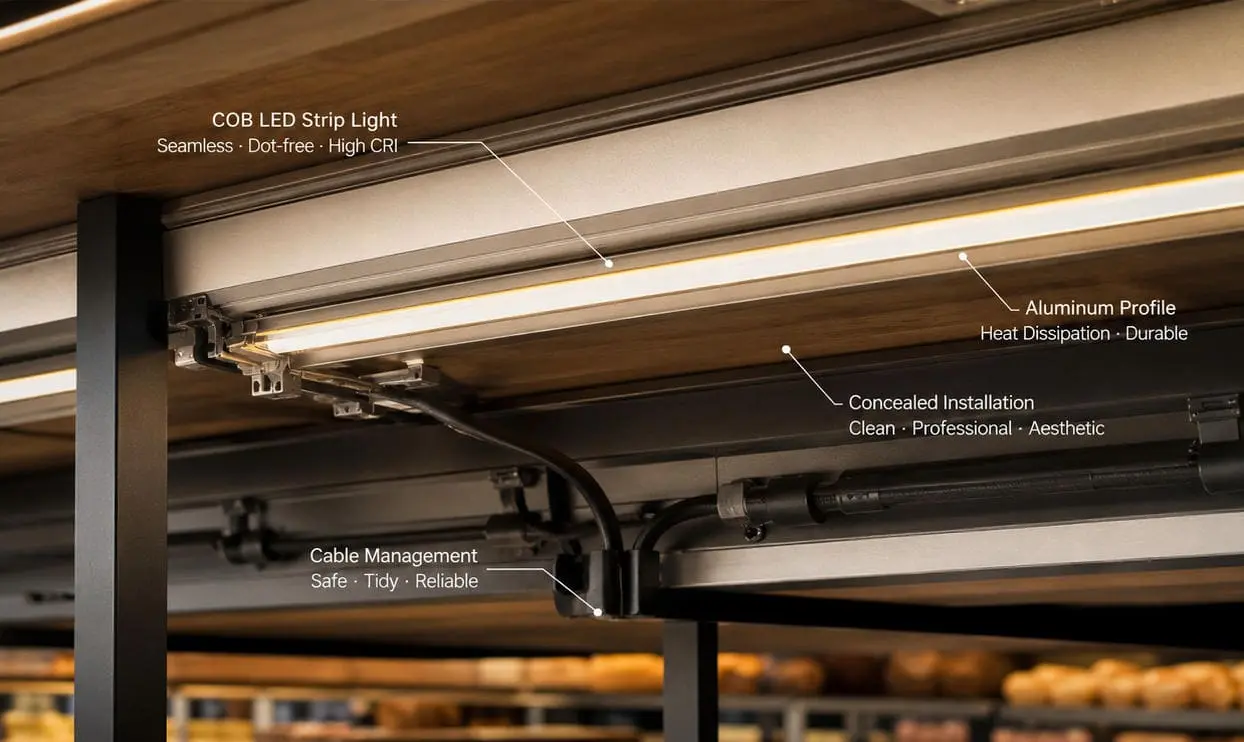
The single most effective solution is mounting COB strips inside aluminum extrusion profiles 5. The aluminum acts as a heat sink, drawing thermal energy away from the LEDs and dissipating it across a larger surface area. This keeps the strip operating within its optimal temperature range, which also preserves the LEDs' lifespan 6 — rated up to 50,000 hours under proper conditions.
| Heat Management Method | Effectiveness | Cost | Notes |
|---|---|---|---|
| Bare COB strip (no profile) | Low | Lowest | Risk of overheating in enclosed cases |
| Aluminum profile (surface mount) | High | Moderate | Best balance of cost and performance |
| Aluminum profile + thermal paste | Very High | Moderate–High | Maximum heat transfer for high-density strips |
| Active ventilation in display case | Very High | Higher | Recommended for large refrigerated units |
Calculating Power Safely
When our team specs a power supply for a bakery project, we always add a 20% safety margin. If your total strip wattage is 80W, use a 100W driver. Running a power supply near its maximum capacity generates excess heat and shortens its life. That heat radiates into the display environment. Proper sizing is a simple step that pays dividends in both energy efficiency and product freshness.
For long runs exceeding 16.4 feet (5 meters), reconnect power at intervals to avoid voltage drop. Dimming at the end of a strip not only looks uneven — the LEDs at the injection point run hotter to compensate. This creates uneven thermal output along the strip, which is exactly what you want to avoid in a food case.
How can I customize COB LED strip lengths to fit the unique dimensions of my commercial display cases?
A buyer in Australia once told me his biggest frustration: every bakery case in his chain was a slightly different size, and off-the-shelf LED strips never fit cleanly — either too long with an ugly fold, or too short with a dark gap at the end.
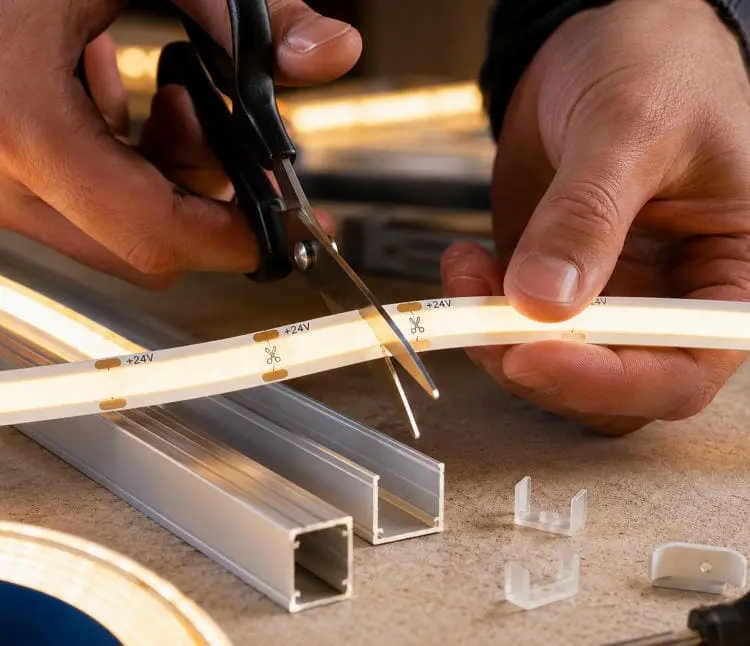
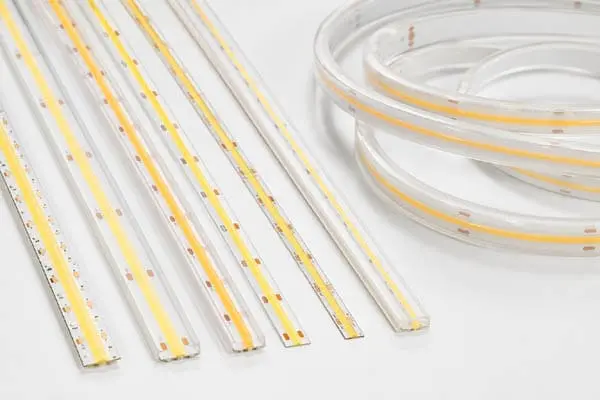
COB LED strips can be cut at designated solder pads to fit exact display case dimensions, and newer free-cut variants allow cutting at virtually any point. For precise lengths, work with a supplier who offers custom-cut reels, pre-soldered connectors, and rapid prototyping to match your specific commercial cases.
Understanding Cut Points and Free-Cut Technology
Traditional COB strips have copper solder pads spaced at regular intervals — typically every 25mm to 50mm. You can cut at these points without damaging the circuit. The remaining strip continues to function normally. This gives you reasonable flexibility for most standard display cases.
However, some modern display designs have curved shelves or non-standard widths. This is where free-cut COB technology comes in. These strips allow you to cut at nearly any point along the length. For retrofit projects in existing bakery cases, this simplifies installation enormously. No more measuring to the nearest solder pad. No more dark gaps.
Working with Your Supplier on Custom Lengths
When contractors and wholesalers come to us with a bakery project, we typically handle the customization in one of three ways:
- Pre-cut reels — We cut strips to exact lengths at our facility, solder lead wires, and ship them ready to install. This eliminates on-site cutting entirely.
- Custom reel lengths — Instead of standard 5m reels, we produce reels in whatever length the project requires. This reduces waste and simplifies logistics.
- Rapid prototyping — For unique display case geometries, we produce a small batch first. The contractor tests the fit before committing to a full order. Our low MOQ policy makes this practical even for smaller projects.
Connectors, Joints, and Seamless Light Lines
Cutting is only half the challenge. Joining strips around corners or across shelf segments is equally important. Visible joints or dark spots between segments destroy the premium look that COB strips are supposed to deliver. Solderless clip connectors work for quick installations, but soldered connections are more reliable for permanent commercial fixtures. In bakery cases where the light line must appear perfectly continuous, I always recommend soldered joints with heat-shrink tubing.
The top-bending flexibility of COB strips also helps. Unlike rigid LED bars, a COB strip can conform to gentle curves in a display case shelf. This means fewer joints and fewer potential failure points.
How do I ensure long-term color consistency across all my food display units to avoid batch variance?
During a recent project review, a distributor showed us photos of two adjacent display cases in the same bakery — both fitted with LED strips from different batches. One glowed a clean warm white. The other had a noticeable greenish tint. The bakery owner was furious. That single image reminded our quality team why binning tolerances matter so much.
To ensure long-term color consistency, specify tight LED binning tolerances (within a 2–3 step MacAdam ellipse), source all strips from the same production lot when possible, use drivers with stable output, and work with a supplier who tests every reel for CCT and CRI before shipment.
What Causes Batch Variance?
Color variance between LED batches comes from the manufacturing process of the LED chips themselves. Even chips from the same wafer can vary slightly in color temperature and brightness. LED manufacturers sort chips into "bins" based on their measured color coordinates. Wider bins mean more variation. Tighter bins cost more but deliver much more consistent results.
For bakery lighting design, even a small color shift is noticeable. Human eyes are extremely sensitive to differences in warm white tones, especially when two light sources sit side by side. A 200K difference between two strips — say 2700K versus 2900K — is visible to most people. Similar color consistency challenges apply in other retail lighting applications where multiple display units must match visually.
The MacAdam Ellipse Standard
The industry uses MacAdam ellipses 8 to quantify color consistency. A 3-step MacAdam ellipse means that color differences are barely perceptible to most observers. A 5-step ellipse allows noticeable variation.
| MacAdam Ellipse Step | Perceptibility | Recommended For |
|---|---|---|
| 1-step | Virtually identical | Laboratory / medical lighting |
| 2-step | Imperceptible to most | Premium retail, high-end displays |
| 3-step | Barely noticeable | Commercial bakery displays, food retail |
| 5-step | Clearly visible side by side | Budget / utility lighting |
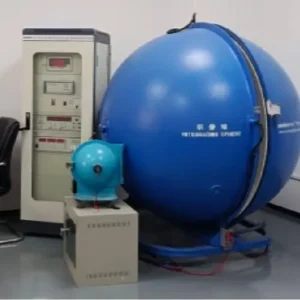
For bakery and food displays, I recommend specifying 3-step or tighter. When we produce a batch of COB strips for a chain bakery project, we test every reel on a calibrated integrating sphere. Reels that fall outside the target bin get set aside. This adds time but eliminates the "two different whites" problem.
Driver Quality and Aging Effects
Even perfectly matched strips can drift apart over time if driven by inconsistent power supplies. A cheap driver may deliver slightly different current levels, which shifts color temperature. Constant-current drivers 9 with tight regulation keep every strip running at its designed operating point.
LED aging also plays a role. Over tens of thousands of hours, phosphor layers can shift slightly, causing a gradual change in color temperature. High-quality COB strips with premium phosphor formulations show less drift. This is why the rated lifespan of 50,000 hours matters — it represents the point at which the strip still maintains acceptable luminosity and color, not just when it stops working entirely.
Practical Steps for Multi-Unit Projects
For contractors rolling out lighting across multiple bakery locations, here is a practical workflow:
- Order all strips for the project from a single production lot.
- Request a color consistency report with each shipment.
- Use the same driver model and wattage rating across all locations.
- Keep spare reels from the same lot for future maintenance.
- Schedule periodic inspections to catch any early signs of color drift.
This level of attention to detail separates a professional installation from one that looks inconsistent within months. The same principles of high CRI and precise color matching apply whether you're lighting bakery cases or jewelry counter displays — anywhere product appearance directly drives sales.
Conclusion
Choosing COB LED strip lights for bakery displays comes down to four pillars: warm color temperature with high CRI for appetizing food presentation, proper heat management to extend shelf life, precise customization for clean installations, and strict quality control for color consistency across every unit.
Footnotes
- Explains the psychological and aesthetic impact of warm white light in various settings. ↩︎
- Provides a comprehensive definition and explanation of the Color Rendering Index. ↩︎
- An NIH article discussing photophysical and photochemical reactions in the context of food preservation. ↩︎
- An NIH article discussing photodynamic inactivation, which involves UV and infrared light in food preservation. ↩︎
- Offers information on architectural LED aluminum profiles and extrusions for LED strips from a reputable lighting company. ↩︎
- Outlines the key factors that influence the lifespan of LED lights, including heat management and driver quality. ↩︎
- Offers a fundamental definition and explanation of how a heat sink functions in electronics. ↩︎
- Wikipedia provides a comprehensive and authoritative explanation of MacAdam ellipses in color vision and lighting. ↩︎
- Provides a detailed explanation of constant-current LED drivers and their importance for LED performance and longevity. ↩︎

 English
 Spanish
 German
 Russian
 Arabic
 French
 Portuguese