
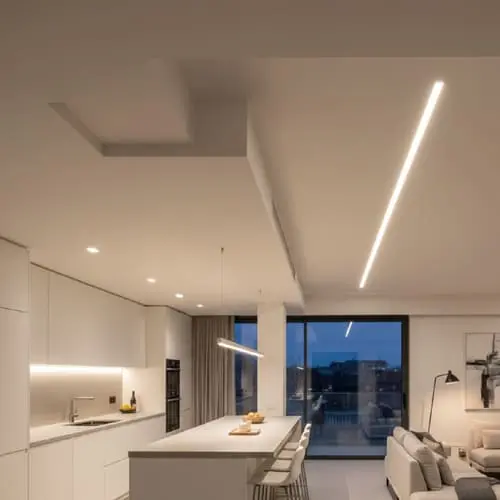
I've lost count of how many contractors have asked me whether COB LED strip lights 1 actually deliver in a living room cove lighting setup — the answer keeps surprising them.
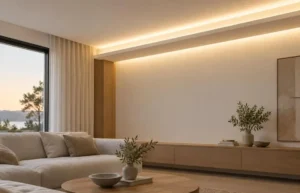
Yes, COB LED strip lights are excellent for indirect living room ambient lighting. Their chip-on-board design produces seamless light output without visible hotspots, making them ideal for cove and valance installations where uniform illumination and a refined, dot-free glow are essential for creating a cozy atmosphere.
But choosing COB is just the starting point. Below, I'll walk you through the real-world details — from eliminating hotspots to managing voltage drop 2 over long runs — so you can design an indirect lighting system that truly performs.
How do I achieve a perfectly seamless glow without visible hotspots in my indirect cove lighting?
A German contractor we supply once sent photos of an SMD strip installation where every single LED dot reflected off a matte white ceiling — the homeowner rejected the entire job chip-on-board design 3.
To achieve a seamless, hotspot-free glow, use dotless LED strips with COB technology. The continuous phosphor layer over densely packed micro-emitters eliminates individual light points, producing a smooth, uniform line of light that bounces cleanly off ceilings and walls in cove lighting applications.

Why COB Eliminates the "Dot Effect"
Traditional SMD LED strips space individual diodes a few millimeters apart 24V DC strips 4. Each diode acts as a point source. When you mount them inside a shallow ceiling recess, the wall or ceiling above catches each point and mirrors it back as a dotted pattern. This looks cheap and distracting — especially in a living room where you sit below the cove and look up PWM (Pulse Width Modulation) dimmer 5.
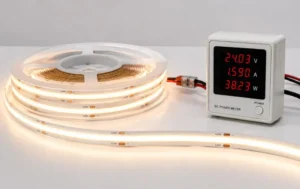
COB strips take a different approach. Hundreds of tiny LED chips sit under a single, shared phosphor layer. The phosphor diffuses the light before it ever leaves the strip surface. The result is a continuous ribbon of light with no visible gaps. Even at close viewing distances — say, 1.5 meters from a sofa to a ceiling ledge — the glow stays perfectly even.
SMD vs. COB: A Direct Comparison
| Feature | SMD 2835 Strip | COB LED Strip |
|---|---|---|
| Light Pattern | Individual dots visible | Continuous, dot-free line |
| Ideal Viewing Distance | >2 meters (to hide dots) | Any distance |
| Diffuser Required? | Yes, almost always | Optional (already smooth) |
| CRI (Premium Models) | 80–90 | 90–97 |
| Flexibility | Moderate | High (bends without dark spots) |
| Cost per Meter | Lower | Slightly higher |
The Role of LED Profiles and Channel Depth
Even with COB strips, the physical installation matters. I always recommend pairing COB strips with aluminum LED profiles for two reasons. First, the profile acts as a heatsink. COB strips pack more emitters per meter, so they generate more heat. Without proper thermal management, the strip's lifespan drops and color shifts over time. Second, the profile gives you a clean mounting surface inside the cove.
Channel depth is critical. If the lip of the cove is too tall relative to the channel, it blocks the light spread. A good rule of thumb: the lip should be no taller than the distance from the strip to the lip edge. This ensures at least a 45-degree spread angle so light washes smoothly across the ceiling.
Reflective Surface Matters
The ceiling or wall you're bouncing light off should be white or near-white. Dark or textured surfaces absorb light and create uneven patches. I've seen projects in Australia where a warm-toned timber ceiling cut the effective brightness by nearly half. If your ceiling isn't white, increase the lumen density of your strip to compensate.
Can I run long lengths of COB LED strips around my living room without experiencing voltage drop?
One lesson I learned early in our export business: a strip that looks perfect on a 2-meter sample roll can disappoint badly when a contractor installs a 10-meter continuous run around a room perimeter.
Yes, you can run long COB LED strips around a living room, but you must use 24V DC strips, limit single-feed runs to 5 meters, and inject power from both ends or at intervals to prevent voltage drop that causes the far end of the strip to appear noticeably dimmer than the feed point.
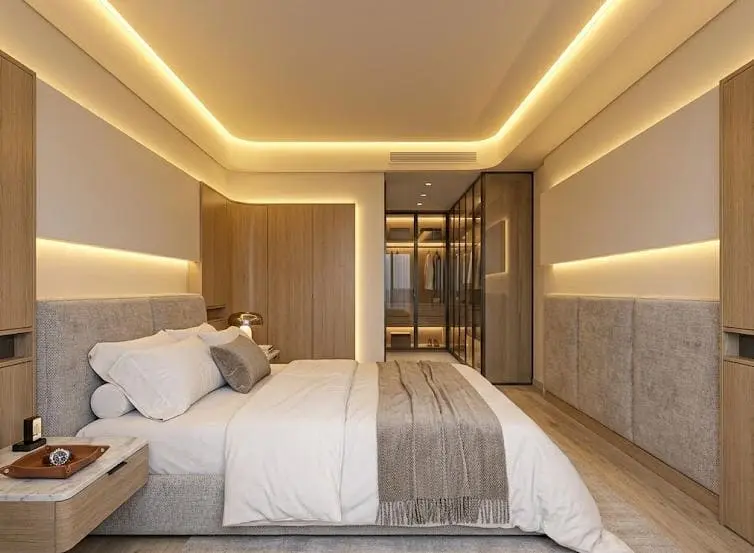
Understanding Voltage Drop
Voltage drop happens because the thin copper traces on a flexible LED strip have resistance. The longer the run, the more voltage is lost along the way. The LEDs at the far end receive less voltage, so they glow dimmer and may shift in color temperature 6. In a living room where the strip might run 12–20 meters around three walls, this effect can be very visible.
12V vs. 24V: Why 24V Wins for Living Rooms
| Parameter | 12V COB Strip | 24V COB Strip |
|---|---|---|
| Max Single-Feed Run | ~3 meters | ~5 meters |
| Current Draw (same brightness) | Higher | Lower (half) |
| Voltage Drop Severity | Worse | Better |
| Cut Points | More frequent | Slightly less frequent |
| Recommended for Living Room Runs | No | Yes |
At the same wattage, a 24V strip draws half the current of a 12V strip. Lower current means less voltage lost across the copper traces. This is why virtually all project-grade COB strips we develop for contractors run on 24V.
Power Injection Strategies
For a typical living room perimeter of 15 meters, I recommend this approach:
- Divide the run into segments. Each segment should be no longer than 5 meters.
- Feed power from both ends of each segment, or inject power at the midpoint.
- Use a single, adequately sized power supply with extension cables running to each injection point. Hide the cables inside the wall or ceiling cavity.
- Calculate total wattage. Multiply the strip's wattage per meter by the total length, then add a 20% headroom margin for the power supply.
For example, a 10W/m strip over 15 meters needs 150W. Add 20% and you need a 180W (minimum) driver. I usually suggest going to 200W for safety and longevity.
Solderless Connectors and Joints
Long runs also mean joints. Every joint is a potential failure point. We test our solderless connectors for contact resistance to make sure they don't introduce additional voltage drop. Still, for critical accent lighting or high-end residential projects, soldered joints remain more reliable. If you're a contractor running 20 meters of strip, invest the time in proper soldering at each connection.
How do I ensure the color temperature of my COB strips remains consistent across my entire project?
A buyer in Australia once returned an order — not because the strips were defective, but because two rolls from different production batches had a visible color temperature mismatch when installed side by side in the same cove.
To ensure consistent color temperature across your project, specify a tight LED binning tolerance (e.g., 3-step MacAdam ellipse), order all strips from the same production batch, request a CCT consistency report, and test samples under your actual installation conditions before committing to the full order.
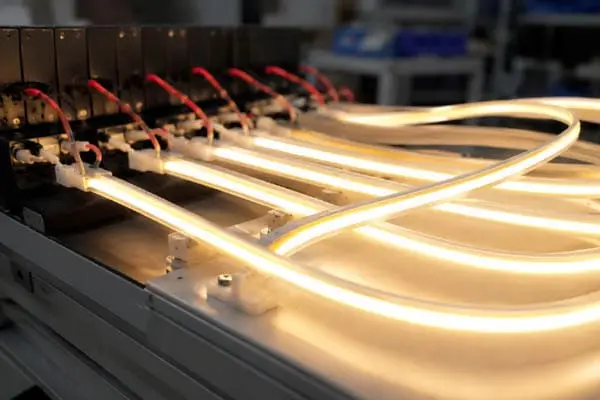
What Causes Color Temperature Variation?
Color temperature in LED strips comes from the phosphor coating applied over the blue LED chips. Small variations in phosphor thickness, composition, or chip wavelength create shifts in the final warm white light or neutral white output. These shifts are measured in Kelvin (K) and in MacAdam ellipse steps.
A 3-step MacAdam ellipse 7 means the human eye cannot easily detect the color difference between two strips. A 5-step ellipse means most people will notice a difference. For indirect living room lighting, where multiple strips sit in the same cove and reflect off the same ceiling, even a 5-step difference becomes obvious.
Binning and Batch Control
| Binning Level | MacAdam Steps | Perceptible Difference? | Suitable For |
|---|---|---|---|
| Standard | 5–7 | Yes, noticeable | Budget accent lighting, TV backlighting |
| Premium | 3–5 | Barely noticeable | Most residential cove lighting 8 |
| Ultra-Tight | 1–3 | Imperceptible | High-end hospitality, luxury residential |
When we run a production order, we bin the COB strips by measuring the CCT and chromaticity of each reel. Strips that fall outside the specified bin are separated. This is why ordering from the same batch matters — if you reorder six months later, the new batch may fall in a different bin even if the nominal color temperature is the same "3000K."
Practical Steps for Contractors and Specifiers
Here's what I tell every procurement officer who orders for a large living room or multi-room project:
- Order 10–15% extra from the same batch. Having spare strips from the same bin saves you if a section gets damaged during installation.
- Request a test reel before full production. We routinely send 1–2 meter samples so the designer can verify the color temperature against the project's material palette.
- Install all strips in the same orientation. Some strips show a slight warm-to-cool gradient along the reel. Running them all in the same direction ensures any minor gradient is consistent.
- Use dimmable LED lighting with care. Some dimming methods — particularly cheap TRIAC dimmers — can shift the apparent color temperature at low levels. PWM dimmers maintain the original color much better.
High-CRI and Color Temperature
Strips with a CRI of 95 or above tend to render warm white light more naturally. This matters for living rooms where skin tones, wood furniture, and fabric textures need to look their best. I've found that pairing a 2700K–3000K COB strip with CRI 95+ creates what designers often call a "hotel lobby" feel — warm, inviting, and premium. This is the kind of energy efficient lighting that also looks genuinely good.
How do I select the best dimming solution for my COB ambient lighting setup?
The trade-off I weigh most often when advising contractors isn't about the strip itself — it's about the dimmer. A beautiful COB installation can be ruined by a dimmer that flickers, buzzes, or can't go below 20%.
For COB ambient lighting, choose a PWM (Pulse Width Modulation) dimmer rated for your strip's total wattage. PWM dimmers provide flicker-free, smooth dimming down to 1% brightness without color shift, and they pair well with smart lighting control systems for scene setting and automation.
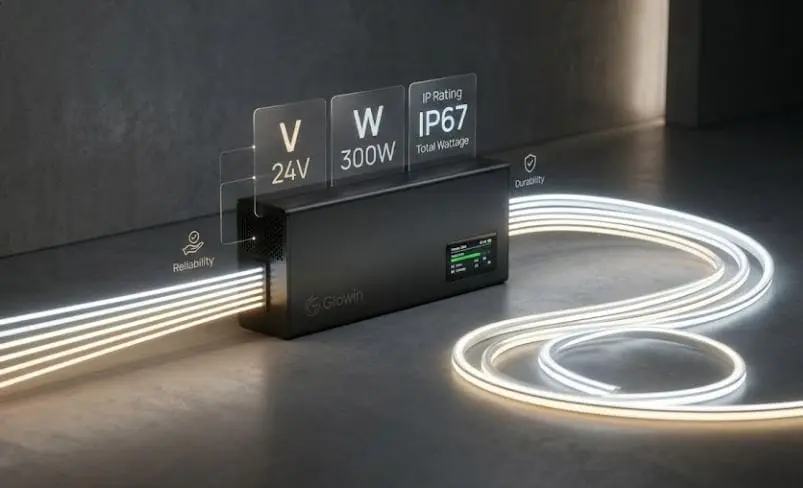
Why PWM Is the Go-To for LED Strips
There are two main dimming methods for low-voltage LED strips: CCR (Constant Current Reduction) and PWM. CCR reduces the current flowing through the LEDs, which dims them but can also shift their color temperature — warm white light may appear slightly cooler at low levels. PWM, on the other hand, switches the LEDs on and off thousands of times per second. At 50% brightness, the LEDs are on for half the cycle and off for the other half. Because the LEDs always operate at full current when they're on, the color stays true.
For living room ambient lighting, where you want to transition from bright evening illumination to a low, cozy glow for movie watching, PWM's ability to dim smoothly to 1% without flicker or color shift is essential.
Dimming Options Compared
| Dimmer Type | Dimming Range | Color Shift | Flicker Risk | Smart Home Compatible | Best For |
|---|---|---|---|---|---|
| TRIAC (AC-side) | 10–100% | Moderate | High | Limited | Retrofit with existing wall dimmers |
| 0-10V | 1–100% | Low | Low | Yes | Commercial installations |
| PWM (DC-side) | 0.1–100% | None | None (high frequency) | Yes | Residential COB strip lighting |
| DALI | 1–100% | Low | None | Yes | Large-scale commercial projects |
Integrating Smart Lighting Control
Many of our buyers — especially those selling to end consumers through private-label channels — want strips that work with smart home ecosystems. The good news is that PWM controllers integrate easily with Zigbee, Wi-Fi, or Bluetooth gateways. This means homeowners can adjust brightness and even switch between tunable white color temperatures using a phone app or voice command.
For a living room, I recommend setting up at least two preset scenes:
- Evening Social: 70–80% brightness at 3000K. Bright enough for conversation and general activity.
- Movie / Relaxation: 15–25% brightness at 2700K. Low enough to feel immersive without turning the room into a cave.
If you're using tunable white COB strips (also called CCT-adjustable), the controller manages two channels — warm and cool — and blends them to hit the target color temperature. This is a great way to support circadian rhythms 9: brighter and cooler during the day, warmer and dimmer in the evening.
Wattage Matching and Driver Compatibility
A common mistake is mismatching the dimmer's wattage rating with the total strip load. If your 15-meter installation draws 150W, your dimmer must handle at least 150W — ideally 180W or more. Undersized dimmers overheat, flicker, or fail prematurely. Also confirm that your LED power supply (driver) is "dimmable" and compatible with the chosen dimming protocol. Not all constant-voltage drivers accept a PWM signal on the input side.
A Note on Ambiance vs. Task Lighting
If I were recommending a setup for a client's living room, I'd pair COB strips in the cove for ambient mood lighting with a couple of direct light sources — a floor lamp for reading, perhaps a pendant over a side table. The COB strips create the atmosphere. The direct sources handle the tasks. This layered approach is far more effective — and far more energy efficient — than trying to blast the room with strip lighting alone. As I mentioned in our internal project reviews: the purpose of ambient lighting is comfort, not turning a living room into an office.
Conclusion
COB LED strip lights are one of the best choices for indirect living room ambient lighting — delivering seamless light output, high CRI, and elegant cove lighting results when paired with proper power design, tight color binning, and smart dimming.
Footnotes
- Explains the fundamental technology and benefits of COB LEDs. ↩︎
- Explains the electrical phenomenon of voltage drop in LED strip circuits. ↩︎
- Details the technical aspects and advantages of chip-on-board LED packaging. ↩︎
- Discusses the advantages of 24V over 12V for longer LED strip installations. ↩︎
- Authoritative explanation of 'Pulse Width Modulation' from an educational electronics platform. ↩︎
- Authoritative and comprehensive explanation of 'color temperature' from Wikipedia. ↩︎
- Clarifies the standard for LED color consistency and binning tolerance. ↩︎
- Provides a general overview of cove lighting applications and design principles. ↩︎
- Authoritative overview of 'circadian rhythms' from the National Institute of General Medical Sciences (NIH). ↩︎


 English
 Spanish
 German
 Russian
 Arabic
 French
 Portuguese