
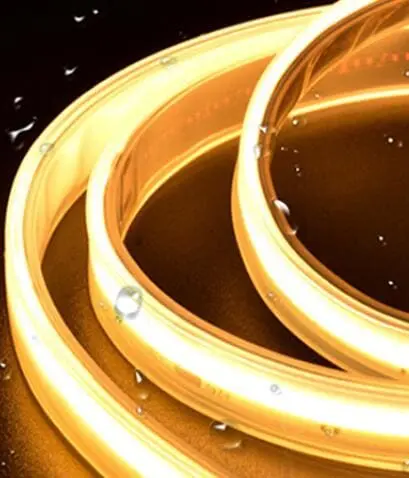
I keep telling clients that indoor and outdoor COB LED strip lights 1 look similar on the spec sheet, but their structural differences cause real problems when you pick the wrong one.
Indoor and outdoor waterproof COB LED strip lights differ in encapsulation method, IP rating, thermal management design, connector sealing, and material composition. Outdoor strips add silicone encapsulation, UV-resistant layers, and sealed end caps that change thickness, flexibility, heat dissipation, and installation requirements compared to bare indoor versions.
These are not cosmetic differences. They affect how you cut, mount, connect, and maintain your strips over years of service phosphor layer 2. Let me walk you through each structural layer so you can make the right call for your next project.
How does the protective encapsulation change the physical dimensions of my outdoor COB LED strips?
One trade-off I weigh on nearly every export order to Germany or Australia is how much extra bulk the waterproofing adds — because it changes almost everything downstream, from aluminum channel 3 sizing to shipping carton volumes.
Outdoor waterproof encapsulation adds 1–3 mm to the total thickness and up to 2 mm to the width of a COB LED strip. Silicone coating (IP65) adds the least bulk, while full silicone extrusion (IP67/IP68) creates the thickest profile, reducing flexibility and requiring wider mounting channels.
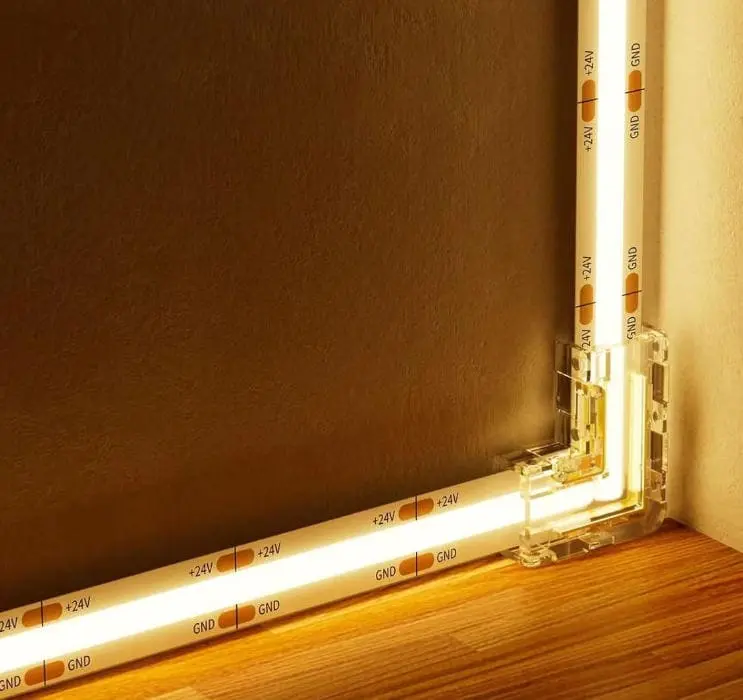
Why Dimensions Change With Each IP Rating
Indoor COB strips — usually rated IP20 — are essentially a bare flexible PCB 4 with a phosphor layer on top. There is no protective shell. The total thickness is typically 2–3 mm, and the width sits around 8–10 mm depending on the LED density.
Once you move to outdoor use, every IP tier adds a new structural layer. Here is what happens at each level:
| IP Rating 5 | Encapsulation Method | Typical Added Thickness | Typical Added Width | Flexibility Impact |
|---|---|---|---|---|
| IP20 (Indoor) | None — bare FPC + phosphor | 0 mm | 0 mm | Maximum flexibility |
| IP65 (Outdoor) | Silicone or epoxy resin coating on top surface | +0.5–1.0 mm | +0–0.5 mm | Slightly reduced |
| IP67 (Outdoor) | Hollow silicone sleeve / extrusion tube | +1.5–2.5 mm | +1.0–2.0 mm | Moderately reduced |
| IP68 (Outdoor) | Full silicone extrusion + polyurethane glue fill | +2.0–3.0 mm | +1.5–2.0 mm | Significantly reduced |
What This Means for Your Aluminum Channels
If your lighting designer specced a slim recessed channel for an indoor COB strip, that same channel almost certainly will not fit an IP67 version. I have seen contractors order thousands of meters of channel only to discover the waterproof strip does not slide in. On our production line, we always cross-check the finished outer dimensions of the waterproof strip against the client's chosen profile before we confirm the order.
Material Differences Beyond Size
The encapsulation material itself matters. Silicone encapsulation 6 stays flexible in cold weather and resists yellowing better than epoxy resin coating. Epoxy is cheaper but tends to harden and crack over time, especially in Australian climates with intense UV exposure. Polyurethane glue fill is used in full-potting IP68 designs for underwater or direct-burial applications. Each material has a different refractive index, which subtly shifts the light output angle.
The bottom line: outdoor durability comes at the cost of added bulk. Plan your channel, your bending radius, and your shipping volume around the finished waterproof dimension — not the bare strip dimension.
Will the waterproof structural layers affect the heat dissipation and longevity of my project lights?
A lesson I learned early in our co-development work: a client in Melbourne once upgraded from IP65 to IP68 strips for a coastal facade project, assuming higher IP rating meant better performance across the board. Within eight months, the IP68 strips showed worse lumen depreciation than the IP65 version on the same building.
Yes. Waterproof encapsulation traps heat around the COB chips by blocking convective airflow. Higher IP ratings with thicker sealing layers create greater thermal resistance, which accelerates light decay and shortens lifespan unless the thermal management design — including PCB copper weight and heat-sink mounting — is upgraded to compensate.
How Heat Moves in Indoor vs. Outdoor Strips
An indoor IP20 COB strip dissipates heat in two directions. Heat conducts downward through the flexible PCB into the mounting surface (usually an aluminum channel). Heat also radiates and convects upward into the surrounding air. This dual-path cooling is simple and effective.
An outdoor waterproof strip loses that upward path. The silicone or epoxy layer sits directly on top of the phosphor and LED chips. Silicone is a thermal insulator 7. It does not conduct heat well. So the only remaining path is downward, through the PCB, into the mounting surface.
The Numbers That Matter
| Parameter | Indoor IP20 Strip | Outdoor IP65 Strip | Outdoor IP67/IP68 Strip |
|---|---|---|---|
| Primary heat path | Down + Up (convection) | Down only (coating blocks upward) | Down only (extrusion fully seals) |
| Thermal resistance of top layer | ~0 (bare air) | Low–Medium (thin silicone coat) | Medium–High (thick silicone tube + fill) |
| Recommended max power per meter | Up to 20 W/m on aluminum channel | Up to 15 W/m on aluminum channel | Up to 12 W/m on aluminum channel |
| Typical junction temperature rise | Moderate | Higher | Highest |
| Suggested PCB copper weight | 1 oz | 2 oz | 2–3 oz or aluminum-core PCB |
These are general guidelines from our engineering team's testing across dozens of projects. The exact thresholds depend on ambient temperature, channel material, and airflow around the installation.
Why Higher IP Is Not Always Better
This is the point I stress to every procurement officer who contacts us: IP rating is about water and dust protection. It is not a quality score. An IP68 strip in a covered soffit where it never sees rain is just wasting thermal headroom. You get worse weather resistance performance-to-heat ratio for no benefit.
The smart approach is to match the IP rating to the actual exposure. A covered patio in Germany might only need IP65. A fountain edge in Sydney needs IP68. But you should never over-spec the sealing without also upgrading the thermal path — thicker copper layers on the flexible PCB, better aluminum profiles, and sometimes even active ventilation in enclosed luminaire housings.
Voltage drop 8 also interacts with heat. Longer outdoor runs at higher power generate more resistive heating along the strip. If the encapsulation traps that heat, the compounding effect shortens LED life faster than either factor alone.
How do the structural differences impact my ability to cut and reseal COB strips for outdoor use?
During a recent buyer interaction with a contractor distributor, the first question was not about lumens or color temperature — it was about cutting. He needed to know whether his installers could field-cut waterproof COB strips and reseal them without compromising the IP rating.
Cutting outdoor waterproof COB strips is mechanically harder because you must slice through the encapsulation layer along with the PCB. After cutting, the exposed end loses its IP protection entirely. Resealing requires heat-shrink end caps, silicone sealant, or specialized waterproof connectors — steps that indoor IP20 strips never need.
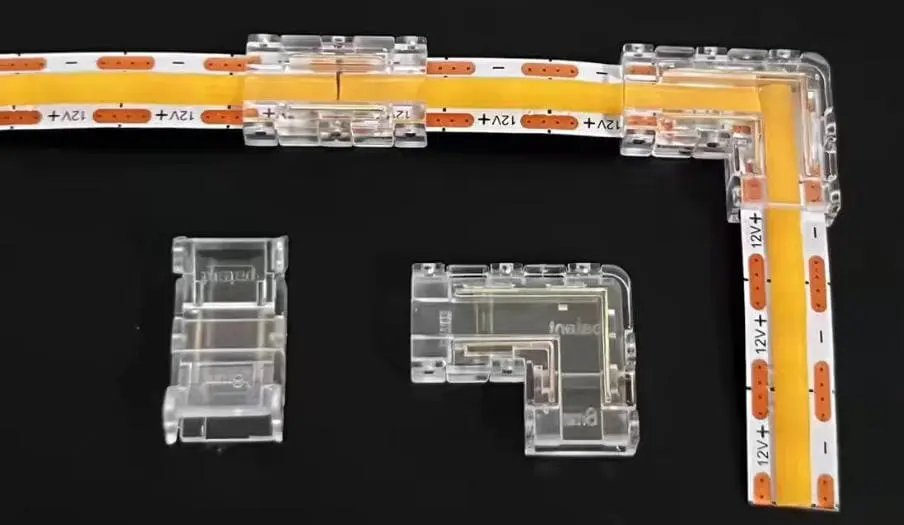
The Cutting Process Step by Step
Indoor IP20 strips are simple. You find the cut mark on the bare PCB, snip with scissors, and you are done. The exposed copper pads are ready for soldering or clip connectors.
Outdoor strips demand more steps:
- Locate the cut mark. On IP65 coated strips, the marks are usually visible through the translucent silicone. On IP67 extrusion tubes, you may need to feel or measure because the marks are hidden.
- Cut through the encapsulation. Use a sharp blade or flush cutters. On extrusion types, cut the silicone sleeve first, then the PCB. Avoid crushing the strip.
- Clean the cut end. Remove any silicone debris from the copper pads so solder or connectors can make clean contact.
- Reseal the cut end. This is the critical step. Options include:
- Heat-shrink tubing with adhesive lining
- Silicone end caps with sealant injection
- IP-rated snap connectors with gaskets
What Happens If You Skip Resealing
Moisture enters through the exposed end by capillary action 9. Within weeks — sometimes days in humid climates — corrosion begins on the copper traces. The flexible PCB delaminates. Short circuits follow. I have seen entire 20-meter runs fail because one cut end was left unsealed on a rooftop in Brisbane.
Connector Sealing Options Compared
| Resealing Method | Approximate IP After Resealing | Skill Level Required | Time Per End | Durability |
|---|---|---|---|---|
| Heat-shrink with adhesive liner | IP65–IP66 | Moderate (heat gun needed) | 2–3 minutes | Good |
| Silicone end cap + sealant | IP67 | Low–Moderate | 3–5 minutes | Very good |
| IP-rated waterproof snap connector | IP65–IP67 | Low (tool-free) | 1 minute | Good if gasket intact |
| Full potting with silicone or polyurethane | IP68 | High (curing time needed) | 10–30 minutes | Excellent |
For projects where frequent cutting is expected — like architectural cove lighting with many custom lengths — I often suggest using IP65 coated strips instead of IP67 extrusion. The thinner coating is easier to cut through, and the resealing process is faster. If you truly need IP67 or IP68, consider pre-cutting to length at the factory. On our production line, we can pre-cut and seal to the exact millimeter the project requires, which saves installers hours of field work.
UV Resistance at Cut Points
One detail people overlook: when you cut and reseal, the new end cap or heat-shrink must also have UV resistance if the strip is exposed to sunlight. Standard clear heat-shrink without UV stabilizers will yellow and crack within a year outdoors. Always specify UV-rated resealing materials for exterior installations.
Can I achieve the same seamless lighting effect with waterproof COB strips as I do with indoor versions?
A specific production detail that shaped my thinking on this: when we run the same COB die layout through our indoor and outdoor encapsulation lines, the light output looks identical on the bench. But once the strips are installed in their final environment, clients sometimes perceive a difference. Here is why.
Waterproof COB strips can achieve a nearly identical seamless lighting effect to indoor versions, but the encapsulation layer slightly alters light transmission, diffusion, and color temperature. Silicone coatings may shift CCT by 50–100K and reduce lumen output by 3–8%, while extrusion tubes add a mild diffusion effect that can actually improve uniformity.
How Encapsulation Affects Light Output
The whole point of COB (chip-on-board) LED strips is the seamless, dot-free line of light. Hundreds of tiny LED chips are placed so closely together — often 320 or 480 per meter — that the individual points merge into a continuous glow. This is the core visual appeal for architects and designers.
When you add a waterproof layer on top, you are placing a new optical medium between the phosphor and the viewer's eye. The key optical effects are:
- Transmission loss. Silicone absorbs a small percentage of light. Thicker layers absorb more. Epoxy resin coating absorbs slightly more than optical-grade silicone.
- Refractive shift. The silicone surface refracts light differently than bare air, which can widen or narrow the beam angle by a few degrees.
- Color temperature shift. Some encapsulation materials absorb more blue wavelengths, creating a slight warm shift. Our quality control team measures this and compensates at the binning stage when possible.
- Diffusion. An IP67 extrusion tube acts like a miniature diffuser. It softens any remaining hotspots. In many cases, this actually makes the light line look smoother.
Real-World Visual Comparison
| Visual Characteristic | Indoor IP20 | Outdoor IP65 (Coated) | Outdoor IP67 (Extrusion) |
|---|---|---|---|
| Dot-free seamless line | Yes | Yes | Yes |
| Perceived brightness (same wattage) | 100% baseline | ~95–97% | ~92–97% |
| Color temperature shift | None (reference) | +30–80K warm shift possible | +50–100K warm shift possible |
| Beam angle | Native (typically 180°) | Slightly widened | Slightly narrowed by tube geometry |
| Surface glare / hotspots | Possible at close range | Reduced by coating | Further reduced by tube diffusion |
| Uniformity at distance (>0.5 m) | Excellent | Excellent | Excellent to superior |
Practical Advice for Designers
If your project demands precise color matching between indoor and outdoor zones — say, a restaurant with an indoor dining area and an outdoor terrace — you need to account for the encapsulation shift. The best approach is to request samples of both the indoor and outdoor versions in the same CCT bin and compare them side by side under the actual installation conditions.
When we develop custom runs for clients, we sometimes adjust the LED bin selection for the outdoor version to compensate for the encapsulation shift. For example, if the indoor strip is 3000K, we might use a slightly cooler bin for the outdoor strip so that both read visually as the same warm white after the silicone layer does its work.
Weather resistance materials have improved significantly. Modern optical-grade silicone maintains over 92% light transmission and resists yellowing for years. Older epoxy formulations turned yellow under UV exposure within 12–18 months, which caused both a color shift and a brightness drop. If your outdoor installation faces direct sunlight, always confirm that the encapsulation uses UV-stabilized silicone — not commodity epoxy.
The seamless effect is preserved. The structural layers do not create visible dots or gaps. But they do introduce subtle optical changes that a careful specifier should anticipate and manage. Understanding how LED chip density impacts COB LED strip light specifications can help you choose the right configuration to maintain that dot-free appearance even with encapsulation.
Conclusion
Indoor and outdoor waterproof COB LED strip lights differ structurally in encapsulation, dimensions, thermal paths, cutting methods, and optical behavior. Match the IP rating to your real exposure conditions — and always verify that the thermal and optical design supports the waterproofing level you choose. If you are still deciding between strip types for your application, exploring the difference between single-color and tunable white COB LED strip lights can help you narrow down the right product alongside the IP rating decision.
Footnotes
- Explains the technology behind COB LED strips. ↩︎
- Explains the role of a phosphor layer in LED technology. ↩︎
- Explains the use and benefits of aluminum channels for LED strip lights. ↩︎
- Explains the construction and benefits of flexible printed circuit boards. ↩︎
- Explains the international standard for ingress protection ratings. ↩︎
- Explains the properties and applications of silicone encapsulation in electronics. ↩︎
- Defines what a thermal insulator is and its function. ↩︎
- Explains the concept of voltage drop in electrical circuits. ↩︎
- Explains the physical phenomenon of capillary action. ↩︎

 English
 Spanish
 German
 Russian
 Arabic
 French
 Portuguese