
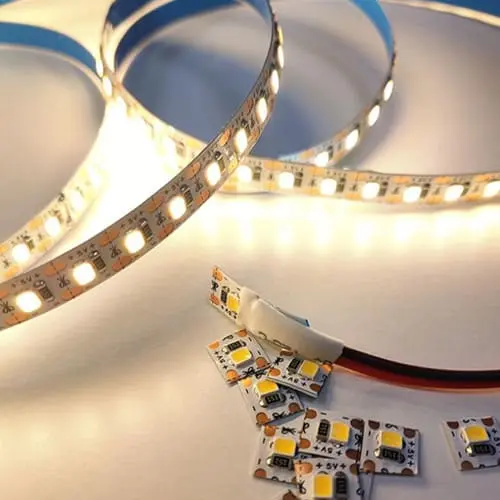
Our engineering team usually fields calls from contractors who wired a long cove lighting run only to find the last few meters embarrassingly dim.
The maximum LED strip light run length depends on voltage and strip type: 12V DC strips max out around 5 meters, 24V DC strips reach about 10 meters, 48V DC strips handle up to 20 meters, and 120V AC strips can run 50 meters or more. Exceeding these limits causes voltage drop, uneven brightness, color shifting, overheating, and shortened LED lifespan.
This guide breaks down how to find the right run length for your project, what goes wrong when you push past the limit, and practical fixes that professional installers rely on every day 24V DC strips 1. Let's dig in.
How do I determine the maximum run length for my specific LED strip project?
We have shipped LED strips to projects across Germany and Australia, and the single most common mistake we see is buyers treating all strips the same when it comes to run length.
To determine your maximum run length, check three things: the strip's operating voltage (12V, 24V, 48V, or AC), its wattage per meter, and the manufacturer's stated maximum length. Higher voltage means longer runs. Higher wattage per meter means shorter runs. Always follow the spec sheet, not assumptions.
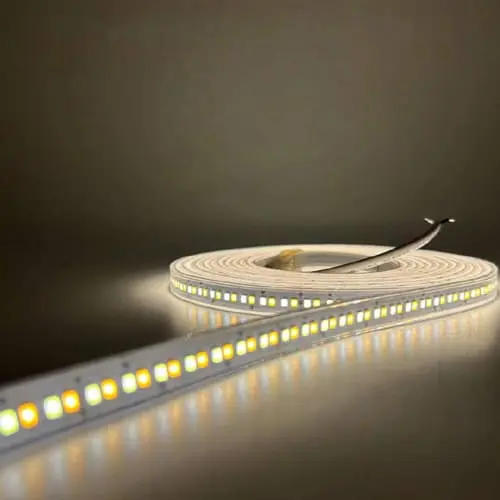
Why Voltage Is the Single Biggest Factor
Voltage directly controls how far electricity can travel along thin copper traces before it drops below a usable level. Think of it like water pressure in a hose. A 12V strip has low "pressure," so the current weakens fast. 12V DC strips 2 A 24V strip has double the pressure, so it can push further. A 48V or 120V AC strip pushes much further still.
Here is a quick reference table our team uses when consulting on projects:
| Strip Voltage | Typical Max Run (Single Feed) | Best Use Case | Power Supply 3 Class |
|---|---|---|---|
| 12V DC | 5 m (16.4 ft) | Short accent runs, DIY projects | Class 2 (60W / 5A max) |
| 24V DC | 10 m (32.8 ft) | Cove lighting, under-cabinet, rooms | Class 2 (96W / 4A max) |
| 24V DC RGB/RGBW | 7 m (23 ft) | Color-changing accent lighting | Class 2 (96W / 4A max) |
| 48V DC | 20 m (65.6 ft) | Large commercial spaces, lobbies | Varies by manufacturer |
| Constant Current DC | 20–50 m (65–164 ft) | Long architectural runs, uniform output | Dedicated CC driver |
| 120V AC (Driverless) | 50 m+ (164 ft+) | Building facades, outdoor perimeters | Direct mains connection |
How Wattage Per Meter Shortens Your Run
A strip rated at 5.5 watts per foot over a 10-meter (32.8 ft) run draws about 180 watts total. Your power supply must exceed that by at least 20%, so you need a 216W unit minimum. But high-wattage strips also pull more current through the same copper traces. More current means more resistance, which means more voltage drop 4 over shorter distances. So a 14W/m strip at 24V may only run 6 or 7 meters cleanly, while a 5W/m strip at 24V can hit the full 10 meters without issues.
The Quick Formula
Here is a simple approach we recommend:
- Find your strip's wattage per meter 5 (from the spec sheet).
- Multiply by your desired length in meters.
- Add 20% safety margin.
- Check if the total stays within the power supply's rated output AND within the manufacturer's stated max run.
If either limit is exceeded, you need to split the run or use power injection 6. There is no shortcut around physics.
RGB and RGBW Strips: A Special Case
RGB and RGBW strips 7 run shorter than single-color strips at the same voltage. The reason is simple: they have three or four channels sharing the same copper traces, so total current is higher. At 24V, expect a max of about 7 meters for RGB strips versus 10 meters for single-color white strips. When we prototype custom RGBW strips for our clients, we always test full-white mode at maximum brightness because that is the worst-case current scenario.
What happens to my light quality and safety if I exceed the recommended run length?
On our production floor, we run deliberate over-length tests on every new strip design. The results are always the same—and they are never pretty.
When you exceed the recommended run length, the LEDs closest to the power source appear bright while those at the far end grow noticeably dim. Colors shift, whites turn yellowish, heat builds up near the feed point, the power supply strains under excess load, and the entire strip's lifespan drops significantly. In worst cases, overheating can pose a fire risk.
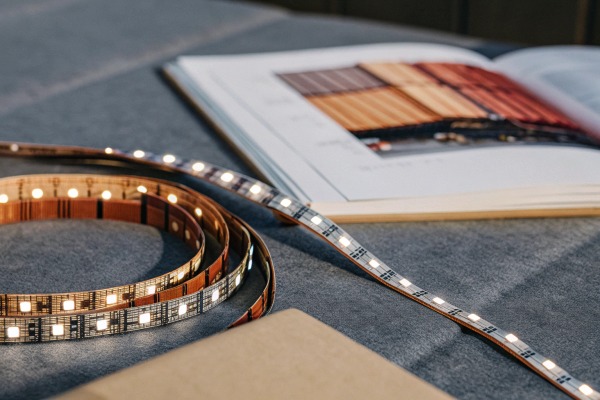
The Science Behind Voltage Drop
LED strip copper traces are thin—typically 1 oz or 2 oz copper on a flexible PCB. Every centimeter of trace has a small amount of resistance. As current flows through this resistance, some voltage is lost as heat. The further the current travels, the more voltage is lost. By the time the current reaches the far end of an over-length run, the remaining voltage may be too low to fully drive the LEDs.
For example, a 12V strip that is pushed to 8 meters might deliver only 9V or 10V at the tail end. The LEDs there receive less power, so they produce less light. That is voltage drop in action.
Visual Symptoms You Will Notice
The most obvious sign is a brightness gradient. The first meter looks great. The last meter looks washed out. With white strips, the color temperature shifts 8 warmer because red phosphors need less voltage to emit light, while blue LEDs are more sensitive to voltage reduction. With RGB strips, you may see color inconsistencies—reds dominating at the far end while blues and greens fade.
In our experience testing for Australian project clients, a 24V strip pushed to 15 meters showed roughly 40–50% brightness loss at the end compared to the feed point. That is unacceptable for any professional installation.
Heat and Safety Risks
Here is the part that worries us most. When you exceed the run length, the LEDs and traces near the power input carry all the current for the entire strip. This concentrates heat at the beginning of the run. Over time, excess heat degrades the LED phosphor, yellows the silicone coating, weakens solder joints, and can even delaminate the adhesive backing.
If the power supply is also undersized or running at full capacity to feed the over-length strip, it overheats too. A stressed power supply that fails can short-circuit. In enclosed installations without airflow—like inside a ceiling cove—this becomes a genuine fire hazard. fire risk 9
Lifespan Impact
| Condition | Expected LED Lifespan 10 | Brightness at 5,000 Hours |
|---|---|---|
| Within recommended run length | 50,000+ hours | 90–95% of original |
| 20% over max run length | 30,000–40,000 hours | 70–80% of original |
| 50% or more over max run length | 15,000–25,000 hours | 50–60% of original |
These numbers come from accelerated aging tests. The takeaway is clear: even moderate over-runs quietly shorten the life of your installation, leading to premature replacements and unhappy clients.
Addressable LED Strips: A Double Problem
For individually addressable (smart) LED strips like WS2812B or SK6812, exceeding run length introduces a second issue: data signal degradation. The digital signal that tells each LED what color to display weakens over distance. You get flickering, wrong colors, or completely unresponsive segments at the far end. Power injection alone does not fix this—you also need data signal boosters or repeaters.
How can I avoid voltage drop and uneven brightness in my long-run installations?
When we work with contractors on commercial fit-outs in Germany and Australia, the conversation always circles back to one question: how do I keep the light even from end to end?
To avoid voltage drop, use multi-point power injection instead of feeding power from one end only. Split long runs into shorter parallel segments, each with its own power feed. Use thicker gauge wires for longer distances, choose higher-voltage strips (24V or 48V over 12V), and always size your power supply at 120% of the total strip wattage.
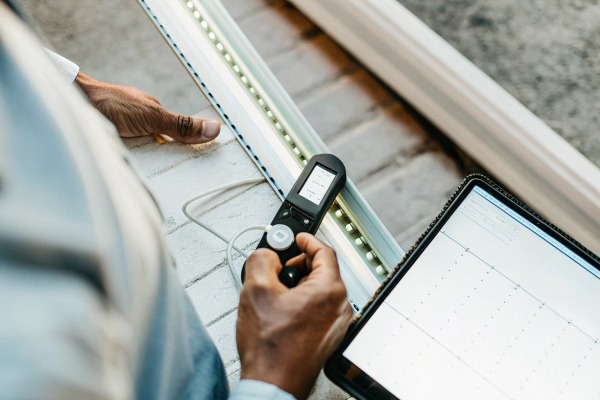
Method 1: Multi-Point Power Injection
Power injection means feeding voltage into the strip at multiple points along its length, not just at one end. For example, a 15-meter 24V strip can be injected at 0 meters, 7.5 meters, and 15 meters. Each injection point refreshes the voltage, keeping the LEDs bright and even throughout.
You run separate power wires from your power supply (or multiple supplies) to each injection point. The strip itself stays in one continuous piece—you are not cutting it. You are just adding extra power feeds.
Our recommendation for standard 24V constant-voltage strips: inject power every 5 meters for best results. For 12V strips, inject every 2.5 to 3 meters.
Method 2: Parallel Wiring (Segmented Runs)
Instead of one long strip powered from one end, cut the strip into shorter segments and wire each segment back to the power supply in parallel. Each segment gets its own positive and negative leads. This way, no single segment exceeds the manufacturer's max run length.
This is the simplest and most reliable method. It adds wiring complexity, but it eliminates voltage drop entirely within each segment.
Method 3: Use Higher Voltage Strips
If your project requires long continuous runs, start by choosing a higher voltage strip. Moving from 12V to 24V doubles your run length. Moving to 48V doubles it again. For many commercial projects, 48V DC strips are the smartest choice because they reduce injection points and simplify wiring.
Wire Gauge Matters
The wire connecting your power supply to the strip is part of the circuit. Thin wires add resistance, which creates voltage drop before the current even reaches the strip. For runs over 3 meters from the power supply to the strip, use heavier gauge wire.
| Distance from PSU to Strip | Recommended Wire Gauge (AWG) | Notes |
|---|---|---|
| 0–3 m (0–10 ft) | 18 AWG | Standard for most short runs |
| 3–6 m (10–20 ft) | 16 AWG | Reduces drop on medium feeds |
| 6–10 m (20–33 ft) | 14 AWG | Essential for longer power feeds |
| 10–15 m (33–50 ft) | 12 AWG | Heavy-duty; consult your electrician |
Use Aluminum Channels for Heat Management
Even with proper power injection, high-wattage strips generate heat. Aluminum extrusion channels act as heat sinks, drawing heat away from the LEDs and PCB. This keeps the LEDs efficient, prevents color shift from thermal stress, and extends lifespan. We include aluminum channel recommendations with every project quote because the performance difference is significant—especially in enclosed cove or recessed installations where air circulation is limited.
A Practical Example
Suppose you have a 20-meter cove lighting run using 24V strips at 10W/m. Total power is 200W, so you need at least a 240W power supply. The max single run for this strip is 10 meters. You cut the strip at 10 meters and wire two parallel segments back to the supply. Or, you keep one continuous strip and inject power at 0m, 10m, and 20m. Either approach works. The key is that no section of strip is more than 10 meters from a power feed.
Which specialized LED strip solutions should I use for my extended commercial runs?
Our product development team has spent years refining strip designs specifically for the long-run challenges that commercial contractors face daily.
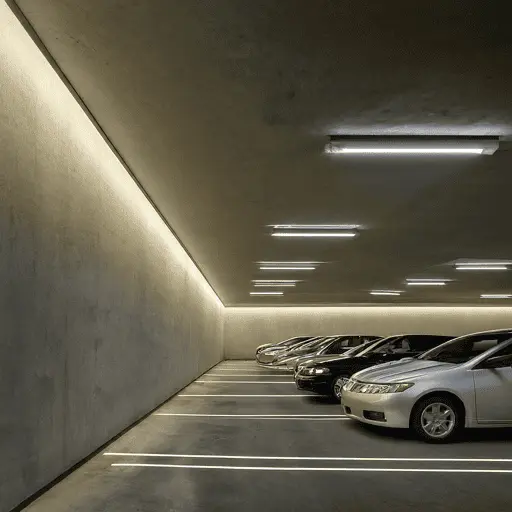
For extended commercial runs, use constant current LED strips (20–50 meters with uniform brightness), 48V DC strips (up to 20 meters with minimal injection), or 120V AC driverless strips (50 meters or more for outdoor facades). Constant current technology regulates current at each LED segment, eliminating the voltage drop problem that plagues standard constant voltage strips.
Constant Current Strips: The Professional's Choice
Standard LED strips use constant voltage (CV) design. The power supply delivers a fixed voltage, and the strip's internal resistors regulate current to each LED cluster. This works well for short runs but fails over distance because voltage drops while the resistors cannot compensate.
Constant current (CC) strips flip this approach. Integrated current regulators on the strip maintain a steady current to each LED segment regardless of minor voltage fluctuations. The result is virtually identical brightness from the first meter to the last, even over runs of 20 to 50 meters.
We have deployed constant current strips in hotel corridor projects spanning 30+ meters in a single continuous run. The brightness uniformity was measured within 3% variation end to end. No power injection was needed. For architects and lighting designers who demand seamless lines of light without visible bright spots or dim zones, constant current is the answer.
The tradeoff? CC strips cost more per meter and require matched constant current drivers rather than generic power supplies. But for commercial projects where quality is non-negotiable, the investment pays for itself in reduced installation labor and zero callback complaints.
48V DC Strips: The Middle Ground
If constant current feels like overkill for your project, 48V DC strips offer a compelling middle ground. They run four times the length of 12V strips and twice the length of 24V strips before voltage drop becomes noticeable. For large open-plan offices, retail spaces, and hospitality lobbies, 48V strips often eliminate the need for multiple injection points entirely.
Our 48V product line has become increasingly popular with German electrical contractors who appreciate the reduced wiring complexity. Fewer injection points means faster installation, fewer junction boxes, and cleaner aesthetics.
120V AC Driverless Strips: Ultra-Long Outdoor Runs
For building facades, perimeter lighting, and outdoor architectural features, 120V AC LED strips can run 50 meters or more from a single connection. They plug directly into mains power (through a simple rectifier/controller) with no external driver needed.
However, AC strips come with important caveats. They operate at dangerous voltage levels, so installation must comply with local electrical codes and typically requires a licensed electrician. They also produce a slight flicker at mains frequency that is imperceptible outdoors but may be noticeable in close-up indoor applications. And they are not compatible with low-voltage dimming systems or smart home ecosystems without specialized controllers.
Comparison: Which Solution Fits Your Project?
| Feature | Constant Current DC | 48V DC | 120V AC Driverless |
|---|---|---|---|
| Max Run Length | 20–50 m | Up to 20 m | 50 m+ |
| Brightness Uniformity | Excellent (±3%) | Good (±8–10%) | Good (±5–8%) |
| Driver Required | Yes (CC driver) | Yes (48V PSU) | No (rectifier only) |
| Dimming Compatibility | Yes (DALI, 0-10V) | Yes (PWM, DALI) | Limited |
| Cost Per Meter | High | Medium-High | Medium |
| Best Application | Hotels, museums, corridors | Offices, retail, lobbies | Facades, outdoor perimeters |
| Safety Voltage | Low (safe touch) | Low (safe touch) | High (requires licensed install) |
Addressable Strips for Long Runs
For projects that need individually controlled color zones over long distances, addressable strips with SPI or DMX protocols are available. But these require data signal repeaters every 5–10 meters in addition to power injection. When we co-develop addressable solutions for our clients, we always include a wiring layout that maps both power and data injection points to prevent signal degradation.
The Trend Toward Higher Voltages
The industry is clearly moving toward 48V and constant current systems for professional applications. These technologies reduce copper usage, simplify installation, improve efficiency, and deliver the uniform output that architects and designers demand. AC driverless strips continue to carve out a strong niche for ultra-long outdoor runs where simplicity and distance matter more than dimming flexibility.
When choosing a solution, match the technology to the project requirements. Short accent runs? 12V or 24V is fine. Medium commercial runs? Go 48V. Long architectural runs demanding perfection? Constant current. Massive outdoor facades? AC driverless. There is no single best answer—only the right answer for your specific installation.
Conclusion
Every LED strip has a physical limit. Exceeding it means dim ends, color problems, overheating, and shortened life. The fix is always the same: segment your power, choose the right voltage, and never fight physics with wishful thinking.
Footnotes
- Compares 24V DC LED strips with other voltages, highlighting benefits. ↩︎
- Provides technical specifications and common applications for 12V DC LED strips. ↩︎
- Guides on selecting the appropriate power supply for LED strip installations. ↩︎
- Explains the fundamental concept of voltage drop in electrical circuits. ↩︎
- Clarifies how wattage per meter impacts LED strip performance and run length. ↩︎
- Describes power injection as a method to maintain consistent brightness in long LED runs. ↩︎
- Explains the characteristics and considerations for RGB and RGBW LED strips. ↩︎
- Discusses the phenomenon of color temperature changes in LED lighting. ↩︎
- Highlights safety concerns and potential fire hazards associated with LED installations. ↩︎
- Details factors influencing LED longevity and performance over time. ↩︎

 English
 Spanish
 German
 Russian
 Arabic
 French
 Portuguese