

Our sales team fields the same question from contractors and distributors worldwide: "How many meters do I actually need to order?"
The typical MOQ for custom LED strip lights ranges from 100 to 3,000 meters, depending on the level of customization. Simple modifications like cut-to-length or connector changes may start at just 10–100 meters, while fully custom PCB designs, private-label packaging, or specialized waterproofing often require 1,000–3,000 meters or more.
That range is wide for a reason. MOQ is not a random policy number. It reflects real manufacturing economics — setup costs, component procurement, and production line efficiency custom LED strip lights 1. Let me walk you through the key factors that shape your actual MOQ, how to negotiate smarter, and when it makes sense to accept a higher minimum.
Can I find a supplier that offers low MOQs for my custom LED strip prototypes?
When we first started working with Australian lighting distributors, many of them needed just 5 or 10 meters to test a concept before committing to a full production run 2. That demand shaped how we built our prototyping workflow 3.
Yes, many suppliers offer low MOQs — sometimes as few as 1 to 20 meters — for prototype or sample orders. The key is to limit your customization to modifications of existing stock products, such as cut length, connector type, or wire tail configuration, rather than requesting a fully new PCB or housing design.
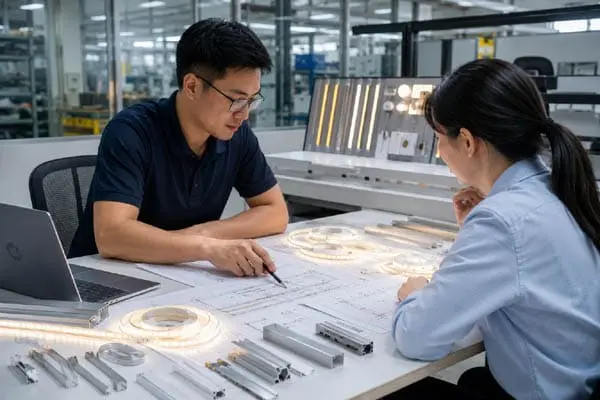
Why Prototyping MOQs Are Different from Production MOQs
A prototype order is fundamentally different from a production run. Factories treat them differently because the cost structure is different. When you ask for 5 meters of a custom-length strip with a specific connector, the factory is modifying an existing product. The PCB is already designed. The LEDs are already on the reel. The assembly line does not need a full changeover.
But if you ask for a brand-new PCB layout, a unique LED density, or a custom waterproof coating for your prototype, the factory must invest engineering time, source new materials, and run test batches. PCB designs 4 That is why some "prototype" requests still carry a 100–300 meter minimum.
What Counts as Light Customization?
Here is a practical breakdown of what most suppliers consider light versus heavy customization:
| Customization Type | Example | Typical Prototype MOQ |
|---|---|---|
| Cut-to-length | 2.5 m strips instead of 5 m reels | 5–20 meters |
| Connector or wire tail change | JST connector instead of bare wire | 10–50 meters |
| Label or sticker on packaging | Your logo on a generic box | 10–50 meters |
| Color temperature selection | 3000K instead of 4000K from stock | 10–100 meters |
| Custom PCB width or layout | 6 mm wide board instead of standard 10 mm | 100–500 meters |
| New waterproof extrusion | Unique silicone sleeve profile | 300–1,000 meters |
Tips for Getting Samples Quickly
From our experience exporting to Germany and Australia, the fastest path to a prototype is to start with a supplier's existing product line. Ask what they already have in stock. Then specify only the changes you need. This approach keeps costs down and turnaround fast — often under two weeks.
If you need a fully bespoke strip, expect the sample to take 3–4 weeks and cost more per meter. That is normal. The supplier is essentially doing a mini production run just for you.
Also, always ask whether sample costs are refundable against a future bulk order. Many mid-to-high-end suppliers, including our team, offer this as standard practice to encourage long-term partnerships.
How will adding my private label to the packaging impact my minimum order requirements?
One of our Australian partners wanted his brand name on every box, every reel label, and even the strip's PCB silkscreen. That single request changed his MOQ from 100 meters to 500 meters overnight.
Adding private-label packaging typically raises your MOQ by 50% to 300% compared to unbranded orders. Simple logo stickers on generic boxes may add little to the minimum, but custom-printed boxes, branded PCB silkscreens, and bespoke packaging inserts often push MOQs to 300–1,000 meters or more because of printing setup costs and minimum material runs.
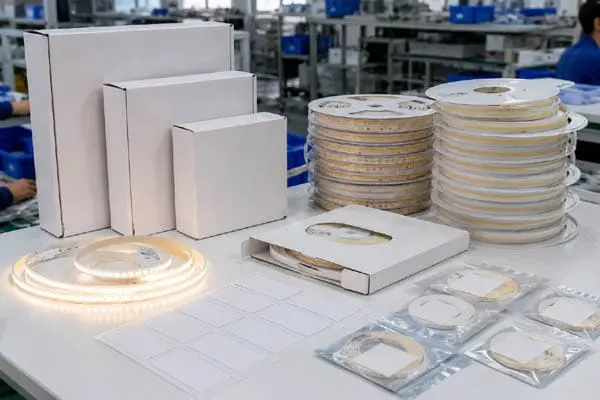
The Hidden Costs Behind a Logo
When you request private-label packaging 5, you are not just adding a sticker. The factory may need to:
- Design and proof a new box layout
- Order a minimum print run from their packaging supplier
- Source custom inserts, foam, or dividers
- Print branded labels for reels and individual strips
- Update QC documentation with your branding
Each of these steps has its own minimum. The box printer might require 500 units. The label printer might require 1,000 sheets. The foam insert supplier might require 200 pieces. Your LED strip MOQ ends up being driven by whichever packaging component has the highest minimum.
Packaging Customization Tiers and Their MOQ Impact
| Packaging Level | What's Included | Typical Added MOQ |
|---|---|---|
| Tier 1: Sticker only | Your logo sticker on a generic white box | +0 to +50 meters |
| Tier 2: Printed sleeve | Custom-printed paper sleeve over generic box | +50 to +200 meters |
| Tier 3: Full custom box | Branded box with your design, colors, and product info | +200 to +500 meters |
| Tier 4: Premium unboxing | Custom box, foam insert, branded reel, instruction card | +500 to +1,000 meters |
| Tier 5: PCB silkscreen branding | Your logo printed directly on the LED strip PCB | +300 to +1,000 meters |
A Smarter Approach: Modular Packaging
Our engineering team often recommends a modular packaging strategy 6 for brands that are still growing. Here is how it works:
You use the factory's generic box. Then you add a custom-printed sleeve or band that wraps around the box. The sleeve carries your brand name, logo, product specs, and website. This approach lets you change designs without reprinting entire boxes. And the MOQ for a paper sleeve is much lower than for a fully custom box.
For the PCB silkscreen, consider whether your end customer will actually see the board. If the strip goes inside an aluminum channel with a diffuser, nobody sees the PCB. In that case, skip the silkscreen branding and save yourself hundreds of meters on the MOQ.
When Private Labeling Is Worth the Higher MOQ
If you are a distributor building a recognizable brand, the investment pays for itself. Branded packaging builds trust with contractors and end users. It also protects your supply chain — competitors cannot easily identify your factory if your product looks unique.
But if you are a design firm ordering strips for a single project, private labeling adds cost and complexity with no return. In that case, stick with unbranded packaging and focus your budget on product quality.
What should I do if my specific project dimensions don't meet the manufacturer's standard MOQ?
We once had a German contractor who needed 73 meters of a very specific 4000K, IP67, 24V strip in a non-standard 8 mm width. The factory's MOQ for that configuration was 300 meters. He almost walked away from the deal.
If your project dimensions fall short of the standard MOQ, you have several practical options: negotiate a higher unit price for a smaller batch, choose a stock product that closely matches your specs, combine your order with other SKUs to meet the factory's total volume threshold, or find a supplier that uses modular PCB platforms to accommodate shorter runs.
Option 1: Pay a Premium for a Short Run
This is the most straightforward solution. Many factories will accept an order below their standard MOQ if you agree to a higher per-meter price. The premium covers the setup costs that would normally be spread across a larger batch.
In practice, this premium ranges from 10% to 40% above the standard unit price. For a high-value project where the strip is a critical component, that premium is often worth paying.
Option 2: Adapt Your Spec to Match a Stock Product
Sometimes the gap between your ideal spec and an off-the-shelf product is smaller than you think. If you need 4000K but the factory has 3800K in stock, the visual difference may be negligible. If you need 8 mm width but the factory has 10 mm on the shelf, check whether the installation channel can accommodate it.
Our technical team regularly helps clients evaluate these trade-offs. A small spec compromise can drop your MOQ from 300 meters to just 10 meters.
Option 3: Bundle Multiple SKUs
Some factories set their MOQ based on total order value or total meters, not per-SKU minimums. If you need 73 meters of one strip and 50 meters of another, the combined 123 meters might meet the factory's threshold.
Ask your supplier whether they allow order bundling. This is especially common among trading companies and assemblers who work with flexible production lines.
Option 4: Find a Supplier with Modular Platforms
This is where sourcing strategy matters most. Factories that use modular PCB platforms — shared board designs that support multiple LED densities, voltages, and color temperatures — can switch between configurations quickly. Their setup costs are lower, so their MOQs are lower.
How to Evaluate Your Options
| Situation | Best Strategy | Expected MOQ Reduction |
|---|---|---|
| Spec is close to a stock product | Adapt to stock specs | 70–90% reduction |
| Budget allows a per-meter premium | Pay premium for short run | 50–80% reduction |
| You need multiple strip types | Bundle SKUs into one order | 30–60% reduction |
| Supplier uses modular PCB platforms | Choose a modular-platform supplier | 40–70% reduction |
| Project is a one-off with unique specs | Negotiate sample pricing or pilot run | Varies widely |
When to Walk Away
Not every supplier is the right fit for every project. If a factory insists on 1,000 meters and your project needs 50, and they will not budge on price or quantity, it is time to look elsewhere. There are suppliers — including our team — that specialize in project-based orders and are built to handle shorter runs without sacrificing quality.
The key is to communicate your full picture early. Tell the factory your project scope, your timeline, and your potential for repeat orders. A smart supplier will see the long-term value and work with you.
How can I negotiate a lower MOQ for high-end LED strips without compromising my unit price?
When we develop high-CRI or tunable-white strips for commercial projects, the component cost per meter is already high. Our clients rightly worry that pushing for a lower MOQ will inflate that cost even further.
To negotiate a lower MOQ without increasing unit price, offer the supplier a credible forecast for future orders, agree to use stock components where possible, consolidate your customization requests, and provide a detailed RFQ that minimizes back-and-forth. Suppliers reward clarity and commitment with flexibility on minimums.

Why High-End Strips Have Higher MOQs
High-end LED strips use premium components: high-CRI LED chips 7 with tight binning, thicker copper PCBs, advanced drivers, and precision waterproofing. Each of these components has its own procurement minimum. A high-CRI LED reel from a reputable manufacturer might come in 3,000-piece reels. A specialized constant-current IC might have a 1,000-unit minimum from the chip supplier. These upstream minimums cascade down to your order.
This means the MOQ for a high-end strip is not just about factory preference. It is about supply chain math.
Negotiation Tactics That Actually Work
Here are strategies that our most successful partners use:
1. Share a 6–12 month forecast. Even if you only need 200 meters now, telling the factory you expect to order 200 meters per quarter gives them confidence. They may accept a lower first-order MOQ because they see the pipeline.
2. Accept standard packaging on the first run. Save your branded packaging for the second or third order when volumes are higher. This removes one of the biggest MOQ drivers without touching the product itself.
3. Choose from the factory's existing LED bins and drivers. If the factory already stocks the 90+ CRI 3000K LEDs you need, the material procurement minimum is already met. You only need enough volume to justify the assembly setup.
4. Provide a complete RFQ upfront. Include voltage, LED density, color temperature, CRI, IP rating 8, strip width, connector type 9, run length, dimming protocol, and target price. A detailed RFQ eliminates quoting rounds and builds trust. Factories give better terms to buyers who clearly know what they want.
5. Offer flexible delivery timing. If the factory can produce your order alongside a similar product for another client, they can share setup costs. Telling them "I'm flexible on lead time" opens this door.
What Not to Do
Do not threaten to go to a competitor. Factories know their market. Ultimatums rarely work and damage the relationship. Also, do not ask for a lower MOQ and a lower price at the same time. Those are opposing forces. Pick one to negotiate.
The Real Cost of Pushing MOQ Too Low
There is a floor below which even the most flexible factory cannot go without cutting corners. If a supplier agrees to produce 20 meters of a high-end custom strip at standard pricing, ask yourself: are they absorbing the cost, or are they substituting cheaper components?
In high-end LED lighting, consistency matters enormously. Color variance between batches, uneven brightness across a long run, or premature waterproofing failure — these problems often trace back to a factory that accepted an uneconomic order size and compensated by skimping somewhere.
The smartest approach is to find the sweet spot. A quantity that is low enough to manage your cash flow and inventory risk, but high enough that the factory can produce profitably with quality materials.
Quick-Reference: MOQ Negotiation Checklist
Before you send your next RFQ, make sure you can answer these questions:
- What is my total annual volume forecast 10?
- Which components must be custom, and which can be stock?
- Am I flexible on delivery timing?
- Can I defer branding to a later order?
- Do I have a clear, detailed specification ready?
- Am I comparing suppliers with compatible production models?
If you check all six boxes, you are in a strong position to negotiate a lower MOQ without sacrificing unit price or product quality.
Conclusion
MOQ is not a fixed rule — it is a reflection of manufacturing economics, customization scope, and supplier capability. Understanding the cost drivers behind your specific order puts you in control of the negotiation and helps you source smarter.
Footnotes
- Provides an overview of the manufacturing process and components of LED strip lights. ↩︎
- Defines a production run as a manufacturing process for continuous production of identical items. ↩︎
- Outlines the key phases and importance of a structured prototyping workflow in product development. ↩︎
- Replaced with an authoritative guide on PCB layout best practices. ↩︎
- Defines private labeling and discusses its implications for product development and branding. ↩︎
- Explains the benefits of modular packaging systems for flexibility and efficiency in manufacturing. ↩︎
- Replaced with an authoritative Wikipedia article on 'High-CRI LED lighting'. ↩︎
- Provides information on the International Electrotechnical Commission (IEC) standard for Ingress Protection (IP) codes. ↩︎
- Details different types of LED strip connectors and their applications for installation. ↩︎
- Discusses various methods and the importance of forecasting in supply chain management. ↩︎


 English
 Spanish
 German
 Russian
 Arabic
 French
 Portuguese