
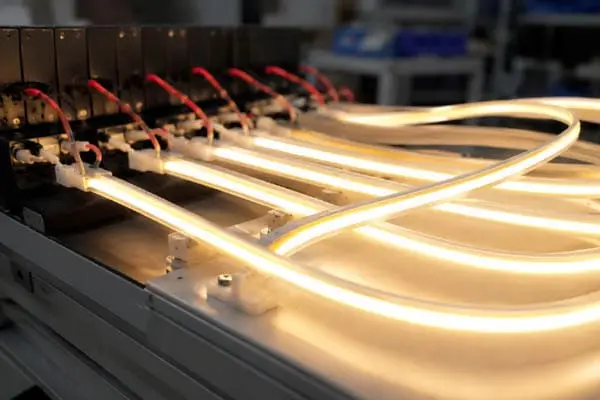
Every week on production line, we test LED strips under accelerated aging conditions 1. One question comes up more than any other from buyers and contractors alike: how long will these strips actually last?
Most quality LED strip lights last between 25,000 and 50,000 hours. That translates to roughly 8 to 17 years at 8 hours of daily use. However, real-world lifespan depends heavily on heat management, power supply quality, installation practices, and the operating environment. LEDs do not burn out suddenly—they gradually dim over time.
But a number on a spec sheet only tells part of the story. The gap between rated hours and actual usable life is often wider than people expect. Below, we break down the factors that matter most—and what you can do to get the longest possible service from your LED strips.
How can I maximize the lifespan of my LED strips in demanding commercial environments?
We ship project-grade strips to contractors in Germany and Australia who install them in shopping centers, hospitality venues, and office buildings. The number one concern we hear is not price—it is whether the product will hold up under heavy daily use.
To maximize LED strip lifespan in commercial settings, use premium-grade strips with proper aluminum heat sinks, a correctly rated power supply, and controlled run lengths with power injection. Avoid enclosed installations without ventilation, and schedule dimming during off-peak hours to reduce thermal stress on LED chips.
Understanding Rated Hours vs. Real-World Hours
LED strip manufacturers, including our own team, rate products under controlled lab conditions. A "50,000-hour" rating means the LEDs maintained acceptable output during standardized testing. In a busy restaurant running strips 16 hours a day, conditions are far from a lab. Dust, grease, heat from kitchens, and vibration all take a toll.
The industry uses L70 as a standard benchmark 2. L70 means the strip has dropped to 70% of its original brightness. At that point, the strip still works, but it may no longer be bright enough for the task. Some specifiers prefer L80 or even L90 for critical applications like retail displays where brightness consistency matters.
Practical Steps for Commercial Installations
Here are the most impactful things contractors can do:
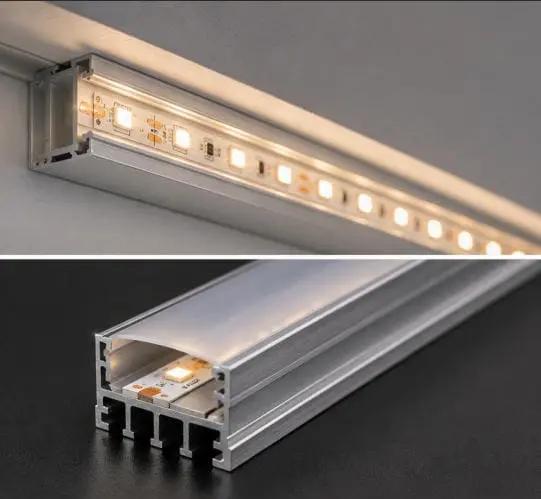
- Mount strips on aluminum profiles. Aluminum channels act as heat sinks and draw heat away from the LEDs. This single step can extend life by 30% or more.
- Use power injection on long runs. Voltage drop over long distances causes uneven brightness and overheats the LEDs closest to the power source. Injecting power at multiple points solves this.
- Match the power supply carefully. The driver should supply 20% more wattage than the strip draws. Running a driver at full capacity generates excess heat and shortens both the driver's and the strip's life.
- Dim when possible. Dimming reduces current, which reduces heat. A strip running at 70% brightness lasts significantly longer than one at 100%.
Lifespan Ranges by Product Tier
| Product Tier | Typical Rated Lifespan | Real-World Estimate (8 hrs/day) | Common Use Cases |
|---|---|---|---|
| Budget | 10,000–20,000 hours | 3–7 years | Temporary displays, hobbyist projects |
| Mid-range | 25,000–35,000 hours | 8–12 years | Residential, light commercial |
| Premium | 50,000+ hours | 15–17+ years | Hospitality, retail, architectural |
Keep in mind, these estimates assume decent installation and a stable power supply. A premium strip installed poorly can underperform a mid-range strip installed well.
Smart Controls Help Too
Smart lighting controllers let you schedule on/off times, set dimming curves, and avoid running strips at full brightness 24/7. In commercial environments, this is a simple but powerful way to extend useful life without sacrificing the lighting design.
Why do some of my LED strips experience color shift or dimming sooner than expected?
Our quality control team runs batch-to-batch consistency tests before any order ships. Even so, we occasionally hear from clients who report that strips installed just a year or two ago are already noticeably dimmer or have shifted in color. The culprit is almost never a single cause.
Premature color shift and dimming in LED strips usually result from a combination of overdriving, poor thermal management, low-quality phosphor coatings, and mismatched power supplies. Even well-made strips degrade faster if installed in enclosed spaces without airflow or powered beyond their rated current.
What Causes Color Shift?
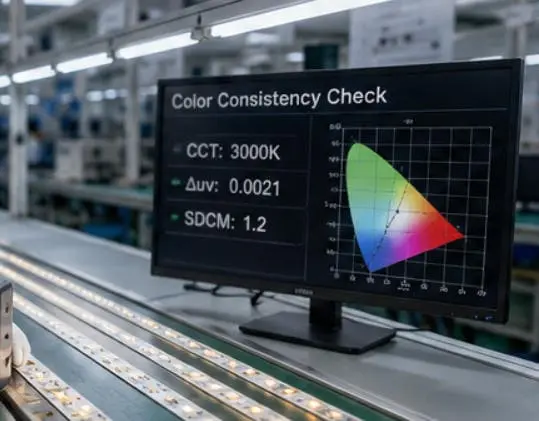
Color shift 3, measured by the metric delta u'v', happens when the phosphor layer 4 on white LEDs degrades. This is a chemical process accelerated by heat. Blue light from the LED chip passes through a phosphor coating to produce white light. As the phosphor breaks down, the color temperature drifts—often toward blue or green tones.
Cheap phosphor compounds degrade faster. This is one reason why budget strips from unknown factories often look noticeably different after 6 to 12 months, even in mild indoor environments. On our production line, we specify phosphor formulations and bin LEDs tightly to minimize this problem, but the physics of phosphor degradation still applies.
What Causes Premature Dimming?
Dimming before expected is usually about heat. When the LED junction temperature 5 runs too high for too long, the semiconductor material degrades. This reduces light output gradually.
Common causes include:
- Running strips in recessed channels with no ventilation
- Using an undersized or poorly regulated power supply
- Exceeding the recommended strip length without power injection 6
- Installing strips on surfaces that absorb and trap heat, like wood or insulated ceilings
The Role of Drive Current
Every LED has an optimal operating current. Exceeding it—even slightly—pushes the junction temperature higher and accelerates both dimming and color shift. Some cheap drivers fluctuate in output, causing periodic over-current spikes that are invisible to the installer but damaging over time.
Color Shift vs. Dimming: A Comparison
| Issue | Primary Cause | When It Becomes Noticeable | How to Prevent |
|---|---|---|---|
| Color shift | Phosphor degradation from heat | Often within 1–3 years on budget strips | Use high-quality LED chips; manage heat |
| Dimming (lumen depreciation) | Semiconductor degradation from heat and overcurrent | Gradual; defined by L70 threshold | Proper thermal management; correct power supply |
| Uneven brightness along strip | Voltage drop on long runs | Immediate or within weeks | Power injection at regular intervals |
| Yellowing of encapsulation | UV exposure or heat on silicone/resin coating | 1–2 years outdoors or in high-heat areas | Use UV-stable materials; appropriate IP rating |
Dynamic Effects and Their Impact
Rapid color cycling, strobing, and frequent on-off switching put additional electrical stress on both the LED chips and the control circuitry. If your project involves dynamic effects, choose strips and controllers rated for that purpose. Static white installations are the gentlest on LED longevity.
What role does heat management play in the longevity of my high-voltage LED installations?
When we develop high-voltage LED strip solutions—like our AC220V or DC48V long-run products—thermal design is the first engineering conversation, not the last. High-voltage strips push more power through the circuit, and without careful thermal planning, that power turns into the one thing LEDs hate most: heat.
Heat is the single biggest factor determining how long your LED strips will last. Every 10°C increase in operating temperature roughly halves the LED chip's useful life. High-voltage installations generate more heat per unit length, making aluminum mounting surfaces, adequate ventilation, and proper derating essential for achieving the rated 50,000-hour lifespan.
Why Heat Matters So Much
LEDs convert electricity into light and heat. Even the most efficient LEDs still produce waste heat at the junction—the tiny point where the semiconductor emits photons. If that heat is not conducted away, the junction temperature climbs. Higher junction temperatures cause:
- Faster lumen depreciation
- Accelerated phosphor breakdown (color shift)
- Increased risk of solder joint failure
- Shortened driver and resistor life
The relationship between temperature and lifespan is not linear. It is exponential. A strip running at 85°C might last half as long as the same strip running at 75°C.
Thermal Management Methods
There are several proven ways to manage heat:
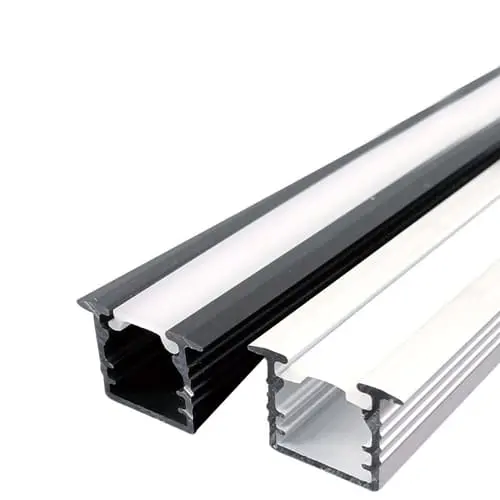
Aluminum extrusion profiles are the gold standard. They act as passive heat sinks and can reduce LED junction temperature by 10–20°C compared to mounting directly on drywall or wood.
Ventilated channels allow hot air to escape. If you must recess strips into a ceiling or cove, make sure there is an air gap. Sealed, insulated cavities are the worst-case scenario for heat.
Derating means running the strip below its maximum rated power. If a strip can handle 14.4 W/m, running it at 10 W/m keeps temperatures lower and extends life substantially.
Temperature Impact on LED Lifespan
| Junction Temperature | Estimated Lifespan Multiplier | Practical Notes |
|---|---|---|
| 55°C or below | 1.5x–2x rated life | Ideal; achievable with aluminum profiles 7 and ventilation |
| 65°C | ~1x rated life | Normal operating range for quality strips |
| 75°C | ~0.6x–0.7x rated life | Common in enclosed or poorly ventilated installs |
| 85°C and above | ~0.3x–0.5x rated life | High risk; premature failure likely |
These multipliers are approximate and vary by LED chip model. But the trend is consistent across all manufacturers.
High-Voltage Strips and Heat
High-voltage strips (such as AC 220V or DC 48V) allow much longer run lengths without voltage drop. That is their key advantage for large commercial or architectural projects. However, because more power flows through a single strip, heat density can be higher.
Our engineering team addresses this by spacing LED chips more generously on high-voltage PCBs and using thicker copper traces to reduce resistive heating. But the installer's side matters just as much. If a 50-meter high-voltage run is pressed flat against an unventilated wooden soffit, no amount of PCB engineering will save it from heat damage.
The Power Supply Factor
A stable, efficient power supply generates less waste heat itself and delivers cleaner current to the strip. Low-quality drivers often run hot, which raises the ambient temperature inside enclosed driver compartments. That extra heat radiates to the strips. Always choose a driver rated for at least 80% efficiency, and mount it in a ventilated location separate from the strips when possible.
How do I choose the right IP rating to ensure my outdoor LED strips reach their full life expectancy?
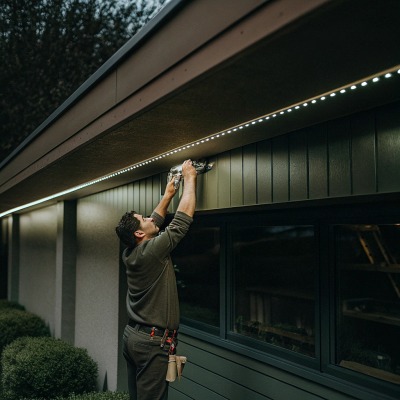
We export IP65, IP67, and IP68 strips for projects ranging from building facades in Melbourne to garden installations in Hamburg. Choosing the wrong IP rating is one of the fastest ways to kill an outdoor LED strip—but choosing too high a rating without considering heat tradeoffs can also shorten life. It is a balancing act.
Select IP65 for sheltered outdoor areas like covered patios and soffits, IP67 for exposed installations subject to rain and direct weather, and IP68 for submersible or ground-level applications. The right IP rating prevents moisture intrusion that causes corrosion and short circuits, but overly thick encapsulation can trap heat, so always pair waterproofing with thermal management.
What IP Ratings Mean for LED Strips
IP stands for Ingress Protection 8. The two-digit number tells you how well the product resists solids (first digit) and liquids (second digit).
- IP20 — No water protection. Indoor use only.
- IP54 — Protected against splashes from all directions. Light outdoor use under cover.
- IP65 — Protected against low-pressure water jets. Suitable for sheltered outdoor areas.
- IP67 — Can withstand temporary submersion up to 1 meter. Good for exposed outdoor use.
- IP68 — Suitable for continuous submersion. Used in pools, fountains, and in-ground applications.
The Waterproofing vs. Heat Tradeoff
This is the tension many buyers overlook. To achieve IP67 or IP68, strips are coated or encased in silicone, PU resin, or placed inside silicone tubes. These materials are excellent at blocking water. But they also act as thermal insulators.
A strip inside a silicone tube generates the same heat as a bare strip, but the heat has nowhere to go. Junction temperatures climb, and all the problems discussed in the heat management 9 section apply.
The solution is to combine waterproofing with thermal management. Mount IP67 strips on aluminum profiles. Choose potting compounds with better thermal conductivity. And never over-specify—if the strip is under a covered porch and will never see direct rain, IP65 with nano-coating may perform better long-term than IP68 full encapsulation.
IP Rating Selection Guide
| Installation Environment | Recommended IP Rating | Key Risk If Under-Specified | Key Risk If Over-Specified |
|---|---|---|---|
| Indoor, dry | IP20 | N/A | Unnecessary cost |
| Indoor, humid (bathroom, kitchen) | IP54–IP65 | Moisture corrosion on PCB | Heat buildup from coating |
| Outdoor, sheltered (soffit, covered patio) | IP65 | Rain splash damage | Excessive heat trapping |
| Outdoor, fully exposed | IP67 | Water intrusion and failure | Slight heat trapping; manageable with aluminum |
| Submerged (pool, fountain, in-ground) | IP68 | Immediate water damage and safety hazard | Thermal issues; must use low-power or actively cooled strips |
UV Exposure and Material Degradation
Outdoor strips face UV radiation from sunlight. Over time, UV breaks down silicone and plastic encapsulation materials, causing yellowing, cracking, and eventual moisture intrusion. High-quality outdoor strips use UV-stabilized materials 10 that resist this degradation. Budget strips often use standard silicone that turns brittle after a year or two of sun exposure.
When specifying outdoor strips, ask your supplier about UV resistance of the encapsulation material. On our side, we use UV-stable silicone for all IP65+ products destined for exposed outdoor installations.
Connections and End Caps Are Weak Points
Even an IP68 strip can fail if the end caps or wire connections are not properly sealed. Water finds the weakest point. Every connection joint, every cut-and-resolder point, and every power entry must be sealed with appropriate waterproof connectors or potting compound. We include detailed sealing instructions and recommend heat-shrink waterproof connectors for field terminations.
Conclusion
LED strip lights typically last 25,000 to 50,000 hours—but only when heat, power, and installation are handled correctly. Choose quality products, manage thermals, and match IP ratings to your environment for the longest possible life.
Footnotes
- The article from Hongzhun Lighting explicitly discusses subjecting LED lights to 'accelerated aging tests under controlled conditions to simulate long-term usage' to determine L70 values, directly matching the anchor text and context. ↩︎
- Wikipedia provides a clear and authoritative explanation of 'Lumen maintenance' and states that 'Useful lifetime estimates for LED lighting products are typically given in terms of the expected operating hours until light output has diminished to 70% of initial levels (denoted L 70 life)'. ↩︎
- Explains color shift as a deviation from original color, often due to phosphor degradation and heat. ↩︎
- Describes the function of the phosphor layer in converting blue light to white light in LEDs. ↩︎
- Luxeon Star LEDs provides a concise and accurate definition of 'junction temperature' as the temperature at the LED's light-emitting diode, and states its critical impact on performance, efficiency, and lifespan. ↩︎
- Details power injection as a technique to counteract voltage drop and ensure consistent brightness. ↩︎
- Explains how aluminum channels function as heat sinks and provide protection for LED strips. ↩︎
- J.W. Speaker's article introduces 'Ingress Protection (IP) ratings' as a system established by the International Electrotechnical Commission (IEC) to classify protection levels against solids and liquids, which is a comprehensive explanation for the anchor text. ↩︎
- Comprehensive overview of thermal management in high-power LEDs, its importance, and methods. ↩︎
- Discusses the use of UV-stabilized materials to resist degradation from UV radiation in outdoor LED applications. ↩︎

 English
 Spanish
 German
 Russian
 Arabic
 French
 Portuguese