
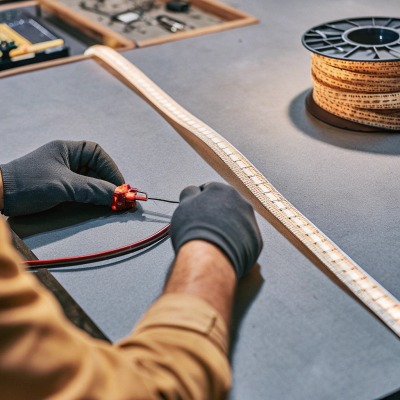
Every year, our team handles dozens of QC disputes that could have been avoided with proper testing before shipment incoming material inspection 1. The problem is real: LED strips look fine on day one, then fail within weeks. The cost of field returns, reinstallation, and lost trust is far greater than the cost of rigorous factory testing.
Factory quality control for LED strip lights requires a layered system of tests covering incoming material inspection, in-process SMT checks, electrical and optical performance verification, aging and burn-in testing, waterproof and environmental stress validation, mechanical durability trials, and safety compliance certification before shipment.
This guide breaks down every major test category, explains why each one matters, and shows you exactly what to ask your supplier. Whether you are a contractor sourcing waterproof strips for an outdoor facade or a distributor building a private-label line, these are the tests that separate reliable LED strips from costly failures.
How do I verify that my LED strips will maintain perfect color consistency across multiple batches?
Batch-to-batch color variance is the single biggest complaint we hear from distributors and lighting designers sourcing from new suppliers. One roll looks warm white. The next roll from the same order looks slightly pink. Side by side on a ceiling cove, the difference is impossible to hide.
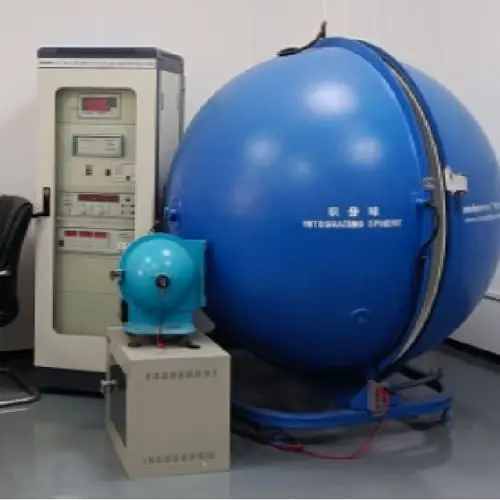
To maintain perfect color consistency across batches, factories must use tight LED binning at incoming inspection, verify correlated color temperature and SDCM values with integrating sphere measurements on every production lot, and maintain traceable binning records that link each roll to its LED reel source.
Why Color Inconsistency Happens
LED chips are semiconductors. Even from the same wafer, individual LEDs vary slightly in wavelength, brightness, and forward voltage. LED manufacturers sort chips into "bins" based on these parameters. A factory that mixes bins — or buys from multiple LED suppliers without tracking — will produce strips that look different roll to roll.
The problem compounds when you order multiple batches over several months. If the factory does not lock in a specific bin code and maintain purchasing continuity, your second order may not match your first.
Incoming Inspection for LEDs
Good factories inspect LED reels before they enter production. They check bin codes, date codes, and supplier certificates. They also spot-test a sample of LEDs from each incoming reel using a spectrometer or integrating sphere to confirm that the actual color temperature and wavelength match the datasheet.
On our production line, we require LED suppliers to provide SDCM (Standard Deviation of Color Matching) 2 data for every reel. We reject reels that exceed our tolerance, even if the supplier's own spec sheet calls them acceptable.
Optical Testing During and After Production
Once strips are assembled, optical testing confirms the final result. The most important measurements are:
| Parameter | What It Measures | Acceptable Range (Architectural Grade) |
|---|---|---|
| CCT (Correlated Color Temperature 3) | Warm, neutral, or cool tone | ±100K of target value |
| SDCM (MacAdam Ellipse Step) | Color point consistency | ≤3 steps for premium; ≤5 for standard |
| CRI (Color Rendering Index) 4 | Color accuracy under the light | ≥90 for retail/hospitality; ≥80 general |
| Luminous Flux (lm/m) | Brightness per meter | Within ±10% of rated spec |
| Chromaticity Coordinates (x, y) | Exact color point on CIE diagram | Per agreed binning window |
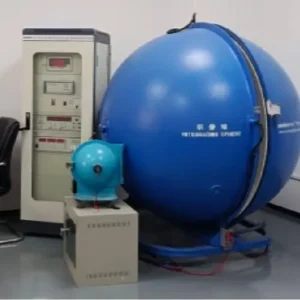
Factories use integrating spheres and spectrophotometers to capture these values. A quick power-on visual check is not enough. Two strips can look "close enough" to the naked eye but measure two or three MacAdam steps apart — a difference that becomes obvious on a long architectural run.
What to Ask Your Supplier
Request the SDCM data for each production batch. Ask whether they use single-bin or multi-bin LEDs. Ask for the integrating sphere test report, not just a product datasheet. If you are running a private-label line, negotiate a color consistency agreement that specifies the maximum allowable CCT deviation and SDCM step between batches. This one step prevents more field complaints than almost any other QC measure.
Traceability Is Key
A strong factory links every finished roll to its LED reel batch number, production date, and test result. If a problem appears months later, they can trace backward and identify the root cause. Without this traceability, you are guessing.
Which waterproof and IP-rating tests are essential for my outdoor project's long-term reliability?
When we first started supplying LED strips for outdoor facades in Australia, we learned a hard lesson. A product that passed a quick water splash test in the factory leaked within three months of coastal installation. Salt air, UV exposure, and thermal cycling 5 broke down the silicone seal faster than anyone expected.
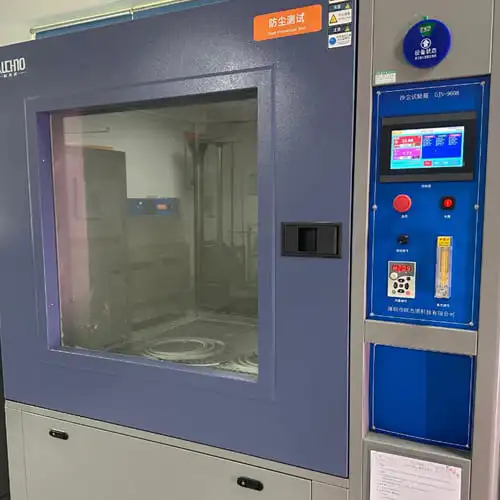
Essential waterproof tests for outdoor LED strips include IP-rated water ingress testing per IEC 60529, salt spray corrosion testing, UV aging exposure, thermal cycling with humidity, adhesive peel strength after environmental conditioning, and end-cap and connector seal verification under immersion pressure.
Understanding IP Ratings
IP stands for Ingress Protection 6. The two digits after "IP" tell you how well the product resists solids (first digit) and liquids (second digit). For LED strips, the most common ratings are:
| IP Rating | Protection Level | Typical Use |
|---|---|---|
| IP20 | No water protection | Indoor dry locations |
| IP54 | Splash-resistant | Sheltered outdoor, bathroom ceilings |
| IP65 | Protected against water jets | Outdoor signage, covered patios |
| IP67 | Protected against temporary immersion | Ground-level outdoor, garden paths |
| IP68 | Protected against continuous submersion | Pools, fountains, underground |
The test methods come from IEC 60529 7. For IP65, the strip is sprayed with water jets from all angles. For IP67, it is immersed in water at a defined depth for 30 minutes. For IP68, the manufacturer and buyer agree on a depth and duration that exceeds IP67.
Beyond the IP Test: Real-World Durability
An IP67 lab test uses clean, room-temperature fresh water. Your outdoor installation faces rain, salt air, UV radiation, temperature swings from freezing to 50°C, and years of exposure. A strip that passes IP67 in the lab may still fail outdoors if the encapsulation material degrades under UV, if the adhesive loses bond strength in heat, or if thermal expansion cracks the silicone sleeve.
That is why responsible factories run additional environmental tests alongside the IP test:
Salt Spray Testing
Salt spray (also called salt fog) testing simulates coastal and marine environments. Salt spray testing 8 Strips are placed in a chamber with a 5% NaCl solution mist at 35°C for 24 to 96 hours, depending on the target standard. After the test, inspectors check for corrosion on solder joints, connector pins, and copper traces. This test is critical for any project near the ocean.
UV Aging
Silicone sleeves, epoxy coatings, and PU potting compounds can yellow, crack, or become brittle under UV exposure. UV aging tests use accelerated UV lamps to simulate months or years of sun exposure in days. After the test, the factory checks for discoloration, surface cracking, and any change in light transmission.
Thermal Cycling with Humidity
This test alternates the strip between high temperature and high humidity (e.g., 85°C / 85% RH) and low temperature (e.g., -20°C). Repeated cycles stress every material interface — solder joints, adhesive layers, silicone bonds, and connector seals. Failures show up as moisture ingress, delamination, or cracked encapsulation.
Connector and End-Cap Integrity
Many waterproof strip failures happen at the ends or at cut-and-rejoin points. Factories should test end caps and connectors separately under immersion to confirm they hold their seal. In our experience, this is the most overlooked weak point in waterproof strip QC.
What to Request
Ask your supplier for the actual IP test report from a third-party lab, not just a self-declared rating. For coastal or harsh outdoor projects, also ask about salt spray hours, UV aging results, and thermal cycling protocols. If they cannot provide these, the IP rating alone does not guarantee long-term outdoor reliability.
How can I be sure the factory's aging and thermal tests will prevent light decay in my high-voltage installations?
Heat is the silent killer of LED strips. We have seen perfectly assembled strips lose 30% of their brightness within a year because the customer installed them in an unventilated aluminum channel with no thermal pathway. But the factory's job is to make sure the strip itself can handle its own heat generation under rated conditions — and aging tests are how that is proven.
To prevent light decay, factories must conduct extended burn-in aging tests (typically 8–24 hours at full power), high-temperature operational testing, thermal cycling, and lumen maintenance sampling. These tests catch weak solder joints, unstable drivers, and LEDs prone to early degradation before the product ships.
What Aging Tests Actually Do
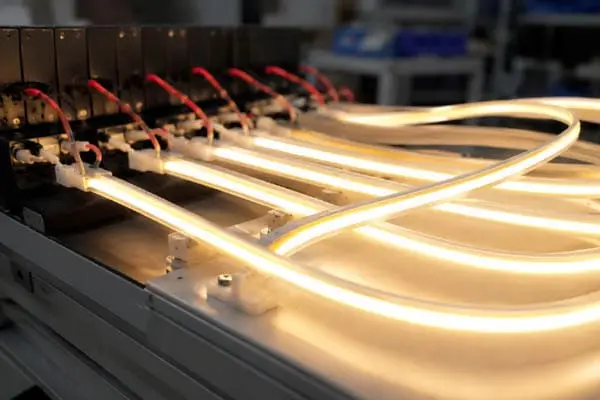
Aging, or burn-in, means powering the finished LED strip continuously for a set period and monitoring it for failures. The logic is simple: most electronic component failures follow a "bathtub curve." Weak parts fail early. If a strip survives 8 to 24 hours of continuous operation at full rated power, it has passed through the infant mortality zone.
During aging, factory technicians watch for dead LEDs, flickering, color shift, dimming, overheating, solder joint failure, and driver instability. High-voltage AC strips deserve special attention because they operate at 110V or 220V, generating more heat per unit length and placing greater stress on insulation and driver components.
Thermal Testing for High-Voltage Strips
High-voltage LED strips are used for long architectural runs — sometimes 50 meters or more without a separate external driver. The integrated rectifier and current-limiting components generate heat that adds to the LED junction temperature. Thermal testing must verify that:
- The strip surface temperature stays within the rated limit at full power in still air.
- No component exceeds its maximum junction temperature.
- After hours of operation, brightness does not drop beyond a defined threshold.
Factories use thermal imaging cameras and thermocouples to measure surface and component temperatures during aging. If a design runs too hot, the engineering team adjusts the current, PCB copper weight, or component layout before the product is approved for mass production.
Lumen Maintenance and Accelerated Life Testing
True lumen maintenance testing 9 (measuring how much brightness remains after thousands of hours) takes a long time. Most factories cannot wait 6,000 hours before shipping. Instead, they use accelerated life testing: running strips at elevated temperatures (e.g., 55°C or 85°C ambient) for shorter periods to predict long-term decay.
The industry benchmark for LED life is often referenced at the point where output drops to 70% of initial lumens. While factories rarely run the full duration test for every batch, they should have qualification data from the product development stage and use batch aging as a screen.
Comparing Aging Protocols
| Aging Type | Duration | Conditions | Purpose |
|---|---|---|---|
| Standard burn-in | 8–12 hours | Full rated power, room temperature | Catch infant mortality defects |
| Extended burn-in | 24–72 hours | Full rated power, room temperature | Higher confidence for premium products |
| High-temperature aging | 8–24 hours | Full power at 55°C–85°C ambient | Simulate worst-case thermal stress |
| Thermal cycling | 100–500 cycles | -20°C to +70°C, rapid transitions | Stress solder, adhesive, encapsulation |
| Accelerated lumen decay | 1,000+ hours (sample) | Elevated temperature and current | Predict long-term brightness retention |
What High-Voltage Buyers Should Ask
If you are specifying high-voltage strips for a 50-meter commercial run, ask for the aging test duration, the ambient temperature during the test, and the pass/fail criteria. Ask whether every roll is aged or only samples. Ask for thermal images showing the hottest points on the strip at full power. A factory that cannot provide this data is skipping a test that directly determines whether your installation will look good in year three.
Also consider that aging and thermal testing only validate the product under controlled conditions. Real installations introduce variables — channel ventilation, ambient temperature, power supply quality, and run length. A good supplier will also provide installation guidance to protect the thermal performance their factory tests have validated.
What quality control documentation do I need to see to ensure my custom-branded products meet international standards?
When our clients in Germany or Australia submit LED strips for project approval, the question is never just "does it work?" The question is "can you prove it meets the standard?" We have seen shipments delayed at customs because a supplier provided a generic CE certificate that did not match the actual product model. Documentation is not paperwork for its own sake. It is the bridge between factory quality and market access.
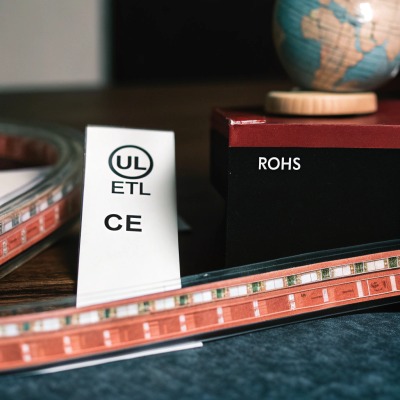
For custom-branded LED strips to meet international standards, you need product-specific test reports for electrical safety (e.g., LVD/IEC 62031), EMC compliance, RoHS/REACH declarations, IP test certificates, photometric data from an accredited lab, a Declaration of Conformity, and batch-level QC inspection records with traceability.
The Documentation Stack
Think of QC documentation as layers. Each layer answers a different question for a different audience — customs, building inspectors, project specifiers, or your own procurement team.
Safety and Compliance Certificates
These are the non-negotiable documents for legal market entry:
- CE Marking (EU/EEA): Requires compliance with the Low Voltage Directive (LVD) and EMC Directive. The factory or an authorized representative issues a Declaration of Conformity backed by test reports.
- RCM Mark (Australia): Requires compliance with relevant electrical safety and EMC standards, registered through the Australian EESS system.
- UL/ETL Listing (North America): Requires third-party testing and ongoing factory audits by the certification body.
- FCC (USA): Covers electromagnetic emissions for electronic products.
- UKCA (UK): Post-Brexit equivalent of CE for the British market.
Each certificate must match the exact product model, voltage, and configuration you are importing. A generic certificate covering "LED strip lights 10" without a specific model number is a red flag.
Chemical and Environmental Compliance
- RoHS Declaration: Confirms restricted substances (lead, mercury, cadmium, etc.) are below legal limits. Required for the EU and many other markets.
- REACH SVHC Declaration: Confirms compliance with the EU's chemicals regulation. Especially important for products containing silicone, adhesive, or PVC.
Photometric and Performance Reports
These prove the product does what the datasheet claims:
- Integrating sphere test report: Shows luminous flux, CCT, CRI, efficacy, and chromaticity coordinates.
- LM-80 data (for the LED component): Provides lumen maintenance data from the LED chip manufacturer, used to project strip-level lifespan.
- Power and electrical test report: Confirms voltage, current, wattage, power factor, and insulation resistance.
Batch-Level QC Records
For project-grade procurement, ask for inspection records from the specific production batch you are buying. These include:
| Document | What It Shows | Why It Matters |
|---|---|---|
| Incoming Quality Control (IQC) report | LED bin codes, FPC copper thickness, component lot numbers | Proves raw materials were verified |
| In-Process Quality Control (IPQC) report | SMT placement accuracy, solder quality, reflow profile | Proves assembly was monitored |
| Final Quality Control (FQC) report | Electrical pass/fail, optical measurements, visual inspection | Proves finished product was tested |
| Aging test record | Duration, conditions, pass rate, failure details | Proves burn-in was performed |
| AQL sampling report | Defect counts by category, accept/reject decision | Proves shipment was statistically inspected |
Traceability and Labeling
Your custom-branded product should carry a label or data matrix code that traces back to the production batch, LED bin, and test results. If a problem arises on-site six months later, traceability lets you and your supplier investigate without guesswork.
Automated Optical Inspection (AOI)
Modern factories use AOI systems during SMT assembly to catch microscopic solder defects, misaligned components, and missing LEDs. Ask your supplier whether they use AOI and whether the AOI results are recorded per batch. This is an increasingly important quality gate, especially for high-density COB strips where manual inspection cannot catch every defect.
Sustainability and Material Transparency
Buyers in Europe and Australia increasingly ask about sustainability. This may include energy consumption during manufacturing, recyclable packaging, and lifecycle assessment data. While not yet mandatory for most LED strip imports, it is a growing expectation for premium brands and public-sector projects.
Red Flags in Documentation
Watch out for test reports that list a different factory name than your supplier, certificates that expired years ago, and "self-certified" claims with no supporting lab report. A trustworthy supplier provides current, product-specific, and traceable documentation without hesitation.
Conclusion
Factory quality control for LED strip lights is not a single test — it is a layered defense system. From incoming LED binning to final aging and compliance documentation, every step protects your project from costly field failures. Ask for the data. Verify the reports. Build partnerships with suppliers who treat QC as a system, not a checkbox.
Footnotes
- Explains the process and importance of incoming quality control in manufacturing. ↩︎
- Explains MacAdam ellipses and SDCM as a metric for color consistency in lighting. ↩︎
- Defines CCT and its relevance in lighting, measured in Kelvin. ↩︎
- Defines CRI and its importance for color accuracy and how light reveals object colors. ↩︎
- Explains thermal cycling for assessing electronic component reliability and stress. ↩︎
- Provides the official definition and explanation of IP codes from the IEC. ↩︎
- Details the international standard for Ingress Protection ratings and test methods. ↩︎
- Describes the ASTM standard method for evaluating corrosion resistance in materials. ↩︎
- Introduces the IES standards for measuring LED lumen maintenance over time. ↩︎
- Provides a general overview and definition of LED strip lights. ↩︎


 English
 Spanish
 German
 Russian
 Arabic
 French
 Portuguese