
When we review color samples from new LED chip batches, and the difference between a CRI 80 strip and a CRI 95 strip is striking—even to the untrained eye LED strip lights 1. Color Rendering Index (CRI) 2 You might have experienced this frustration yourself: you install LED strips in a beautiful retail space or a luxury home, and everything looks flat, washed out, and cheap. The culprit is almost always poor color rendering. Colors that should pop—rich reds, warm skin tones, vibrant fabrics—turn muddy and grey under low-CRI light. It is the silent quality killer in lighting projects.
Color Rendering Index (CRI) directly determines how accurately LED strip lights reproduce the true colors of objects. Higher CRI values (90+) deliver vibrant, lifelike illumination ideal for architectural and commercial applications, while lower CRI (<80) produces dull, muted colors that diminish the perceived quality of any space.
In the sections below, we will break down exactly why CRI matters for your projects, how it affects design consistency, whether it helps you win bids, and how to keep it stable across large orders. Let's get into the details.
Why should I prioritize high CRI for my high-end architectural lighting projects?
When we supply LED strips for hospitality and museum projects in Germany and Australia, the first specification our clients ask about is CRI—before lumens, before wattage.
High CRI (90+) is essential for high-end architectural lighting because it renders materials, finishes, and skin tones with natural accuracy. It makes stone, wood, fabric, and artwork appear rich and authentic, elevating the perceived luxury of any architectural space far beyond what low-CRI lighting can achieve.

What CRI Actually Measures
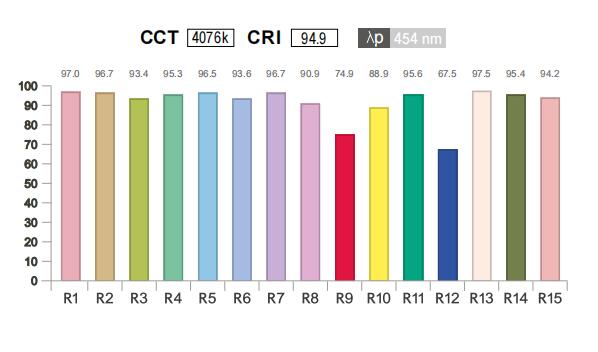
CRI is a 0–100 scale. It compares how colors look under a given light source versus how they look under a reference light 3 (natural sunlight or incandescent at 100 CRI). The higher the number, the more faithfully colors are reproduced. A CRI of 100 means perfect color accuracy.
The standard CRI (Ra) is calculated using the average of 8 test color samples (R1–R8). But there is a critical detail many buyers miss: the R9 value 4. R9 measures how well a light source renders deep, saturated red. Red is everywhere—in skin tones, wood grains, brick, wine, food, and fabrics. A strip can score Ra 85 and still have a terrible R9, making reds look brown or grey.
Why Architecture Demands 90+ CRI
In architectural lighting 5, every surface tells a story. Marble veining, oak flooring, brushed brass hardware, textured wallpaper—all of these rely on accurate color rendering to look their best. Under low CRI light, a $200-per-square-meter Italian marble can look like cheap tile. That is not an exaggeration. Our engineers have tested identical material samples under different CRI levels, and the difference is unmistakable.
Here is what we typically recommend based on project type:
| Project Type | Minimum CRI (Ra) | R9 Recommendation | Reason |
|---|---|---|---|
| Luxury residential | 90+ | ≥50 | Skin tones, wood, fabrics must look natural |
| Museums & galleries | 95+ | ≥80 | Artwork color fidelity is non-negotiable |
| High-end retail | 90+ | ≥60 | Products must appear vibrant and appealing |
| Hospitality (hotels, restaurants) | 90+ | ≥50 | Ambiance, food, and guest comfort |
| General office | 80+ | ≥0 | Color accuracy less critical |
| Warehouses & industrial | 70–80 | Not prioritized | Functional lighting only |
The Real Cost of Going Cheap on CRI
I have seen projects where the contractor chose CRI 80 strips to save a few cents per meter. The result? The designer rejected the installation. The warm wood paneling looked yellowish-grey. The client's expensive artwork appeared lifeless. They had to rip it all out and start over. The "savings" turned into double the cost.
High CRI strips do cost more—typically 15–30% more than CRI 80 equivalents. But in high-end architecture, lighting is 5–10% of the overall project budget while influencing 80% of the visual impression. The math is clear.
How High CRI is Achieved in LED Strips
At the chip level, white LEDs start as blue LED chips coated with phosphor. Standard phosphor blends produce a spectrum with gaps—especially in the red range. To achieve CRI 90+, manufacturers use premium phosphor formulations 6 that broaden the spectrum and fill those red gaps. Some use multi-chip designs blending different wavelengths. This is why chip quality and phosphor technology are the two biggest drivers of CRI performance.
Color temperature 7 also plays a role. Warmer whites (2700K–3000K) naturally tend to achieve higher CRI because their spectrum is closer to incandescent light. Cooler whites (4000K–5000K) require more advanced phosphor engineering to hit the same CRI targets.
How does color rendering accuracy affect the visual consistency of my interior design installations?
One problem we hear about constantly from design firms is this: the lighting looked perfect in the showroom sample, but once installed across an entire space, the visual effect felt uneven and inconsistent.
Color rendering accuracy is fundamental to visual consistency because even small CRI variations between LED strip batches cause noticeable color differences on walls, ceilings, and furnishings. Consistent high-CRI strips ensure uniform color appearance across an entire interior, eliminating patchwork effects that undermine professional design work.
The Consistency Problem in Real Projects
Interior design installations often span hundreds of meters of LED strip across multiple rooms, corridors, and feature walls. If one batch of strips renders colors slightly differently from another, you get visible inconsistencies. A cove light in the living room looks warm and rich, while the same strip model in the hallway looks slightly greenish or flat. This happens more often than you might think.
The root cause is variation in CRI and color point between production batches. Even strips labeled "CRI 90" can vary. One batch might measure Ra 91 with R9 at 65, while another measures Ra 89 with R9 at 40. To the human eye, that gap is noticeable, especially on neutral surfaces like white walls and light-colored wood.
Why CRI Matters More Than Brightness for Design
Many buyers focus on lumens per meter first. But our experience shipping to Australian design firms has taught us something important: brightness is easy to adjust with dimmers, but color rendering is baked into the LED chip. You cannot fix bad CRI after installation.
When a designer specifies a warm, inviting atmosphere, they are relying on accurate color rendering across every surface. If the LED strip mutes red tones, the warm oak floor looks dull. If it shifts green, white walls take on a sickly cast. These subtle problems destroy the designer's intent.
CRI vs. CCT: Understanding the Difference
This is a common point of confusion. Let me clarify it simply:
| Metric | What It Measures | Scale | Impact on Design |
|---|---|---|---|
| CRI (Ra) | How accurately colors are rendered | 0–100 | Determines color truth of surfaces |
| R9 | Deep red rendering specifically | -100 to +100 | Affects skin tones, wood, warm fabrics |
| CCT (Color Temperature) | Warmth or coolness of the light itself | 2700K–6500K | Sets mood (warm, neutral, cool) |
| SDCM 8 (MacAdam Ellipse) | Color point consistency between LEDs | 1–7 step | Controls batch-to-batch uniformity |
You need both high CRI and tight SDCM (≤3 step MacAdam) to achieve true visual consistency. CRI ensures colors look right. SDCM ensures every meter of strip looks the same.
Practical Impact on Different Materials
Different interior materials react differently to CRI levels. Here is what we have observed during testing in our lab:
- White walls: Low CRI can introduce a green or yellow tint that is invisible under the strip itself but very obvious on large flat surfaces.
- Wood flooring and paneling: Red undertones in oak and walnut disappear under low R9 light. The wood looks flat and cheap.
- Fabric and upholstery: Rich burgundy, navy, and earth tones lose their depth. Everything trends toward grey.
- Skin tones: People look pale or sallow. In hospitality, this matters enormously.
- Art and photography prints: Colors shift. A professional photograph looks like a faded copy.
The lesson is straightforward. For any project where visual quality matters, CRI consistency is not optional—it is the baseline.
How Designers Can Specify Correctly
If you are writing lighting specifications for a project, include these parameters:
- Minimum CRI Ra ≥ 90
- Minimum R9 ≥ 50 (≥ 80 for galleries)
- SDCM ≤ 3 step MacAdam
- Specific CCT with tolerance (e.g., 3000K ± 100K)
- Request test reports from each production batch
This level of detail prevents surprises and gives your supplier a clear target to hit.
Will choosing high CRI LED strips help me win more project bids and meet strict client specifications?
In the last two years, we have noticed a clear trend: project specifications from architects and lighting designers are getting tighter, and CRI requirements are moving from 80 to 90+ across the board.
Yes, choosing high CRI LED strips gives you a measurable competitive advantage in project bids. Many commercial and architectural specifications now mandate CRI 90+ with documented R9 values. Suppliers and contractors who can provide certified high-CRI products with batch-level test reports consistently outperform competitors offering generic CRI 80 strips.
What Specifications Are Demanding Now
Project specifications have evolved significantly. Ten years ago, "LED strip, warm white" was enough. Today, a typical architectural lighting specification from a German or Australian design firm includes:
- CRI Ra ≥ 90
- R9 ≥ 50
- Specific CCT (e.g., 2700K or 3000K)
- SDCM ≤ 3
- Relevant certifications (CE, SAA, ETL, or UL)
- IES/LDT files for photometric verification
- Lumen maintenance data 9 (L70 lifetime)
If you bid with a CRI 80 product when the spec says 90+, you are disqualified immediately. No discussion. No negotiation.
The Competitive Landscape
Here is the reality of the current market. Most off-the-shelf LED strips from generic suppliers sit at CRI 80–85. Moving to CRI 90+ requires better chips, premium phosphors, and tighter quality control. Not every factory can do it reliably.
This is where differentiation happens. When you can provide a CRI 95 strip with documented R9 of 80+, batch-level test reports, and the right certifications, you are in a different tier. You are not competing on price alone anymore. You are competing on capability.
ROI of High CRI in Commercial Projects
The business case for high CRI extends beyond winning the bid. Consider retail:
| Factor | CRI 80 Strip | CRI 90+ Strip |
|---|---|---|
| Product appearance | Adequate, slightly muted | Vibrant, true-to-life |
| Customer perception | Standard | Premium, inviting |
| Typical price per meter | $3–6 | $5–10 |
| Specification compliance | General use only | Meets architectural specs |
| Rework risk | Higher (if spec rejected) | Lower |
| Client satisfaction | Acceptable | High |
Retail studies have shown that better lighting directly influences purchasing behavior. Products look more appealing. Customers stay longer. Sales increase. For a retailer investing millions in a store build-out, the marginal cost difference between CRI 80 and CRI 90+ strips is trivial compared to the revenue impact.
Certifications and Documentation
Beyond CRI numbers, winning bids often requires third-party documentation. Our team prepares IES photometric files, spectral power distribution 10 charts, and batch-specific CRI test reports for every order. This level of documentation is not a nice-to-have—it is a requirement for many government, healthcare, and institutional projects.
If your current supplier cannot provide this, you are at a disadvantage. Designers and specifiers trust data, not marketing claims.
Photography, Video, and Content Creation
There is a fast-growing segment that demands the highest CRI levels: content creation. E-commerce product photography, video studios, and live-streaming setups need CRI 95+ strips. Some clients now ask for TLCI (Television Lighting Consistency Index) ratings too, since standard CRI does not account for how camera sensors perceive light.
For this niche, full-spectrum LED strips approaching CRI 97–99 are emerging. They use advanced phosphor technology to simulate near-sunlight spectral output. These are premium products, but the demand is real and growing.
How can I ensure my supplier maintains consistent CRI levels across multiple bulk orders?
This is the question that keeps our quality team busy every day. Producing one batch of CRI 95 strips is achievable. Producing twenty consecutive batches at CRI 95 with matching color points—that is the hard part.
To ensure consistent CRI across bulk orders, require your supplier to provide batch-level spectral test reports, enforce tight LED binning (SDCM ≤ 3), use single-bin chip sourcing per project, and conduct incoming quality inspections with a calibrated spectrometer. Long-term supplier partnerships with clear quality agreements are far more reliable than switching vendors for price.
Why CRI Drifts Between Batches
The main causes of CRI variation between orders are:
- Different LED chip bins. LED chips are sorted into bins based on color point, brightness, and voltage. If your supplier mixes bins between orders, CRI and color shift.
- Phosphor batch variation. Phosphor formulations are mixed in batches. Even small differences in phosphor thickness or composition change the spectral output.
- Different chip suppliers. Some factories switch chip brands based on price or availability. A Samsung chip and an equivalent from another brand may both be rated CRI 90, but their spectral profiles differ.
- Aging of production equipment. Phosphor coating machines require calibration. Over time, coating thickness can drift.
What to Ask Your Supplier
Here is a practical checklist we share with our long-term partners:
- Request single-bin chips per project. This means all strips for your project come from the same chip bin, ensuring identical color points.
- Ask for spectral test reports per reel or per batch. Not just a generic datasheet—actual measurements from that specific production run.
- Specify SDCM tolerance. SDCM ≤ 3 is professional grade. SDCM ≤ 5 is acceptable for general use. Anything above 5 will show visible inconsistency.
- Lock the chip brand and model. Do not let your supplier substitute without your approval.
- Require a golden sample. Keep a reference sample that every future batch is compared against visually and instrumentally.
Tools for Verification
You do not need a $10,000 lab spectrometer to verify CRI. Portable tools have become affordable and practical:
| Tool | Approximate Cost | What It Measures | Suitable For |
|---|---|---|---|
| Opple Light Master III | $30–50 | CRI (Ra), R1–R15, CCT, lux | Quick field checks |
| Sekonic C-800 | $1,200–1,500 | Full SPD, CRI, TLCI, SSI | Professional verification |
| UPRtek MK350N | $1,500–2,000 | Full SPD, CRI, CCT, SDCM | Lab-grade QC |
| Supplier test reports | Free (request it) | Batch-specific CRI, CCT, flux | Documentation & records |
Even the Opple Light Master at $30 can catch obvious problems. If your supplier claims CRI 95 and the Opple reads 82, you know there is a serious issue.
Building a Long-Term Quality Framework
Short-term supplier relationships lead to inconsistent quality. When we work with distributors like Roy's team in Australia, we establish a quality agreement that includes:
- Agreed CRI, R9, CCT, and SDCM tolerances
- Mandatory batch testing with reports shipped alongside product
- Golden sample retention for visual comparison
- Annual factory audit or video call review of QC processes
- Clear escalation process if a batch falls outside tolerance
This framework takes effort to set up, but it eliminates the guesswork. After two or three orders, both sides understand the standards, and consistency improves dramatically.
The Long-Term Stability Question
One point worth noting: CRI can degrade over time as phosphor ages. High-quality phosphor formulations maintain their spectral output for 30,000–50,000 hours. Cheaper phosphors may shift within 10,000 hours, causing a gradual color change that is visible in long-run installations. Always ask your supplier about phosphor sourcing and lumen/color maintenance data (L70/L80 ratings).
This is an area where cutting costs hurts you most. The strip works fine on day one, but 18 months later, the CRI has dropped and the color has shifted. By then, the warranty discussions become painful for everyone.
Conclusion
CRI is not just a number on a datasheet. It shapes how every surface, material, and face looks under your lighting. For anyone involved in architectural, commercial, or design-driven projects, prioritizing high CRI with verified R9 values and batch-level consistency is the clearest path to professional results and satisfied clients.
Footnotes
- Provides context for the product discussed in the article. ↩︎
- Explains the fundamental concept of color rendering in lighting. ↩︎
- Provides a clear, detailed, and authoritative explanation of reference illuminants for CRI, citing CIE standards. ↩︎
- Details a crucial aspect of color rendering beyond Ra. ↩︎
- Defines a key application area for high CRI lighting. ↩︎
- Describes the material science behind high CRI LEDs. ↩︎
- Explains another key characteristic of light quality. ↩︎
- Defines a standard for color consistency in LEDs. ↩︎
- Explains a metric for LED longevity and performance. ↩︎
- Describes a method for analyzing light source characteristics. ↩︎



 English
 Spanish
 German
 Russian
 Arabic
 French
 Portuguese