
Over the years, we have shipped millions of meters of LED strips to contractors in Germany and Australia. One lesson comes up again and again: the biggest gap between professional-grade and residential LED strips is not brightness—it is stability.
Professional-grade LED strip lights differ from residential versions in durability, color consistency, power architecture, control integration, and certifications. They use higher-quality components, tighter binning tolerances, and superior thermal management to deliver reliable, long-term performance in demanding commercial and architectural installations.
This article breaks down the core differences so you can make informed decisions for your next project. Whether you are a contractor bidding on a commercial fit-out 1, a wholesaler building a private-label catalog, or a lighting designer specifying products for a high-end interior, the details below will help you understand exactly where professional-grade strips earn their premium.
How do professional-grade LED strips improve the durability and lifespan of my commercial installations?
When we run reliability tests on our engineering samples, the failure patterns tell a clear story. Residential strips start showing issues within months of continuous use. Commercial projects cannot afford that kind of risk.
Professional-grade LED strips improve durability and lifespan through thicker PCBs, better thermal management, higher-rated components, and robust encapsulation. They routinely achieve 50,000 to 100,000 hours of operation, compared to 25,000 to 50,000 hours for residential strips, even under 24/7 continuous use.
Why Residential Strips Fail Early
Most residential LED strips use thin, narrow printed circuit boards 2. The copper traces are minimal. When the strip runs for extended hours, heat builds up. The solder joints weaken. LEDs degrade unevenly. Within a year or two of heavy use, you see dead spots, color shift, and flickering.
In a home, this is annoying. In a hotel lobby or a retail display running 16 hours a day, it is a costly disaster. You need to shut down, remove the old strip, re-install, and repaint or re-seal surfaces. The labor alone can exceed the cost of the original strip many times over.
What Makes Professional Strips Last
Our engineering team focuses on three pillars when designing for commercial durability:
1. PCB Construction. Professional strips use PCBs that are nearly 2 to 4 times thicker than budget residential strips. Wider copper traces distribute current more evenly. This means less heat at each LED, which directly extends chip life.
2. Thermal Management. Heat is the number one killer of LEDs. Professional strips pair thick PCBs with aluminum channel installations and thermal interface materials. Some of our IP67-rated strips use full silicone extrusion that doubles as both waterproofing and heat dissipation.
3. Component Quality. The LED chips 3, resistors, and connectors in professional strips are sourced from tier-one suppliers. They undergo stricter incoming quality inspections. We test components at elevated temperatures before they even reach the SMT line.
Lifespan Comparison at a Glance
| Feature | Residential LED Strip | Professional-Grade LED Strip |
|---|---|---|
| Typical Lifespan | 25,000–50,000 hours | 50,000–100,000 hours |
| PCB Thickness | 0.5–1.0 oz copper | 2.0–3.0 oz copper |
| Operating Temp Range | 0°C to 40°C | -20°C to 60°C |
| IP Rating | IP20 (indoor only) | IP65 / IP67 / IP68 |
| Warranty Period | 1–2 years | 3–5 years |
| 24/7 Operation Suitability | Not recommended | Designed for it |
The Real Cost of "Cheap"
A residential strip at $5 per meter looks attractive until you factor in replacement cycles. If a strip lasts 2 years instead of 10, you are buying it five times. Add labor, downtime, and potential damage to surrounding finishes, and the total cost of ownership 4 for residential strips in commercial settings can be three to five times higher than simply specifying professional-grade from the start.
Can I guarantee perfect color consistency across different batches for my high-end interior projects?
One of the most common complaints we hear from new clients is this: "The last supplier's strips looked fine individually, but when we installed two rolls side by side, the color was visibly different." This is a batch consistency problem, and it can ruin a project.
Yes, you can guarantee color consistency across batches by specifying tight LED binning tolerances, requesting MacAdam ellipse ratings of 3-step or less, and working with a supplier that maintains strict incoming inspection and production controls. This eliminates visible color variance on site.
What Causes Color Inconsistency
LED chips are manufactured in large wafers. Each chip on the wafer has slightly different characteristics—color temperature, brightness, and forward voltage. Chip manufacturers sort these into "bins." A tight bin means the chips are very similar. A loose bin means there is wider variation.
Residential strips often use loosely binned LEDs because they are cheaper. If you buy one roll, you probably will not notice. But buy ten rolls across two production runs, and you will see warm spots next to cool spots along a continuous installation.
How We Solve This
At our facility, we specify 3-step MacAdam ellipse binning 6 as the standard for project-grade orders. For premium architectural work, we go to 2-step. Here is what that means in practice:
- 1-step MacAdam: Virtually indistinguishable. Lab-grade consistency.
- 3-step MacAdam: No visible difference to the trained eye under normal viewing.
- 5-step MacAdam: Noticeable difference when strips are placed side by side.
- 7-step MacAdam: Obvious color variation. Common in budget residential strips.
We also lock LED chip reels by bin code for each project order. If your project needs 2,000 meters delivered across three shipments over six months, we reserve chips from the same bin range at the start. This is something most residential strip suppliers simply do not offer.
CRI and Color Accuracy
Color Rendering Index 7 matters too. Residential strips typically deliver CRI 80. Professional strips for retail, hospitality, and gallery projects need CRI 90 or above. Higher CRI means colors look natural under the light. Skin tones look healthy. Fabrics and paint colors appear true to the designer's intent.
| Specification | Residential Strip | Professional-Grade Strip |
|---|---|---|
| MacAdam Ellipse Step | 5–7 step | 2–3 step |
| CRI (Color Rendering Index) | 80+ | 90+ (up to 97) |
| CCT Tolerance | ±200K–300K | ±50K–100K |
| Bin Code Locking | Not available | Available per project |
| Color Shift Over Lifespan | Noticeable after 1–2 years | Minimal over 5+ years |
Why This Matters for Interior Designers and Specifiers
Imagine a luxury hotel corridor. The cove lighting runs 80 meters on each side. If the strips on the left wall are 3000K and the strips on the right wall drift to 3300K, the entire space feels unbalanced. Guests may not name the problem, but they feel it. The designer gets the blame.
When we ship project-grade strips, we include bin code documentation and test reports for every reel. This gives designers and contractors a paper trail that proves consistency—before anything goes up on the ceiling.
Why should I choose long-run, high-voltage solutions over the standard strips found in retail stores?
Every week, our sales team gets calls from contractors who tried to use retail 12V strips on a 30-meter corridor. The result is always the same: the first few meters are bright, and the end is dim. Voltage drop 8 kills the installation.
Long-run, high-voltage LED strip solutions (110V/220V or 48V DC) eliminate voltage drop over extended distances, reduce the number of power supplies needed, simplify wiring, and lower installation costs. They are essential for continuous runs of 10 meters or more in commercial and architectural projects.
The Voltage Drop Problem
Standard retail LED strips run on 12V or 24V DC. At 12V, voltage drop becomes a visible problem after just 5 meters. At 24V, you might get 10 meters before brightness fades noticeably at the far end. This is physics—resistance in the copper traces causes voltage to decrease along the length.
For a homeowner installing 3 meters under a kitchen cabinet, this is not an issue. For a contractor running 50 meters along a building facade, it is a deal-breaker.
How High-Voltage Strips Solve This
High-voltage strips operate at 48V DC, 110V AC, or 220V AC. The higher the voltage, the lower the current needed for the same wattage. Lower current means less voltage drop over distance.
Our 220V AC strips can run up to 50 meters from a single power connection point without any visible brightness difference from start to end. No repeaters. No mid-point power injections. No extra wiring. This dramatically simplifies the installation.
Comparing Strip Architectures
| Parameter | 12V DC Retail Strip | 24V DC Standard | 48V DC Professional | 110V/220V AC Long-Run |
|---|---|---|---|---|
| Max Single Run | 5 m | 10 m | 15–20 m | 50–100 m |
| Power Supplies Needed (50m) | 10+ | 5+ | 3 | 1 |
| Wiring Complexity | Very high | High | Moderate | Low |
| Installation Labor Cost | Highest | High | Moderate | Lowest |
| Voltage Drop at End of Run | Severe | Noticeable | Minimal | Negligible |
| Cuttable Increments | Every 25–50mm | Every 50–100mm | Every 100–200mm | Every 500–1000mm |
Fewer Power Supplies, Fewer Failure Points
Each power supply 9 is a potential failure point. It generates heat. It takes up space in a ceiling void or electrical closet. It needs its own wiring run. If you need ten power supplies for a 50-meter residential strip installation, you have ten things that can fail, ten things that need maintenance access, and ten things that add cost.
With a single high-voltage driver for the same 50 meters, you cut complexity by 90%. Our contractors in Australia regularly tell us that the labor savings alone justify the higher per-meter cost of professional strips.
When Low Voltage Still Makes Sense
Low-voltage strips are not always wrong. For short accent runs, display cases, and furniture-integrated lighting, 24V DC strips are safe, easy, and effective. The key is to match the voltage architecture to the application. If the run is under 5 meters and accessibility is easy, 24V works well. If the run is long, continuous, and in a hard-to-access location, high-voltage is the clear winner.
Safety Considerations
High-voltage AC strips must be properly insulated and installed by qualified electricians. Our 220V strips feature double-layer silicone insulation and pass rigorous dielectric strength tests. They are not DIY products. But for professional installations where licensed electricians handle the work, they are the most efficient option available.
What certifications must my LED strips have to pass the strict requirements of my project bidding process?
We have seen orders delayed by months because a contractor submitted a bid with products that lacked the right certification mark. In Australia and Germany—two of our core markets—compliance is not optional. It is a gate that opens or closes the entire project.
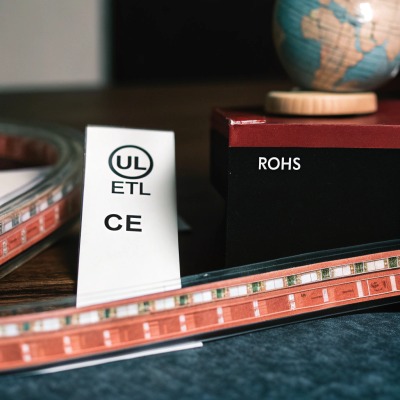
LED strips for commercial project bids typically require region-specific safety certifications (CE, SAA, UL, or ETL), electromagnetic compatibility (EMC) compliance, and often RoHS and REACH environmental standards. Many projects also demand IP rating verification, fire classification, and detailed test reports from accredited third-party laboratories.
Why Certifications Matter in Commercial Projects
When a contractor or distributor submits a tender for a government building, a hospital, a retail chain, or a hotel, the specification document almost always lists required certifications. If your product does not have them, your bid is disqualified before anyone looks at your price.
Beyond compliance, certifications serve as quality filters. A product that passes UL or SAA testing has been evaluated for electrical safety, fire risk, and material toxicity. This protects the contractor, the building owner, and the end users.
Key Certifications by Market
For Australia (SAA / RCM): The Regulatory Compliance Mark covers both electrical safety and EMC. It is mandatory for all electrical products sold in Australia. Our strips are tested and certified through accredited Australian laboratories, so our partners can submit compliant documentation with their bids immediately.
For Europe (CE / ENEC): CE marking covers the Low Voltage Directive (LVD) and EMC Directive. For higher-tier projects, ENEC certification adds another layer of credibility, as it involves testing by European notified bodies.
For North America (UL / ETL / cUL): UL listing 10 or ETL certification is required by most building codes and insurance providers. Many US and Canadian contractors will not even consider a product without a UL mark.
Certifications Residential Strips Usually Lack
Most residential strips sold on Amazon or at hardware stores carry basic CE or FCC marks. They rarely have SAA, UL, or detailed third-party test reports. They almost never provide IP rating verification from an independent lab. The manufacturer's self-declaration is all you get.
For a home user, this may be acceptable. For a project bid, it is not.
Environmental and Material Compliance
Modern project specifications increasingly require:
- RoHS: Restriction of hazardous substances. Standard for any responsible supplier.
- REACH: EU chemical regulation compliance. Required for European projects.
- Fire ratings: Some projects require specific flame spread and smoke generation test results for materials used in ceilings and walls.
Documentation We Provide
For every project order, we supply a complete certification package:
- Certificate copies with valid dates and scope
- Test reports from accredited labs (IEC/ISO 17025)
- Product datasheets with verified specifications
- Bin code and traceability records
- Declaration of conformity documents
This package saves our clients days of back-and-forth during the bid submission process. Several of our Australian partners have told us this documentation alone sets us apart from other suppliers they have worked with.
A Quick Certification Reference
| Certification | Region | What It Covers | Typically Required For |
|---|---|---|---|
| CE (LVD + EMC) | Europe | Electrical safety, EMC | All EU commercial projects |
| SAA / RCM | Australia | Electrical safety, EMC | All Australian projects |
| UL / ETL | North America | Electrical safety, fire | US/Canada commercial bids |
| RoHS | Global | Hazardous substance limits | Most modern specifications |
| REACH | Europe | Chemical compliance | EU government and institutional projects |
| IP Test Report | Global | Ingress protection verification | Outdoor and wet-area installations |
Conclusion
The difference between professional-grade and residential LED strips comes down to one word: reliability. For projects that demand consistent color, long runs, certified safety, and years of stable performance, professional-grade is the only responsible choice.
Footnotes
- Defines the process of preparing internal spaces for business needs. ↩︎
- Found an authoritative Wikipedia page explaining 'printed circuit boards'. ↩︎
- Describes what an LED chip is and its function in lighting. ↩︎
- Found an authoritative Wikipedia page explaining 'total cost of ownership'. ↩︎
- Explains the importance of managing heat in LED lighting systems. ↩︎
- Explains the concept of MacAdam ellipses for color consistency. ↩︎
- Defines CRI as a measure of a light source's ability to reveal colors. ↩︎
- Explains the decrease of electric potential in a circuit. ↩︎
- Describes the function of a power supply in converting electrical power. ↩︎
- Explains the meaning and importance of UL listing for product safety. ↩︎




 English
 Spanish
 German
 Russian
 Arabic
 French
 Portuguese