
When we design COB LED strips on our production line, the first question is never price. It is always where the light will be used, because lighting that sells products is fundamentally different from lighting meant to help people relax at home.
You should choose COB LED strip specifications based on the core goal of the space: commercial shops need high brightness, high CRI, and strict consistency to enhance product appeal, while residential homes need softer brightness, warmer color temperatures, and flexible installation to create comfort without visual fatigue.
Once this core logic is clear, CRI, lumen output 1, voltage, certifications, and color temperature all become easier to decide.
What CRI Rating Is Necessary for Retail Displays vs Home Lighting?
From our export experience with shopfitters and lighting designers 2, CRI is one of the most underestimated parameters until problems appear.
In our factory testing, low CRI does not look "bad" on the reel, but it quickly becomes a problem once installed near real products like clothing, food, or cosmetics.
For retail displays, a CRI of 90 is the minimum, and CRI 95+ is strongly recommended, while general residential ambient lighting usually performs well at CRI 80–90 without visible compromise.
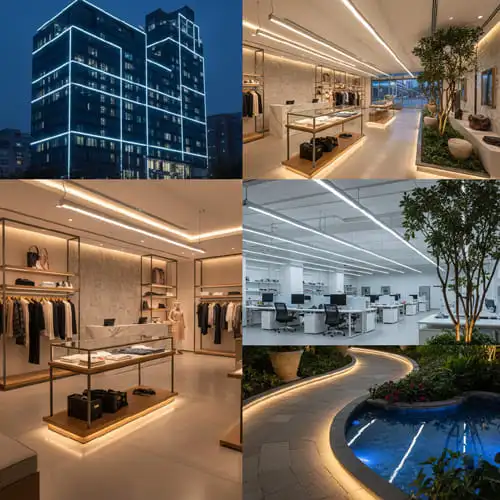
Why Retail Needs Higher CRI
In commercial shops, lighting is part of the sales system. Colors must look accurate and attractive.
- Apparel stores rely on correct reds and skin tones.
- Food displays need fresh-looking colors.
- Showrooms must match daylight perception.
| Application | Recommended CRI | Risk if Too Low |
|---|---|---|
| Retail display shelves | ≥95 | Color distortion, reduced product appeal |
| General commercial areas | ≥90 | Inconsistent brand presentation |
| Residential living spaces | 80–90 | Usually acceptable, minor color loss |
High CRI COB strips trade some efficiency for color accuracy. In commercial projects, this trade-off is justified. In homes, it often is not necessary.
Residential Perspective
In residential homes, people rarely compare colors side by side. Warm ambient lighting masks minor CRI differences naturally. Using CRI 90 3 is a quality upgrade, but CRI 80–85 is usually sufficient for bedrooms and living rooms.
How Many Lumens per Meter Do You Need for Task vs Decorative Lighting?
Brightness mistakes are among the most common causes of project dissatisfaction.
When we receive complaints, they are rarely about "too dim" in homes — they are about "too bright and uncomfortable."
Task lighting typically requires 1000–2000 lm/m, while decorative cove or ambient lighting works best between 300–800 lm/m, depending on ceiling height and reflection surfaces.
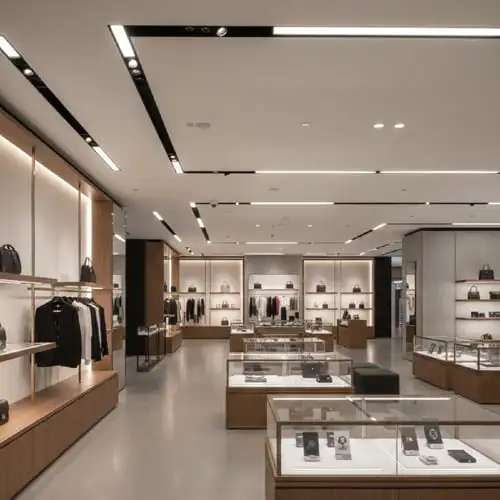
Commercial Task Lighting
Retail and commercial environments often require long operating hours 4 and visual clarity.
| Use Case | Typical Lumens per Meter |
|---|---|
| Retail shelf / display | 1200–2000 lm/m |
| Under-counter commercial task | 1000–1500 lm/m |
| Window display accents | 800–1200 lm/m |
Higher lumen output ensures products remain visible even under strong ambient light or daylight spill.
Residential Decorative Lighting
Homes prioritize comfort over visibility.
| Residential Use | Typical Lumens per Meter |
|---|---|
| Cove lighting | 300–500 lm/m |
| Under-cabinet kitchen | 600–1000 lm/m |
| Step or skirting light | 200–400 lm/m |
Lower brightness reduces glare, eye fatigue, and the need for complex dimming setups.
Do Commercial Projects Require Stricter Fire Safety or IP Certifications?
This is not a subjective question. The answer is yes, and ignoring it can stop a project at inspection stage.
From our cooperation with Australian and European contractors, certification requirements 5 differ clearly.
Commercial projects usually require stricter fire safety compliance, documented testing, and tighter IP control compared to residential installations, especially in public-access areas.
Commercial Requirements
Commercial installations often require:
- Fire-rated or low-smoke materials
- Documented thermal testing
- Certified power supplies
- Consistent IP ratings across batches
| Environment | Typical Requirement |
|---|---|
| Retail interiors | IP20 + fire-rated profiles |
| Food service areas | IP65 minimum |
| Public corridors | Fire compliance mandatory |
Long operating hours also mean better heat dissipation 6 and aluminum profiles are not optional.
Residential Requirements
Residential projects are simpler, but not careless.
- IP20 is acceptable in dry rooms
- IP65 needed for kitchens and bathrooms
- Fire rating usually not enforced but recommended
Residential users benefit from flexibility and easier installation more than formal certification.
Which Color Temperatures Create Cozy Homes vs Vibrant Shops?
Color temperature 7 directly affects mood. This is not marketing language — it is observable behavior.
When we test lighting mockups internally, people naturally prefer warmer tones for rest and cooler tones for focus.
Homes feel most comfortable at 2700K–3000K, while shops typically perform better at 3000K–4000K depending on brand positioning and product type.
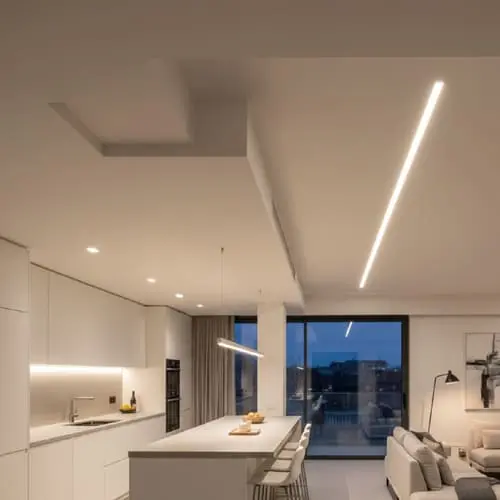
Commercial Color Temperature Strategy
| Shop Type | Recommended CCT |
|---|---|
| Fashion retail | 3000K–3500K |
| Electronics | 4000K |
| Supermarkets | 4000K |
Neutral whites enhance clarity and perceived cleanliness.
Residential Color Temperature Strategy
| Space | Recommended CCT |
|---|---|
| Living room | 2700K–3000K |
| Bedroom | 2700K |
| Kitchen | 3000K |
Warm light supports relaxation and reduces psychological stress after long days.
Choosing COB LED strips 9
Commercial vs Residential COB LED Strip Selection Framework
| Specification | Commercial Shops | Residential Homes | Reason |
|---|---|---|---|
| Density | 240–480+ LEDs/m | 120–240 LEDs/m | Uniformity vs cost |
| Brightness | 1000–2000 lm/m | 300–1000 lm/m | Visibility vs comfort |
| CRI | ≥95 | 80–90 | Color accuracy needs |
| Voltage | 24V | 12V / 24V | Run length vs simplicity |
| Certifications | Strict | Basic | Compliance level |
Conclusion
Choosing COB LED strips 10 is not about chasing the highest specification, but matching light behavior to human behavior in each space.
Footnotes
- Official US government guide on understanding lumens and lighting performance. ↩︎
- Educational resource on lighting design strategies for commercial and retail spaces. ↩︎
- Official technical committee page for the international CRI standard. ↩︎
- Federal safety guidelines for workplace lighting levels and visual clarity. ↩︎
- IEC standards for electrical equipment certifications and protection ratings. ↩︎
- Manufacturer technical data on heat dissipation requirements for LED systems. ↩︎
- Research on how different light color temperatures impact human circadian rhythms. ↩︎
- News report on updated energy efficiency and certification standards in Europe. ↩︎
- Comprehensive overview of LED technology and its various applications. ↩︎
- Technical specifications and benefits of Chip-on-Board (COB) LED technology. ↩︎

 English
 Spanish
 German
 Russian
 Arabic
 French
 Portuguese