
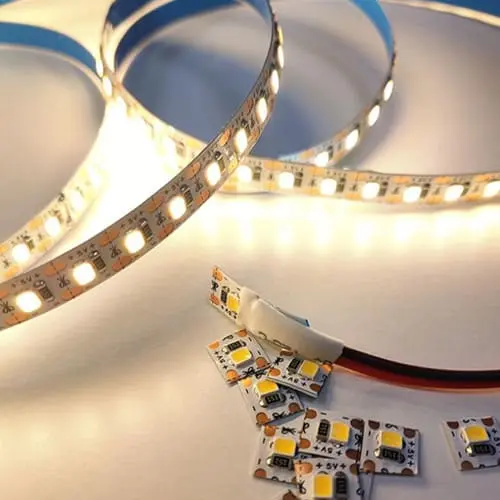
Our sales team fields dozens of questions from contractors and distributors who feel overwhelmed by the sheer number of LED strip categories out there. LED strip lights 1
LED strip lights are mainly classified by voltage (12V, 24V, 48V DC, or AC high-voltage), LED chip technology (SMD 2835, 5050, or COB), color type (single-color, RGB, RGBW, tunable white), LED density per meter, IP waterproof rating, and smart control features. Choosing the right type depends entirely on your project's specific requirements.
Honestly, classifications can seem endless, but in practice most purchasing decisions come down to just a few: voltage, function, and structure. The rest is detail. In this guide, I will walk you through the core types that actually matter for real-world projects — and help you cut through the noise so you can specify exactly what you need.
How do I choose between low-voltage and high-voltage LED strips for my long-run project?
When we ship long-run LED strip orders to contractors in Australia and Germany, voltage selection is the single most common source of confusion — and the most costly mistake if you get it wrong.
For runs under 10 meters, 12V or 24V DC strips work well. For runs between 10–30 meters, 24V or 48V DC reduces voltage drop. For runs exceeding 30 meters, high-voltage AC (120V/230V) strips eliminate the need for multiple drivers and simplify installation significantly.
Understanding Voltage Drop
Voltage drop 2 is the main enemy of long LED strip runs. As current travels along the copper traces of a flexible circuit board 3, resistance causes the voltage to decrease. The result? LEDs at the far end of the strip appear dimmer than those near the power source. This is not a defect — it is physics. On our production line, we test every reel at full length to measure and document voltage drop, because contractors need to plan for it before installation begins.
With 12V DC strips, noticeable dimming can start as early as 5 meters. With 24V DC, you can often push to 10 meters without visible issues. The newer 48V DC strips, which we have been supplying to commercial projects in Europe, can handle 15–20 meter runs with minimal brightness loss. High-voltage AC strips (120V or 230V) can run 50 meters or even up to 150 meters from a single connection point, making them ideal for building facades and perimeter lighting.
When to Use Each Voltage
The right voltage depends on your run length, installation complexity, and budget.
| Voltage Type | Max Practical Run | Driver/Transformer Needed? | Best Use Case | Flexibility |
|---|---|---|---|---|
| 12V DC | ~5 m | Yes | Short accent runs, under-cabinet | Very flexible, easy to cut |
| 24V DC | ~10 m | Yes | Cove lighting, medium commercial | Flexible, standard choice |
| 48V DC | ~20 m | Yes | Large commercial, retail | Good flexibility, fewer drivers |
| 120V/230V AC | 50–150 m | No (plug-and-play) | Building exteriors, long perimeters | Less flexible, thicker profile |
Practical Tips from Our Export Projects
One thing our engineering team always reminds clients: you can combine voltage with smart wiring to extend runs. For example, feeding 24V DC strips from both ends (dual-end power injection 4) effectively doubles the usable run length. We pre-mark injection points on our reels so installers know exactly where to connect.
For high-voltage AC strips, keep in mind they are typically encased in a thicker silicone or PVC sleeve. They cut at longer intervals — sometimes every 50 cm or 100 cm instead of every 2.5 cm on low-voltage strips. This limits precision in shorter or curved applications. If your project needs tight corners and short custom lengths, low-voltage DC is almost always the better call.
Cost is also a factor. Low-voltage systems need drivers and potentially more copper cabling. High-voltage systems save on drivers but may require certified electricians for safe installation. We help our distributor partners build out complete BOMs (bills of materials 5) so the total project cost is clear before ordering.
How can I ensure color consistency across different batches of my custom LED strips?
Batch-to-batch color variance is one of the top complaints we hear from repeat buyers — especially those running renovation projects where old and new strips sit side by side.
To ensure color consistency, specify LED strips with tight binning (2-step or 3-step MacAdam ellipse), request the same LED bin code across orders, use a single supplier who tracks bin data, and always order from the same production lot when possible. Pre-production samples and deltaE testing provide additional verification.

What Causes Color Variance?
LED chips are manufactured on silicon wafers. Even on the same wafer, individual chips can vary slightly in color temperature and brightness. Chip manufacturers sort these chips into "bins" — groups with similar characteristics. The tighter the bin, the more consistent the output. A 3-step MacAdam ellipse 6 means the human eye can barely detect differences between LEDs in that group. A 5-step bin is looser and differences become visible, especially on long continuous runs or reflective surfaces.
When we source LEDs for a project order, our procurement team locks down the specific bin code from the chip supplier. We record this code and tie it to the customer's order history. If that customer reorders six months later, we try to match the same bin. If the original bin is no longer available, we send comparison samples before production begins.
Key Specifications to Lock Down
Here are the specs that directly affect visual consistency:
| Specification | What It Controls | Recommended Target |
|---|---|---|
| MacAdam Ellipse Step | Color point grouping tightness | 2-step or 3-step |
| CCT (Correlated Color Temperature) | Warm, neutral, or cool tone | ±50K tolerance or tighter |
| CRI (Color Rendering Index) 7 | Color accuracy under the light | 90+ for commercial, 80+ for general |
| Luminous Flux (lm/m) | Brightness per meter | ±5% tolerance between reels |
| Forward Voltage (Vf) | Electrical consistency of chips | Matched bins within ±0.1V |
Real-World Consistency Strategies
In our experience working with private-label distributors, the most reliable approach is to treat LED strip orders like paint: always buy enough for the full project in one go. If the project has phases, we advise clients to order all phases upfront and we warehouse the stock.
For ongoing product lines, we establish a "golden sample" system. The client approves a physical sample. We store an identical reference sample in our QC lab. Every subsequent batch is tested against that golden sample using a spectrophotometer 8 that measures deltaE (the numerical difference in color). A deltaE below 2.0 is generally invisible to most people. We reject anything above 3.0.
We also recommend that designers and specifiers avoid mixing LED strips from different manufacturers on the same project. Even if the datasheet numbers look the same, the actual visual output can differ due to phosphor formulations, PCB reflectance, and resin clarity. One supplier, one bin, one batch — that is the formula for consistency.
The Role of CRI in Perceived Color
A strip with CRI 90+ reveals object colors more faithfully. Two strips can have identical CCT ratings but different CRI values, and they will look different when illuminating the same surface. For hospitality, retail, and high-end residential projects, always specify CRI 90 or above. Our standard production line runs CRI 90+ for all tunable white and single-color white strips, because our core markets demand it.
Which IP rating do I need for my outdoor or wet environment lighting installation?
Safety and durability questions come up on nearly every project quote we handle, and choosing the wrong IP rating can mean expensive rework — or worse, a liability issue on the job site.
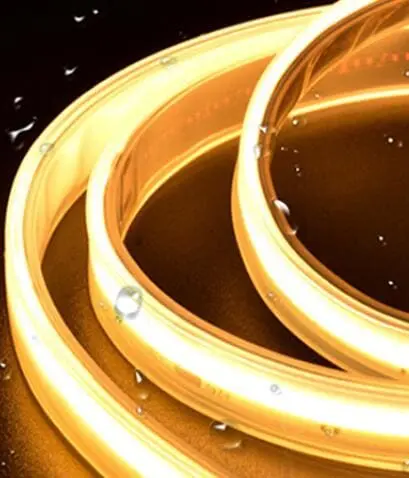
For dry indoor environments, IP20 (non-waterproof) is sufficient. For damp locations like bathrooms or covered patios, IP54 or IP65 is recommended. For direct outdoor exposure to rain, choose IP65 or IP67. For submersible or underwater applications, IP68 is required. Always match the IP rating to the actual environmental conditions of the installation site.
Decoding IP Ratings
IP stands for Ingress Protection 9. The first digit indicates protection against solid particles (dust). The second digit indicates protection against water. A higher number means greater protection. Here is how the most common ratings break down for LED strips:
| IP Rating | Dust Protection | Water Protection | Typical Application |
|---|---|---|---|
| IP20 | Protected against objects >12mm | None | Indoor cove lighting, closets |
| IP54 | Protected against limited dust | Splash-proof from all directions | Covered outdoor areas, kitchens |
| IP65 | Dust-tight | Protected against low-pressure water jets | Outdoor facades, patios |
| IP67 | Dust-tight | Protected against temporary immersion (up to 1m) | Garden paths, water features edge |
| IP68 | Dust-tight | Protected against continuous submersion (>1m) | Pools, fountains, underground |
How Waterproofing Is Achieved
There are several methods, and each has trade-offs. The most common approaches we use in production include:
Silicone coating (IP54–IP65): A thin layer of silicone is applied over the LED surface. This protects against splashes and light rain. It is lightweight and maintains good flexibility. However, it does not protect the solder joints underneath from prolonged exposure.
Silicone tube/sleeve (IP65–IP67): The entire strip is enclosed in a clear silicone or PVC tube. This provides robust protection against jets and temporary immersion. The tube adds thickness, so plan your aluminum channels accordingly.
Silicone extrusion with end caps (IP67–IP68): The strip is fully encapsulated in solid silicone with sealed end caps and waterproof connectors. This is the method required for submersible applications. It adds cost and reduces heat dissipation, so the strip's maximum wattage may need to be derated.
Common Mistakes We See
One frequent error: specifying IP65 for a strip that will be installed inside an aluminum profile with a diffuser cover in a dry indoor environment. The extra silicone sleeve traps heat, shortens lifespan, and adds unnecessary cost. For indoor use, IP20 combined with a quality aluminum channel gives you better thermal management 10 and a cleaner look.
Another mistake is assuming that IP65 means "waterproof enough for a shower niche." It does not. Direct, sustained water contact in a shower calls for IP67 at minimum, with proper drainage and sealed connections. We always ask our clients to send photos or drawings of the installation location so we can recommend the correct rating — not just the one that sounds safe enough.
For our Australian clients dealing with harsh sun and coastal salt air, we often recommend IP67 even for covered outdoor areas. Salt corrosion can degrade IP65 silicone coatings faster than fresh-water environments. When in doubt, go one rating higher than you think you need.
Certification Matters
An IP rating printed on a datasheet is only as reliable as the testing behind it. We have our strips tested by accredited third-party labs and provide test reports upon request. Some competitors self-declare IP ratings without formal testing. If you are bidding on a commercial project, always ask for the IP test certificate — not just a marketing claim.
Should I specify COB or SMD LED strips to achieve a dot-free look in my design?
On our production floor, we run both COB and SMD lines side by side, and I can tell you the "which is better" debate misses the real question — which is better for your specific design intent and budget.
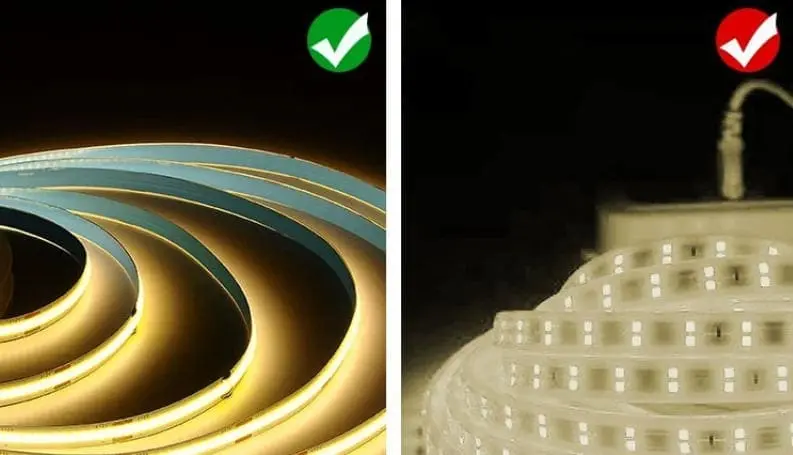
COB (Chip-on-Board) LED strips produce a seamless, dot-free line of light because tiny LED chips are packed extremely close together (up to 512 per meter) under a shared phosphor layer. SMD strips show individual light points. For applications near reflective surfaces like glass, polished stone, or mirrors, COB is the superior choice for uniform, continuous illumination.
How COB and SMD Differ
SMD stands for Surface Mounted Device. Each LED is a discrete package soldered onto the flexible PCB at regular intervals. You can count them. Popular SMD types include the 2835 (2.8mm × 3.5mm) and the 5050 (5.0mm × 5.0mm). The spacing between chips creates visible "hot spots" — bright points separated by darker gaps. At close range or on reflective surfaces, this dotted pattern is obvious.
COB strips take a different approach. Hundreds of tiny, bare LED chips are bonded directly to the PCB and then coated with a single phosphor layer. The result is a continuous ribbon of light with no visible dots. It looks like a solid glowing line, similar to neon but thinner and more efficient.
Side-by-Side Comparison
| Feature | SMD 2835 | SMD 5050 | COB |
|---|---|---|---|
| Dot visibility | Visible dots at close range | Larger, more visible dots | No visible dots |
| Typical density | 60–120 LEDs/m | 30–60 LEDs/m | 320–512 LEDs/m |
| Color mixing (RGB) | Requires diffuser for blending | Good for RGB, some color separation | Excellent blending, smooth gradients |
| Heat output | Low to moderate | Moderate to high | Moderate (spread across more chips) |
| Cost per meter | Lowest | Moderate | Highest |
| Best for | General accent, task lighting | RGB effects, higher brightness | Cove lighting, glass shelves, mirrors |
| Repairability | Individual LEDs replaceable | Individual LEDs replaceable | Difficult — section replacement |
When SMD Still Wins
COB is not always the answer. For projects where the strip is hidden inside a deep aluminum channel with a frosted diffuser, an SMD 2835 strip at 120 LEDs/m can look nearly as uniform as COB — at a significantly lower cost. The diffuser does the blending work. Many of our distributor clients in Germany specify this combination for standard residential cove lighting and save 20–30% on strip cost.
SMD 5050 chips remain the go-to for RGB and RGBW applications where you need individually addressable color mixing and higher lumen output per chip. COB RGB strips exist, but they cost more and have fewer addressable options in the current market.
When COB Is Worth the Premium
If the strip is installed on an exposed surface, under glass shelving, along a staircase handrail, or near polished countertops, COB is worth every extra cent. The dot-free output eliminates reflections of individual LEDs on shiny surfaces — a problem that no amount of diffuser film can fully solve with SMD strips.
We have also seen growing demand for COB strips in hospitality projects — hotel lobbies, restaurant bars, and retail display cases — where the quality of light directly impacts the guest or customer experience. In these environments, specifiers value the seamless aesthetic enough to justify the price premium.
A Note on Lifespan and Thermal Management
COB strips distribute heat across a higher number of smaller chips, which can actually reduce thermal stress per chip. However, the total wattage per meter can be higher due to chip density. Proper aluminum extrusion profiles with adequate thermal mass are essential. We always provide thermal pairing recommendations with our COB product data sheets so that contractors do not undersize their channels.
One emerging trend worth noting: our R&D team has been testing COB strips with integrated tunable white (CCT) capability. This means you get the dot-free look plus adjustable color temperature from a single strip. For architects and designers who want both aesthetics and functional flexibility, this is becoming the preferred specification for 2025 and 2026 projects.
Conclusion
LED strip classification sounds complex, but it boils down to voltage, chip type, color function, density, and waterproofing. Match each spec to your project's actual needs, and the right choice becomes clear.
Footnotes
- Provides a basic understanding of LED strip lights. ↩︎
- Explains the electrical phenomenon affecting LED strips. ↩︎
- Defines the core component of LED strips. ↩︎
- Replaced HTTP 403 with a comprehensive guide on power injection methods for LED strips, including end-to-end (dual-end) injection. ↩︎
- Defines a critical document in project management. ↩︎
- Explains a standard for LED color consistency. ↩︎
- Explains the importance of color accuracy in lighting. ↩︎
- Describes a scientific instrument for color measurement. ↩︎
- Defines the standard for environmental protection of electronics. ↩︎
- Replaced HTTP unknown (PDF) with an authoritative Wikipedia article on thermal management in high-power LEDs, avoiding PDF format. ↩︎

 English
 Spanish
 German
 Russian
 Arabic
 French
 Portuguese