
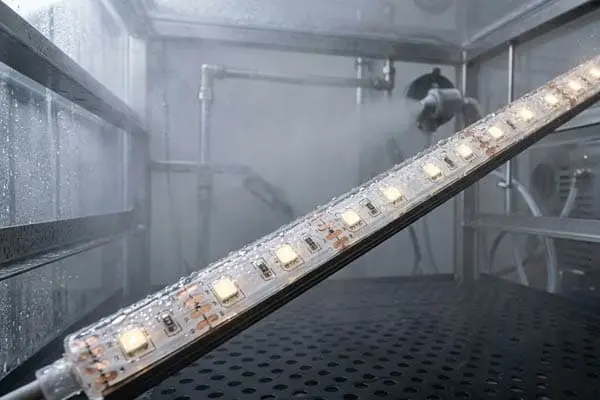
Every time our production line ships a batch of outdoor LED strips to a coastal project in Australia, one question haunts the entire process: will these strips survive?
Salt spray tests follow ASTM B117, ISO 9227, and GB/T 10125 to measure corrosion resistance, while aging tests rely on IEC 60068 environmental standards and powered burn-in protocols to verify lumen stability, color consistency, and material endurance over time. Together, they prove real-world durability.
Salt spray measures how well a strip resists corrosion Copper PCB traces 1. Aging measures how well it holds up under heat, humidity, and electrical stress. Neither test alone tells the full story. In this article, I will walk you through the exact standards, what they test, how to read the reports, and what benchmarks to demand from your supplier.
How do I verify that my LED strips will survive salt spray in harsh coastal environments?
When we prepare shipments for waterfront projects in Germany or beachside installations in Queensland, salt spray resistance is the first thing our clients ask about Luminous flux (lumen output) 2.
To verify salt spray survival, require test reports based on ASTM B117 or ISO 9227 NSS (neutral salt spray). Strips should endure at least 48–96 hours for general outdoor use and 500+ hours for direct coastal exposure, with no blistering, pitting, or conductivity loss on solder joints and connectors.

What Happens Inside a Salt Spray Chamber
A salt spray test is simple in concept. The strip sample goes into a sealed chamber. A 5% sodium chloride solution 3 is atomized into a continuous fog at 35°C. The fog settles on every surface. Then you wait. The test runs for a set number of hours — 24, 48, 72, 96, 168, 240, 500, or even 1000 hours depending on the requirement. After the exposure period, technicians pull the samples out and inspect them.
They look for blistering, white rust, red rust, pitting, peeling of coatings, discoloration of solder joints, and any loss of electrical conductivity. The evaluation criteria matter as much as the hours. A strip that "passes 500 hours" but has corroded solder joints is not really a pass.
Key Salt Spray Standards Explained
Three standards dominate this space. Here is a quick comparison:
| Standard | Origin | Test Type | Key Conditions | Common Use |
|---|---|---|---|---|
| ASTM B117 4 | United States | Neutral salt spray | 5% NaCl, 35°C, continuous fog | US market, general corrosion screening |
| ISO 9227 5 | International | NSS, AASS, CASS | NSS: 5% NaCl, 35°C; AASS adds acetic acid; CASS adds copper chloride | International projects, export lighting |
| GB/T 10125 | China | Aligned with ISO 9227 | Same conditions as ISO 9227 variants | Chinese manufacturing QC, domestic and export |
For LED strip lights, the NSS (neutral salt spray 6) variant is most relevant. AASS and CASS are harsher and primarily used for heavily plated metal parts, not flexible strip assemblies.
Which Parts of an LED Strip Are Most Vulnerable?
Salt spray does not attack the LED chip directly. It attacks the surrounding materials. Here are the weak points on a typical strip:
- Copper PCB traces — exposed edges can corrode quickly
- Solder joints — salt fog penetrates micro-cracks and causes resistance changes
- Connectors and pins — metal-to-metal contacts are prime corrosion targets
- Adhesive layers — salt can undermine adhesion, causing peeling
- Silicone or PU jackets — pinholes allow salt penetration
- End caps and cut ends — the most common entry point for moisture and salt
Our engineering team always tests complete assemblies, not just bare PCBs. A strip might pass on the board level but fail at the connector or end seal. That difference matters when you are bidding on a 5-year warranty project.
Do Not Confuse Hours with Years
One common mistake: assuming 72 hours of salt spray equals 3 years of outdoor life. That math is too simple. Salt spray is an accelerated comparison test, not a calendar-to-hours converter. A 500-hour result on one product and a 200-hour result on another tells you the first is more corrosion-resistant. But it does not tell you either one will last exactly X years in Sydney harbor air. Real-world factors — UV, rain washing, temperature swings, installation quality — all affect actual lifespan.
Which aging test standards should I require to ensure my lights don't dim or shift color prematurely?
On our production floor, every LED strip batch goes through a powered aging process before it ships. We learned the hard way that skipping this step leads to returns.
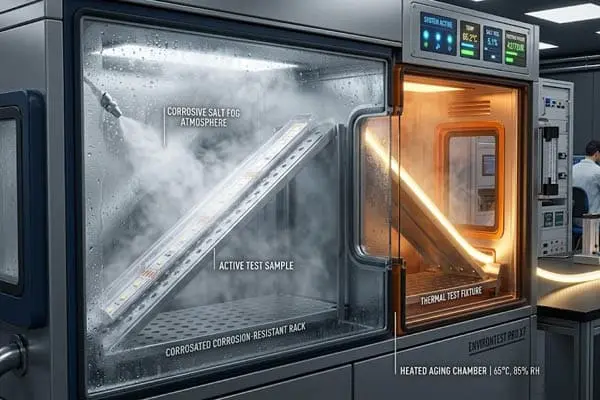
Require aging tests based on IEC 60068 environmental standards — specifically IEC 60068-2-2 (dry heat), IEC 60068-2-78 (damp heat, steady state), and powered burn-in at elevated temperature for a minimum of 24–72 hours. These tests catch early lumen drop, color shift, adhesive failure, and solder defects before products leave the factory.
What Aging Tests Actually Measure
Aging tests are about stability over time. While salt spray checks corrosion resistance, aging checks whether the strip maintains its electrical and optical performance under sustained stress. The key parameters monitored during aging include:
- Luminous flux (lumen output) — does the strip dim?
- Color temperature — does it shift warm or cool?
- Color consistency (delta uv or SDCM) — do LEDs drift apart?
- Power consumption — does it change?
- PCB and resin condition — any yellowing, cracking, or delamination?
- Solder and connector integrity — any open circuits or intermittent failures?
The Standards That Matter
The IEC 60068 family is the backbone of environmental aging tests for electronics and lighting. IEC 60068 environmental standards 7 Here are the most relevant tests for LED strips:
| IEC 60068 Test | Name | Conditions | What It Reveals |
|---|---|---|---|
| IEC 60068-2-1 | Cold test | Low temperature, typically -25°C to -40°C | Brittleness, adhesive cracking, connector shrinkage |
| IEC 60068-2-2 | Dry heat | High temperature, typically 70°C–85°C | Lumen drop, color shift, resin yellowing, solder fatigue |
| IEC 60068-2-14 | Temperature cycling | Rapid transitions between hot and cold | Thermal expansion mismatch, solder joint cracking, delamination |
| IEC 60068-2-78 | Damp heat, steady state | 85°C / 85% RH, sustained | Moisture ingress, insulation failure, corrosion under coatings |
Powered Burn-In: The Practical Aging Test
Beyond IEC standards, most serious LED strip manufacturers run a powered burn-in. This means the strip is energized at rated current (or slightly above) inside a temperature-controlled chamber for 24 to 72 hours. Some factories go to 168 hours for high-end orders. During this process, lumen output and color coordinates are logged before and after.
In our facility, we measure luminous flux and CCT at the start of burn-in and again at the end. A deviation beyond 3% in lumen output or beyond 2 SDCM steps in color signals a material or process issue. We pull those strips from the line.
LM-80 and TM-21: Context, Not the Whole Story
You may have seen LM-80 8 and TM-21 referenced in LED datasheets. LM-80 is a standardized method for measuring lumen depreciation of LED packages over 6000+ hours. TM-21 9 is the method for projecting lumen maintenance beyond the LM-80 test period. These are valuable for evaluating LED chips, but they apply to LED packages and modules — not the complete strip assembly. A strip can use LM-80-tested LEDs and still fail early because of bad solder, poor encapsulation, or inadequate thermal design. So when you evaluate a supplier, ask for both: LM-80 data on the LED source and aging test data on the finished strip.
Why Combined Stress Testing Matters
A strip might pass a dry heat aging test at 70°C for 72 hours. But will it survive 85°C at 85% relative humidity for 500 hours? Probably not, if the potting compound has micro-voids or the adhesive tape is not rated for humidity. In real-world outdoor applications, heat and moisture come together. That is why the best QC programs combine multiple IEC 60068 tests — dry heat, damp heat, and thermal cycling — rather than relying on a single test.
How can I use salt spray and aging test reports to qualify my supplier for high-end project bids?
When clients like Roy need to submit lighting documentation for a commercial fitout in Melbourne, having the right test reports can make or break the bid. We have helped multiple distributors build their compliance files from scratch.
Use salt spray and aging test reports as objective evidence in your bid package. Confirm the report references a recognized standard (ASTM B117, ISO 9227, or IEC 60068), lists specific test conditions and duration, defines pass/fail criteria clearly, and covers the exact product model and configuration you are quoting — not just a similar product.

What to Look for in a Salt Spray Report
Not all test reports are equal. Some manufacturers hand you a one-page certificate that says "passed 500 hours salt spray." That is not enough for a serious bid. A credible salt spray report should include:
- The exact standard referenced (e.g., ISO 9227 NSS)
- Chamber temperature, NaCl concentration, and pH
- Spray deposition rate
- Sample description and mounting method
- Duration of exposure
- Evaluation criteria (corrosion rating scale, blistering grade, conductivity check)
- Photos of samples before and after
- Name and accreditation of the testing lab
If the report is from an internal lab rather than a third-party accredited facility, ask for the lab's calibration records. For high-end projects, third-party reports from CNAS, ILAC, or A2LA accredited labs carry far more weight.
What to Look for in an Aging Report
Aging reports should tell you what stress was applied, for how long, and what changed. Here is a checklist:
- Test standard or internal protocol reference
- Temperature, humidity, and duration
- Whether the strip was powered during the test
- Initial and final measurements of lumen output, color temperature 10, power
- Visual inspection notes (yellowing, cracking, delamination)
- Electrical continuity check results
- Sample identification (SKU, batch, date)
Matching Reports to Your Actual Product
One trap buyers fall into: the supplier provides a report for a different product model. For example, the salt spray report covers an IP20 indoor strip, but you are ordering an IP67 silicone-extruded strip for outdoor use. The materials, coatings, and construction are completely different. Always confirm the report matches your exact SKU, or request testing on the specific configuration you intend to purchase.
Building a Qualification File for Bids
For commercial and government projects, the documentation package usually needs to include:
- Product datasheet with electrical and photometric specs
- IP rating test report (e.g., IEC 60529)
- Salt spray test report
- Aging or environmental durability test report
- Relevant certifications (CE, SAA, UL, RCM, etc.)
- Warranty terms and conditions
Our team routinely helps distributors assemble these files. We keep updated test reports linked to each product revision so that when a project tender comes in, the documentation is ready within days, not weeks.
What are the specific QC benchmarks I should check to guarantee my custom LED strips last for years?
We run over a dozen checkpoints on every custom order before it leaves our warehouse. Even so, our clients often ask: which benchmarks actually matter most?
Check salt spray endurance of at least 48–96 hours NSS for outdoor use, powered aging burn-in with less than 3% lumen drop and less than 2-step SDCM color shift, adhesive peel strength retention after thermal cycling, and connector contact resistance stability — these four benchmarks together are the minimum for long-term reliability.

Benchmark 1: Salt Spray Duration and Pass Criteria
Duration alone is not enough. You need to define what counts as failure. Here is a practical guideline:
| Application Environment | Minimum NSS Hours | Key Failure Criteria |
|---|---|---|
| Indoor (dry) | Not typically required | N/A |
| Bathroom / high humidity | 24–48 hours | No visible corrosion on solder joints or connectors |
| Outdoor (general) | 48–96 hours | No blistering, no pitting, no conductivity loss |
| Coastal / marine-adjacent | 240–500+ hours | No white or red rust, no adhesive delamination, full electrical function |
| Industrial / chemical exposure | 500–1000 hours | No corrosion, no encapsulation failure, full IP seal integrity |
When our team runs salt spray for a coastal project, we check solder joints under magnification, test continuity at every cut point, and inspect end seals for any signs of salt penetration. Visual inspection alone is not sufficient for high-end projects.
Benchmark 2: Aging Performance Metrics
After powered burn-in, the numbers need to hold. Here are the thresholds we use internally:
- Lumen maintenance: ≥97% of initial output after 72 hours at 55°C powered operation
- Color shift: ≤2 SDCM steps from initial measurement
- CCT drift: ≤100K from rated value
- Power stability: ≤2% deviation from rated wattage
- No dead LEDs, flickering, or visible discoloration
These are our internal standards. For your projects, you can adjust thresholds based on application criticality. A decorative cove light may tolerate 5% lumen variation. A museum display or retail accent light should not.
Benchmark 3: Adhesive and Mechanical Integrity
LED strips get mounted with 3M VHB tape, silicone adhesive, or mounting channels. After thermal cycling (e.g., -20°C to +60°C, 100 cycles per IEC 60068-2-14), the adhesive bond should not peel, crack, or lose holding strength. We test peel strength on aluminum and painted surfaces. If the adhesive fails in the chamber, it will fail on the ceiling.
Benchmark 4: Connector and Solder Joint Reliability
Connectors are the number-one field failure point in LED strip installations. After aging and thermal cycling, check:
- Contact resistance at every connector (should not increase by more than 10%)
- Solder joint appearance under 10x magnification (no cracking, no cold joints)
- Wire pull strength at soldered leads (minimum 2 kg-f for typical 18 AWG wire)
Benchmark 5: IP Rating Validation After Stress
An often-overlooked step: re-test IP rating after environmental exposure. A strip that passes IP67 fresh out of the factory might fail after thermal cycling or salt spray if the silicone sleeve shrinks, the end cap loosens, or the potting compound cracks. The best QC programs include post-stress IP re-verification.
Putting It All Together
No single test proves durability. Salt spray proves corrosion resistance. Aging proves electrical and optical stability. Thermal cycling proves mechanical resilience. IP testing proves sealing integrity. When you combine all four, you get a realistic picture of how the strip will perform in the field. That is the approach we recommend to every project buyer we work with.
Conclusion
Salt spray tests prove corrosion resistance. Aging tests prove stability under stress. Together, they give you the evidence you need to trust your LED strips for years of reliable service.
Footnotes
- Discusses corrosion of copper traces on printed circuit boards. ↩︎
- Defines luminous flux and lumen output in the context of lighting. ↩︎
- Replaced with an article detailing the preparation of sodium chloride solution for salt spray testing. ↩︎
- Replaced with the official ASTM International standard page for ASTM B117. ↩︎
- Replaced with the official ISO standard page for ISO 9227. ↩︎
- Replaced with a Wikipedia entry providing a clear explanation of neutral salt spray testing. ↩︎
- International standards for environmental testing of electrotechnical products. ↩︎
- Explains the LM-80 standard for measuring LED lumen and color maintenance. ↩︎
- Describes the TM-21 method for projecting LED lumen maintenance from LM-80 data. ↩︎
- Explains lighting color temperature and its measurement in Kelvins. ↩︎


 English
 Spanish
 German
 Russian
 Arabic
 French
 Portuguese