
When we watch our COB LED strips roll off the production line, the continuous phosphor encapsulation looks flawless. We spend weeks perfecting the color consistency and adhesion, but all that effort can be wasted in seconds if the shipping process is flawed. We have seen photos from clients where boxes arrived crushed or wet, turning a premium product into scrap metal. This not only delays your project installation but also creates a massive headache regarding insurance claims and replacements.
shipping process 1
To prevent transit damage, request anti-static shielding bags, high-impact polystyrene reels with moderate tension, and double-walled K=K corrugated master cartons. Ensure suppliers use desiccant packets for moisture control and separate individual reels with EPE foam to withstand vibration, stacking pressure, and electrostatic discharge during international shipping.
In this guide, we will break down the specific packaging protocols you need to enforce to ensure your lighting products arrive in perfect condition.
packaging protocols 2
Do you use anti-static bags and reinforced reels to protect the COB strips from electrostatic discharge and bending?
In our engineering lab, we treat the phosphor layer on COB strips like fresh paint—it is incredibly sensitive until installed. We often see competitors cut costs by using thin plastic bags, but we know that static electricity can destroy the internal circuitry before you even open the box. If the reel is too flimsy, the strip bends awkwardly, causing that beautiful continuous light to crack.
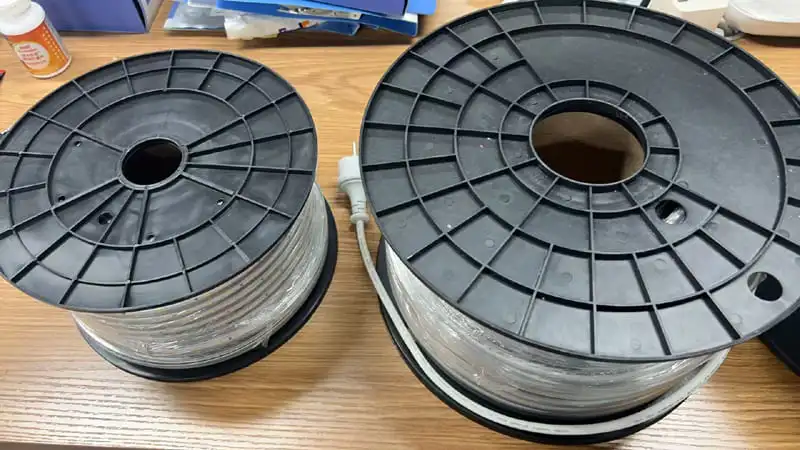
Yes, effective protection requires aluminized anti-static shielding bags to block electrostatic discharge and moisture. Furthermore, strips must be wound onto high-impact polystyrene (HIPS) reels with a minimum 50mm hub diameter. This combination prevents micro-fractures in the PCB and shields the sensitive LED chips from invisible electrical damage.
The Hidden Dangers of Static and Tension
When we discuss COB (Chip on Board) technology, we are dealing with thousands of tiny LED chips mounted directly onto a flexible printed circuit board (PCB). Unlike traditional SMD strips, COB strips are covered by a layer of silicone mixed with phosphor powder. This layer is flexible, but it has limits.
If a supplier winds the strip too tightly onto a small reel, the tension stretches the copper traces and the phosphor layer. During transit, temperature changes cause expansion and contraction. If the reel hub is too small (under 50mm), this stress can cause microscopic cracks. You might not see them immediately, but they will result in dark sections or flickering once installed.
Why Standard Plastic Bags Are Not Enough
Standard clear plastic bags (PE bags) are insulators. When they rub against other materials during shipping, they generate static electricity. For sensitive electronics like LEDs, this Electrostatic Discharge (ESD) can be fatal. It might not kill the light immediately, but it weakens the chip, leading to early failure.
Electrostatic Discharge (ESD) 3
We recommend—and you should demand—Aluminized Shielding Bags. These create a Faraday cage effect, blocking external static fields.
Reel Material and Design
The reel itself acts as the first line of defense. Cheap paper reels absorb moisture and can deform, crushing the strip edges. We insist on High-Impact Polystyrene (HIPS) plastic reels. They are rigid and do not absorb water.
Additionally, the "Leader Tape" is crucial. This is the tape that holds the end of the strip to the reel. It must be low-residue but high-tack. If it comes loose, the strip unravels inside the bag. As the box vibrates in a truck, the loose strip rubs against the bag, damaging the phosphor surface.
Comparison of Inner Packaging Standards
Here is a breakdown of what to look for versus what to avoid:
| Feature | Standard/Cheap Packaging | Professional/Safe Packaging | Why It Matters |
|---|---|---|---|
| Bag Material | Clear PE Plastic | Aluminized ESD Shielding Bag | Prevents static shock and moisture ingress. |
| Reel Material | Cardboard/Paper | HIPS Plastic (Anti-static) | Prevents deformation and moisture absorption. |
| Hub Diameter | Small (<40mm) | Large (≥50mm) | Reduces bend radius stress on copper traces. |
| Desiccant | None | Silica Gel + HIC Card | Absorbs trapped moisture; indicates humidity levels. |
What specifications should I demand for the master cartons to ensure they withstand stacking pressure?
We once had a shipment to a distributor in Germany where the local courier stacked heavy automotive parts on top of our lighting cartons. The result was heartbreaking. Since then, we have overhauled our carton standards because we realize that once the goods leave our factory, we cannot control how rough the handlers will be. You need a box that acts like a helmet for your products.
carton standards 4
You must demand double-walled corrugated cartons with a K=K hardness rating to resist crushing forces. These cartons should feature corner protectors and internal dividers that prevent reel compression. This specification ensures the packaging maintains structural integrity even when stacked three high or subjected to heavy loads in consolidation warehouses.
The Science of Cardboard Strength
Not all cardboard is created equal. In the packaging industry, the strength of a box is measured by the material of its layers. A standard box often uses "A=B" or "B=C" grade paper, which is fine for clothing but terrible for electronics.
For COB LED strips, you must specify K=K Double Wall Corrugated Board.
- "K" stands for Kraft paper, which is the strongest virgin paper fiber.
- "=" indicates a double-wall structure (5 layers total).
- "K=K" means both the outer and inner skins are made of this high-strength Kraft paper.
This structure provides excellent Edge Crush Test (ECT) results, meaning the box can support significant weight from above without buckling.
Internal Architecture: The Floating Design
The outer box is only half the battle. If you throw 50 reels into a box without organization, they will smash against each other. We utilize a "floating" inner box design or specific compartment dividers.
- EPE Foam Sheets: We place a sheet of Expanded Polyethylene (EPE) foam between layers of reels. This absorbs shock.
- Vertical Dividers: For larger orders, we use cardboard grids that separate each reel. This ensures that if the box is dropped, the impact is absorbed by the divider, not the LED strip.
- Corner Protectors: Hard plastic or rigid cardboard corners are added to the exterior edges of the master carton. This prevents the box from losing its shape if a strap is pulled too tight.
Labeling Protocols
A strong box is useless if the handler treats it like a football. You must require specific labeling on all four sides:
- Fragile: Standard broken glass icon.
- This Side Up: Double arrows. This is critical because COB strips are more resistant to vertical vibration than horizontal crushing.
- Keep Dry: Umbrella icon.
- Do Not Stack: Or a limit (e.g., "Max Stack 3").
Cardboard Grade Performance Matrix
| Grade Code | Layers | Bursting Strength (kgf/cm²) | Recommended Use |
|---|---|---|---|
| A=B | 5 (Double) | 10-12 | Domestic shipping, lightweight clothing. |
| K=A | 5 (Double) | 14-16 | Standard electronics, short-haul export. |
| K=K | 5 (Double) | 18-22 | Heavy export, fragile COB LEDs, LCL sea freight. |
| Triple Wall | 7 (Triple) | >25 | Heavy machinery, pallet skirts. |
Is palletization necessary for LCL sea shipments to prevent rough handling at consolidation warehouses?
Exporting to Australia and Europe has taught us that LCL (Less than Container Load) shipments are where most damage occurs. In a shared container, your boxes might sit next to heavy furniture or leaking drums of oil. We strongly advise our clients not to save money by skipping pallets. Loose cartons are easy to throw, drop, or lose.
Palletization is absolutely necessary for LCL shipments to minimize handling risks. By securing cartons onto a pallet with shrink wrap and strapping, you prevent individual boxes from being thrown or lost. This unitized load forces forklift handling, significantly reducing the likelihood of manual drops and impact damage during consolidation.

The Chaos of Consolidation Warehouses
When you ship LCL, your goods pass through a consolidation warehouse (CFS). Here, forklifts zoom around, and workers manually stack boxes to maximize space inside the container. If your cartons are loose, workers will hand-stack them. This introduces human error—drops, throws, and placing heavy items on top of your fragile LEDs.
By palletizing, you convert your shipment into a single "unit." A unit that weighs 300kg cannot be thrown by hand. It must be moved by a forklift. While forklift accidents happen, they are statistically rarer than manual handling damage.
manual handling 5
Proper Pallet Building Techniques
Simply putting boxes on a wood pallet isn't enough. We follow a strict protocol to ensure the pallet survives the journey:
- No Overhang: The boxes must fit perfectly within the pallet dimensions (usually 110x110cm or 120x80cm). Overhanging boxes take the direct impact of collisions with other pallets.
- Column Stacking: We stack boxes in columns (aligned corners) rather than interlocking bricks. Column stacking offers 40% more compressive strength.
- Edge Protectors: Rigid V-shaped cardboard guards are placed on all four vertical corners of the stack. This distributes the tension of the strapping bands so they don't cut into the boxes.
- Shrink Wrap: We apply at least three layers of industrial stretch film. This keeps the boxes from shifting and offers a secondary moisture barrier.
- Strapping: Plastic (PET) or steel bands secure the load to the pallet base.
Cost vs. Risk Analysis
Many buyers hesitate because pallets add volume (CBM) and cost. However, consider the cost of replacing 10% of your order.
- Cost of Pallet: ~$15 - $25 USD.
- Added Freight: Increases volume by approx 0.1 - 0.2 CBM.
- Savings: Reduces damage rates from ~5% (loose) to <0.5% (palletized).
Loose vs. Palletized Risk Assessment
| Risk Factor | Loose Cartons (LCL) | Palletized Shipment |
|---|---|---|
| Handling Method | Manual (Human hands) | Mechanical (Forklift) |
| Loss Risk | High (Boxes separated) | Low (Single unit) |
| Crushing Risk | High (Other cargo stacked on top) | Low (Flat top, difficult to stack unevenly) |
| Moisture Risk | Medium (Floor contact) | Low (Elevated off floor) |
How can I verify that the moisture-proof packaging is sufficient for long-term sea transport?
We operate in a humid climate, and we know that "container rain" is a real phenomenon. When a ship travels from warm waters to cold ports, condensation forms on the container ceiling and drips down. We have opened test shipments where the cardboard was soggy, but the LEDs inside were bone dry because of our internal barriers. You need to be sure your supplier isn't just using a plastic bag, but a true moisture defense system.
silica gel 6
Verify moisture protection by checking for vacuum-sealed bags containing active silica gel desiccants and humidity indicator cards. Upon arrival, the indicator card should show safe levels, and the vacuum seal must remain tight. This confirms the barrier effectively blocked salt air and condensation during weeks of ocean transit.

Understanding "Container Rain"
Inside a sealed shipping container, temperature fluctuations create a microclimate. During the day, the air inside heats up and absorbs moisture from wooden pallets or packaging materials. At night, the temperature drops, and that moisture condenses into water droplets—literally raining inside the container.
Double Wall Corrugated Board 8
For COB LED strips, moisture is an enemy. It can corrode the silver plating on the PCB or degrade the phosphor silicone, causing color shifts (browning) over time.
Faraday cage effect 9
The Defense System: Desiccants and Indicators
To combat this, we implement a two-step verification system inside every reel bag:
static electricity 10
- Silica Gel Desiccant: We include a 5g or 10g packet of silica gel inside the vacuum-sealed bag. This absorbs any residual moisture trapped during the packaging process.
- Check: When you receive the goods, the silica beads should be clear or orange (depending on type). If they are dark green or pink, they are saturated, meaning the seal failed.
- Humidity Indicator Card (HIC): This is a small paper card with dots that change color (usually Blue to Pink, or Brown to Azure) at specific humidity levels (10%, 30%, 60%).
- Check: If the 60% dot has changed color, the internal environment was compromised.
Vacuum Sealing vs. Heat Sealing
Simple heat sealing leaves air inside the bag. We use Vacuum Sealing. By removing the air, we remove the medium that carries moisture. It also immobilizes the reel, preventing it from rotating inside the bag.
However, the bag material matters. A standard PE bag is semi-permeable; moisture will eventually pass through it over 30 days at sea. This is why we return to the importance of the Aluminized Barrier Bag (mentioned in the first section). It has a Water Vapor Transmission Rate (WVTR) that is nearly zero.
Testing Your Supplier
You don't need a lab to test this. When you receive a sample or a shipment:
- The Shake Test: Shake the reel bag. It should be tight and solid (vacuumed). If the reel slides around, the vacuum is lost.
- The Water Test: Submerge a sealed bag in a bucket of water for 5 minutes. Dry the outside and open it. If the paper HIC card inside is dry, the seal is good.
Conclusion
Ensuring your COB LED strips arrive in working order is not about luck; it is about physics and strict protocols. By demanding anti-static shielding, K=K double-walled cartons, palletization for LCL, and verified moisture barriers, you virtually eliminate shipping damages. These standards might cost a few cents more per meter, but they save thousands in reputation and replacement costs.
Footnotes
- Official US government guidance on preparing products for international export. ↩︎
- Major carrier guidelines for properly packaging sensitive electronics. ↩︎
- Authoritative definition from the Electrostatic Discharge Association. ↩︎
- Links to International Organization for Standardization (ISO) packaging distribution standards. ↩︎
- UK Government safety regulations regarding manual cargo handling risks. ↩︎
- Educational resource explaining how silica gel absorbs moisture. ↩︎
- Industry guidance from a major P&I club on preventing moisture damage in cargo. ↩︎
- Definition of the material structure and fluting types. ↩︎
- General background on the physics principle used in shielding bags. ↩︎
- Technical overview of static generation from a leading ESD control manufacturer. ↩︎





 English
 Spanish
 German
 Russian
 Arabic
 French
 Portuguese