
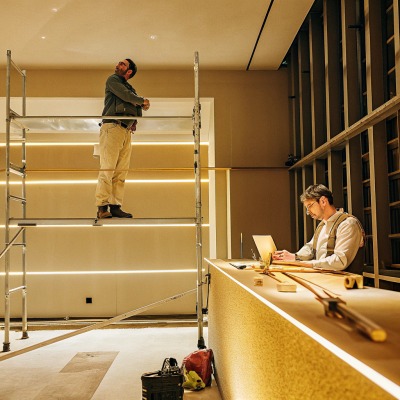
I still remember the panic in a client's voice when they realized their "quick fix" purchase of standard off-the-shelf LED rolls resulted in visible [voltage drop](https://glowinled.com/how-to-evaluate-voltage-drop-in-led-strips-after-prolonged-use/ "voltage drop") across their visible voltage drop 1 hotel lobby ceiling. We managed to salvage the project with emergency engineering, but the stress and extra labor costs were entirely preventable. While grabbing a product that ships tomorrow feels efficient, applying a standard solution to a complex architectural requirement often introduces risks that surface only after installation.
Choosing between in-stock and custom high-density [dotless COB LED strips](https://glowinled.com/cob-led-strip "dotless COB LED strips") hinges on balancing immediate availability against long-term performance and installation efficiency Luminous Efficacy 2. In-stock options are ideal for short, standard runs where speed is critical, whereas custom solutions provide necessary control over voltage, precise lengths, and color consistency to eliminate risk in large-scale commercial projects.
To help you decide which path fits your current project, let's break down the critical differences in specs, performance, and cost.
What specific project requirements suggest I need custom COB specs over standard rolls?
When we analyze technical drawings for high-end high-end art gallery 3 retail or hospitality high-end retail 4 projects, we often spot constraints that standard inventory simply cannot accommodate without compromising the design. Attempting to force a standard 10mm wide strip into a slim 5mm joinery channel usually leads to overheating or adhesion failure.
Custom COB specifications become strictly necessary when your project involves non-standard physical dimensions, such as ultra-narrow PCBs for specialized millwork, or electrical requirements like 48V inputs for long continuous runs. If your installation environment demands specific chemical resistance or exact cut lengths to avoid shadowing in corners, standard rolls will fail to meet these engineering standards.
Understanding Physical and Electrical Constraints
The decision to customize is rarely just about aesthetics; it is usually dictated by the laws of physics and the laws of physics 5 hard constraints of your installation site. In-stock products are designed for the "average" user—typically 12V or 24V, 5 meters long, and 8mm or 10mm wide. However, professional integration often steps outside these averages.
The "10-Meter Rule" and Voltage Drop
One of the most common reasons our partners switch to custom orders is the need for long continuous runs. Standard in-stock 24V COB strips generally suffer from voltage drop after 5 to 7 meters. If you power them from one end, the LEDs at the far end will look dimmer.
For a project requiring a 15-meter or 20-meter run around a ceiling perimeter, using stock strips means you must run parallel wiring back to parallel wiring 6 the driver every 5 meters. This adds significant labor and cabling costs. By customizing the strip to a constant current design or increasing the voltage to 48V, we can achieve runs of up to 50 meters with a single power feed, ensuring perfect brightness uniformity without the wiring headache.
Geometric Precision
Standard rolls come with cut points every 25mm to 50mm. While this sounds flexible, it can be a disaster for precision joinery. If your cabinet is exactly 482mm wide, and your strip can only be cut to 450mm or 500mm, you are left with either a dark spot at the end or a strip that doesn't fit. Custom manufacturing allows us to engineer the circuit so the cut points align exactly with your fixture dimensions, ensuring edge-to-edge illumination.
Environmental Adaptability
Stock strips usually come in IP20 (indoor) or generic IP65 (silicone dropped). However, specific projects need more. For example, a swimming pool area requires chlorine resistance, and a coastal villa needs salt-mist resistance. We can customize the encapsulation material—using polyurethane or specialized neon silicone extrusions—to meet these rigorous demands, something off-the-shelf products rarely offer.
Summary of Technical Triggers
| Feature | Standard In-Stock COB | Custom COB Solution | When to Choose Custom |
|---|---|---|---|
| PCB Width | Fixed 8mm or 10mm | 3mm, 4mm, 5mm, 12mm+ | When fitting into narrow routed channels or slim profiles. |
| Voltage | 12V / 24V | 12V / 24V / 36V / 48V | For runs longer than 10m to avoid voltage drop. |
| Cut Points | Fixed (e.g., every 50mm) | Adjustable / Precisely Calculated | When exact edge-to-edge light is required in joinery. |
| Waterproofing | Standard IP20 / IP65 | IP67 / IP68 / Chemical Resistant | For submerged, outdoor, or harsh chemical environments. |
Will in-stock high-density strips provide the exact brightness and color temperature my design requires?
We frequently receive samples from clients complaining that the "3000K" strip they bought online looks clashingly pink or green next to their premium downlights. In B2B supply, relying on generic stock for color-critical applications is a gamble that can ruin the visual coherence of a luxury space.
In-stock strips typically rely on wider binning tolerances, meaning the brightness and color temperature can vary noticeably between different reels or production dates. Custom production allows you to enforce tight binning controls, often within a 2-step or 3-step MacAdam ellipse, guaranteeing that every meter of light matches perfectly across the entire project area for a flawless visual finish.

The Science of Color Consistency
When LED chips are manufactured, they do not all come out identical. They are sorted into "bins" based on their color and brightness. Stock products, in an effort to keep costs low, often use a mix of bins. This is why one roll might look "crisp white" while another looks "creamy yellow," even if both are labeled 3000K.
MacAdam Ellipses and Binning
In professional lighting, we measure consistency using MacAdam Ellipses (SDCM). MacAdam Ellipses 7
- Stock Standard: Usually 5-step or 7-step SDCM. The human eye can easily see the difference between two strips side-by-side.
- Custom Standard: We can specify 2-step or 3-step SDCM. At this level, the human eye cannot perceive any difference between chips.
If you are lighting a jewelry store or a high-end art gallery, "close enough" is not acceptable. Customizing the strip ensures that the bin code is locked for the entire order, and we can even reserve extra inventory of that specific bin for future repairs.
Lumen Output vs. Power Consumption
Another misconception is that "brighter is better." Stock strips are often driven hard to achieve high lumen numbers on the spec sheet, which generates excessive heat and shortens lifespan.
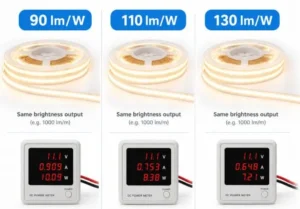
With custom COB strips, we can optimize the Luminous Efficacy. Instead of just pumping more power (Watts) to get more light, we can use higher-tier chips that produce more light with less heat.
- Scenario: You need 1000 lumens/meter.
- Stock Option: Might use 14W/meter to achieve this (getting hot).
- Custom Option: We can engineer it to use 10W/meter to achieve the same brightness by using better chips and a thicker copper PCB (3oz or 4oz) for heat dissipation. This results in a lighting system that lasts significantly longer.
CRI and R9 Values
Standard stock COB strips often boast "CRI 90," which is good, but they may have a low R9 value (the rendering of saturated red). R9 is crucial for rendering skin tones, food, and wood finishes accurately. In custom production, we can specify full-spectrum LEDs with CRI 97+ and R9>90, ensuring that the rich mahogany in a hotel bar or the fresh produce in a supermarket looks vibrant and true to life.
Performance Comparison Matrix
| Metric | Typical In-Stock Specs | Optimized Custom Specs | Impact on Project |
|---|---|---|---|
| Color Tolerance | 5-Step MacAdam (Visible variance) | 2 or 3-Step MacAdam (No visible variance) | Critical for adjacent runs and reflective surfaces. |
| CRI (Ra) | 80 - 90 | 95 - 98 | Essential for high-end retail and art displays. |
| R9 (Red) | Often < 50 | > 90 | Makes wood, skin, and food look natural. |
| Copper Weight | 2oz (Standard) | 3oz or 4oz | Better heat management and longer lifespan. |
How do lead times and costs compare when I switch from standard to custom-made LED solutions?
Our contractor partners often assume that going custom will blow their budget or delay the site handover, but we have found the opposite is often true for medium-to-large scale projects. The initial unit price of a product is only a fraction of the total installed cost, and rework is expensive.
While custom orders typically require a 2 to 4-week production lead time and may carry higher initial unit costs for small batches, they eliminate expensive on-site labor modifications. For projects exceeding 500 meters, economies of scale often make custom manufacturing cost-competitive with high-end stock options while significantly reducing installation time, material waste, and potential failure points.
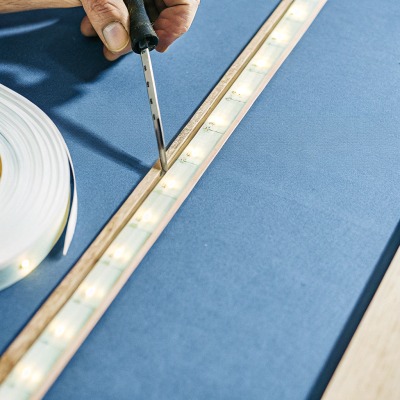
Analyzing the Total Landed Cost
It is easy to look at a catalog price of $5 per meter for stock and compare it to $7 per meter for custom and think stock is cheaper. However, this ignores the "labor tax" of installation.
The Hidden Costs of "In-Stock"
If you buy standard rolls for a project with 100 different cabinet lights, your electricians have to:
- Unroll and measure every piece.
- Cut the strip (creating waste/offcuts).
- Manually solder cables onto tiny pads (high risk of cold solder joints).
- Add heat shrink and sealants.
This manual labor is slow and expensive. In Western markets like Australia or the US, labor rates can exceed $80-$100 per hour.
The Efficiency of Customization
When we produce a custom order, we do the work at the factory level.
- Strips are manufactured to the exact length required.
- Connectors are machine-soldered and injection-molded (waterproof and durable).
- Labels are applied to match your architectural drawings (e.g., "Kitchen Cabinet L1").
The electrician simply opens the box and plugs it in. The savings in labor hours often outweigh the slightly higher material cost.
Lead Times: Planning vs. Panic
The main drawback of custom is time.
- In-Stock: Ships in 1-2 days. Good for last-minute changes or small renovations.
- Custom: Takes 15-20 days for production + shipping.
However, "Panic Procurement" often leads to errors. If a project is planned properly, a 3-week lead time is usually acceptable within the construction schedule. The key is construction schedule 8 freezing the lighting design early. If you are in the "rough-in" stage, you have time to order custom. If you are two days away from handover, you are stuck with stock.
Minimum Order Quantities (MOQ)
Factories have setup costs. Changing the production line for a specific resistor or PCB width costs money.
- Low Volume (<100m): Custom is expensive. Setup fees are amortized over a small number of meters. Stick to stock unless specs are critical.
- Medium Volume (100m - 500m): Custom becomes viable. Prices align closer to premium stock.
- High Volume (>500m): Custom is often cheaper than stock because we can optimize the bill of materials (BOM) specifically for your needs, removing unnecessary packaging or features you don't use.
Cost Breakdown: 500m Project Scenario
| Cost Component | Standard Stock Approach | Custom Factory Approach |
|---|---|---|
| Material Cost | $2,500 ($5/m) | $3,500 ($7/m) |
| Waste (Offcuts) | $250 (10% waste) | $0 (Exact lengths) |
| Connectors/Cables | $300 (Purchased separately) | Included |
| On-Site Labor | $2,000 (20 hours soldering/cutting) | $200 (2 hours plug-and-play) |
| Total Project Cost | $5,050 | $3,700 |
Can I maintain strict color consistency across different batches if I rely on in-stock inventory?
A recurring nightmare for facility managers is replacing a failed section of strip light two years later, only to find the new "Warm White" is noticeably pinker than the original installation. This inconsistency degrades the brand image and usually forces a total replacement of the entire run.
Maintaining strict color consistency with in-stock inventory is highly risky because suppliers frequently switch LED chip batches or even manufacturers without notice to maintain stock levels. Custom orders allow you to lock in specific bin codes and color coordinates, ensuring that future maintenance replacements or project extensions match the exact visual characteristics of the original installation.
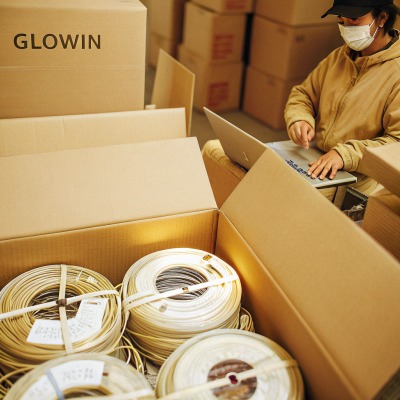
The "Market Standard" Trap
In the open market, "3000K" is a range, not a point. A supplier might buy chips from Brand A in January and Brand B in June. Both are technically 3000K, but Brand A might lean towards magenta (below the Black Body Locus) and Brand B Black Body Locus 9 might lean towards green (above the Black Body Locus).
If you install a project in phases—Phase 1 in January and Phase 2 in June—using stock strips, you will likely see a visible color shift where the two phases meet. This is disastrous for hotels, retail chains, or large residences.
Custom Bin Code Locking
When we handle a custom project, we record the unique "Bin Code" of the LED chips used.
- Project Archive: We save a sample of the production run in our archives.
- Bin Reservation: For large clients, we can ask the chip manufacturer to reserve a specific portion of their wafer production for us.
- Replacement Guarantee: If you need 50 meters for repairs two years later, we pull up the original Bin Code and manufacture the new strips to match exactly.
Future-Proofing Your Brand
For retail chains, consistency is branding. If a luxury fashion brand has 50 stores, the lighting must look identical in every single one.
- Stock Approach: Every store looks slightly different depending on what was available at the local wholesaler during construction.
- Custom Approach: We produce a massive batch of LEDs with a single bin code, store them, and manufacture strips on demand for each new store opening. This ensures global consistency.
Reducing Maintenance Liability
Using stock strips implies you are at the mercy of the market. If a specific model is discontinued (EOL), you cannot match it. Custom solutions give you ownership of the spec. Even if ownership of the spec 10 the underlying technology evolves, we can engineer the new chips to mimic the spectral output of the old ones, keeping your maintenance seamless.
Conclusion
The choice between in-stock and custom COB LED strips is ultimately a choice between convenience and control. For small residential renovations or rapid prototyping where deadlines are tight, in-stock high-density strips offer an excellent, low-risk solution. However, for commercial scale, high-end residential, or projects demanding specific technical performance, customization is not just a luxury—it is the only way to guarantee installation efficiency, visual uniformity, and long-term reliability.
Footnotes
- Explains the electrical phenomenon mentioned in the project failure example. ↩︎
- Technical metric for lighting efficiency mentioned in the performance section. ↩︎
- Example of a color-critical environment requiring precise lighting. ↩︎
- Provides context for the commercial environments requiring custom LED solutions. ↩︎
- General reference to the physical constraints affecting electrical design. ↩︎
- Technical term for the electrical configuration used to mitigate voltage drop. ↩︎
- Defines the metric used for measuring color consistency. ↩︎
- General reference for project management and quality standards. ↩︎
- Explains the reference curve for white light chromaticity. ↩︎
- Refers to proprietary specifications and standards maintained by industry leaders. ↩︎

 English
 Spanish
 German
 Russian
 Arabic
 French
 Portuguese