we frequently receive inquiries from Australian contractors and wholesalers who are confused by the "alphabet soup" of compliance acronyms. You want to import high-quality COB strips for your projects, but the fear of customs seizure or installation rejection is a constant worry. We understand that navigating these regulations is frustrating, but getting the paperwork right is just as critical as the quality of the LEDs we solder onto the PCB.
To import COB LED strips into Australia legally, you must request a valid Regulatory Compliance Mark (RCM) registration. This requires a Certificate of Conformity (often SAA) for electrical safety and a test report for Electromagnetic Compatibility (EMC) under AS/NZS CISPR 15 standards.
Once you understand the core requirements, the process becomes a straightforward checklist rather than a guessing game.
How do I verify if a supplier's SAA certificate is genuine and valid in Australia?
During our raw material sourcing and competitor analysis, we often encounter sub-suppliers claiming compliance with outdated or manipulated documents. Relying on a PDF sent via email without independent verification is a recipe for disaster, as we have seen shipments detained simply because a certificate number didn't match the database.
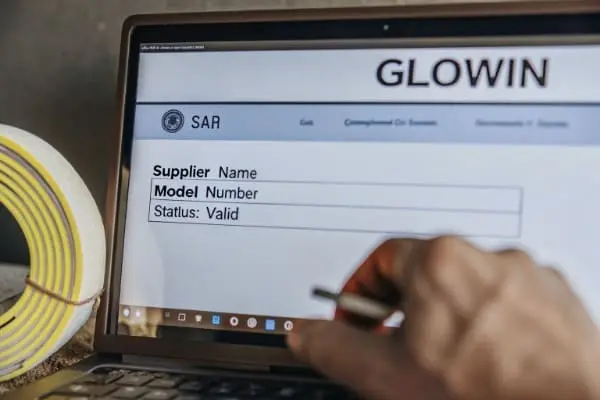
Verify SAA certificates by searching the unique certificate number on the JAS-ANZ register or the issuing body's online database. Ensure the supplier's name and specific model numbers match the document exactly, as slight variations in model suffixes can render the certification invalid for your shipment.
The Verification Process
When we prepare documents for our Australian partners, we encourage them to audit us. You should take the same approach with any vendor. A PDF file is easy to forge in Photoshop; a database entry is not.
Step 1: Identify the Issuing Body
The "SAA" term is often used loosely to refer to any electrical safety approval, but the actual certificate might be issued by SAA Approvals, Global-Mark, or another JAS-ANZ accredited body. Look at the logo on the top of the certificate.
Step 2: Use the EESS and JAS-ANZ Databases
Australia uses the Electrical Equipment Safety System (EESS). You can search for the equipment registration, but for the certificate itself, go to the JAS-ANZ register or the specific certifier's website (e.g., SAA Approvals). Enter the certificate number found on the document. If the status is "Expired," "Cancelled," or "Withdrawn," do not proceed.
Step 3: The Model Number Trap
This is where most importers fail. If your invoice lists a model number like GL-COB-24V-10W, but the certificate only lists GL-COB-24V-5W, you are not covered. At our factory, we ensure that the "family" of models listed on the certificate covers the specific wattage and voltage variants we export. If the supplier says "it's basically the same product," do not accept it. The Australian Border Force (ABF) looks for exact matches.
Red Flags to Watch For
We have compiled a list of common indicators that a certificate might be questionable based on what we see in the market.
| Indicator | Genuine Certificate | Suspicious/Fake Certificate |
|---|---|---|
| Resolution | Crisp, vector-based text or high-res scan. | Blurry text, pixelated logos, or different fonts used for model numbers. |
| Holder Name | Matches the factory or exporter exactly. | Lists a different company name without an authorization letter. |
| Dates | Issue date is within the last 5 years. | Issue date is very old (SAA certs are typically valid for 5 years). |
| Scope | Explicitly lists "LED Module" or similar. | Vague description or covers a different product type (e.g., "Power Supply"). |
Linking SAA to RCM
Remember, the SAA certificate is just one part of the puzzle. It proves electrical safety (AS/NZS 60598 series). You also need the EMC report (AS/NZS CISPR 15). The RCM mark on the product signifies that both of these have been met and the supplier is registered.
What are the penalties for installing non-RCM certified LED strips in commercial projects?
We have seen competitors lose entire project contracts because they tried to cut corners on compliance to save a few cents per meter. Contractors often ask us if they can skip the RCM for "small" projects, but the risk extends far beyond a simple fine; it threatens your business's existence and reputation.
IP67 rating 1
Installing non-RCM compliant LED strips in commercial projects can result in corporate fines and mandatory product recalls at your expense. Furthermore, using uncertified electrical equipment typically voids property insurance policies, leaving contractors personally liable for fire or safety damages.
Financial and Legal Consequences
The penalties in Australia are among the strictest in the world. The regulators, such as the ACMA (Australian Communications and Media Authority) and state-based electrical safety regulators, have the power to audit and fine.
Australian Communications and Media Authority 3
Direct Fines
For corporations, fines can scale massively depending on the severity of the breach. While individual fines might start lower, a systemic failure to ensure compliance across a large commercial project can lead to maximum penalties. If we were to ship non-compliant goods, we would risk being blacklisted, but as the importer or installer, you face the immediate financial hit.
Mandatory Recalls
Imagine you have installed 5,000 meters of COB strip in a new shopping mall. If those strips are found to be non-compliant (causing radio interference or posing a fire risk), you may be ordered to remove and replace every single meter. The cost of labor, access equipment (scissor lifts), and business disruption often dwarfs the cost of the product itself.
Insurance Voiding
This is the "silent killer" of businesses. Commercial property insurance policies almost universally contain clauses requiring all electrical work and materials to comply with local laws (AS/NZS 3000 Wiring Rules).
- Scenario: A fire starts in a ceiling bulkhead where your LED strips are installed.
- Outcome: The forensic investigator finds the LED strips lack RCM compliance. The insurer denies the claim.
- Liability: The building owner sues the contractor for the entire cost of the damage.
The Chain of Responsibility
Legislation in Australia creates a "Chain of Responsibility." This means liability doesn't just stop at the manufacturer in China.
- The Importer: Legally defined as the "Responsible Supplier."
- The Wholesaler: Must ensure goods sold are compliant.
- The Installer: Must verify the RCM mark before installation.
| Party Involved | Primary Risk | Consequence |
|---|---|---|
| Importer | Customs Seizure | Loss of stock, storage fees, potential prosecution. |
| Contractor | License Suspension | Loss of electrical license, fines, litigation. |
| Building Owner | Insurance Denial | Uninsured losses from fire or electrical accidents. |
Do I need specific test reports for IP67 waterproof COB strips used outdoors?
When we engineer waterproof solutions for the Australian market, we account for more than just rain. The combination of intense UV exposure and high ambient temperatures can destroy standard silicone casings quickly. We often see "waterproof" strips turn yellow and crack within six months because they were only tested for water, not the environment.
destroy standard silicone casings 4
Yes, you need a formal test report according to AS 60529 standards confirming IP67 protection against dust and water immersion. Additionally, request thermal validation reports to ensure the silicone casing does not delaminate or yellow under Australia's high UV and temperature conditions.

Why Standard IP Ratings Are Not Enough
A standard IP67 rating simply means the product was submerged in water (usually 1 meter deep) for 30 minutes and remained functional. However, in our lab, we know that a fresh product straight off the production line performs differently than one that has been baking in the sun for a year.
silicone potting material 6
The Thermal Cycling Factor
Australia has extreme temperature fluctuations. A COB strip installed on an outdoor facade might reach 60°C during the day and drop to 10°C at night.
- The Problem: The PCB (circuit board) and the silicone potting material expand and contract at different rates.
- The Failure: Over time, this causes delamination—the silicone pulls away from the PCB. Once this happens, moisture enters, and the IP rating is void.
- The Solution: We perform "Thermal Cycling Immersion" tests. We heat the strip, then immediately submerge it in cold water. This stresses the seals. You should ask suppliers if they perform this specific durability test, not just the static IP test.
Photobiological Safety and UV Stability
For outdoor projects, the material of the waterproofing is critical.
- PVC vs. Silicone: Cheap strips use PVC, which yellows under UV light, shifting the color temperature of your light (e.g., 4000K becomes 3000K). High-quality strips use UV-stabilized silicone.
- Blue Light Hazard: With high-density COB strips, the intensity of the light is high. An IEC 62471 report ensures the light is safe for human eyes (Photobiological Safety), which is increasingly required for commercial specs.
Checklist for Outdoor COB Strips
Don't just ask "Is it IP67?" Ask for the evidence.
- AS 60529 Test Report: Issued by an accredited lab.
- Material Data Sheet: Confirming UV-stabilized silicone (not PVC).
- Salt Spray Test: If the project is coastal (near the ocean), standard IP67 is insufficient. You need salt mist corrosion testing to ensure the solder pads and connectors won't corrode.
How does the RCM compliance process differ for OEM private label LED products?
Our OEM partners often assume they can simply use our factory certificates directly and slap their brand on the box. However, Australian regulations are very specific about who holds the liability. If you are importing our products under your own brand name (Private Label), the legal burden shifts significantly towards you.
AS/NZS 3000 Wiring Rules 7
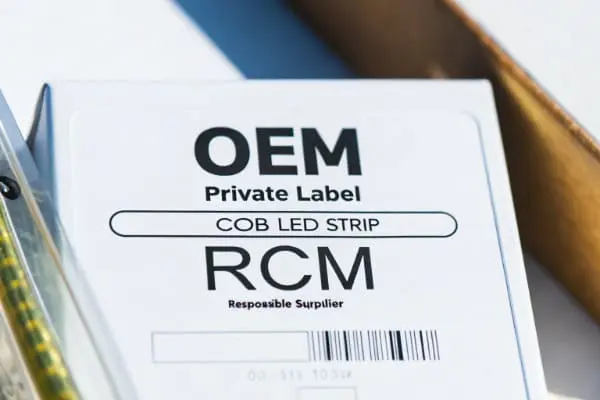
For OEM private label products, the Australian importer must register as a Responsible Supplier on the EESS database. You cannot simply use the factory's RCM; you must link our original safety certificates to your own profile and ensure your unique brand packaging bears the RCM logo.
The "Responsible Supplier" Concept
In the eyes of the EESS (Electrical Equipment Safety System), the entity that puts the product onto the Australian market is the Responsible Supplier.
- If you buy our brand (Glowin): We (or our local agent) are the Responsible Supplier. We handle the registration.
- If you buy your brand (OEM): YOU are the Responsible Supplier.
The Linking Process
You do not need to pay for thousands of dollars in new testing if we have already done it. The process works like this:
- Obtain Original Certs: We provide you with our SAA Certificate of Conformity and EMC reports.
- Permission Letter: We issue a letter authorizing you to use our test reports for your registration.
- EESS Registration: You log into the EESS database, register your company, and "link" our certificate number to your profile.
- Declaration of Conformity (DoC): You sign a document stating that the products you are importing (under your model numbers) are identical to the ones tested in our reports.
Labeling Requirements
This is a common friction point. The RCM logo must be applied to the product.
- Size Rule: The logo must be at least 3mm high.
- Placement: Ideally on the product itself (the PCB).
- Exemption: If the COB strip is too narrow (e.g., 5mm or 8mm slim strips) to fit a legible 3mm logo, the regulations allow the mark to be placed on the packaging and documentation instead. However, you must document why it wasn't on the product in your compliance folder.
Comparison: Standard vs. OEM Import
| Feature | Standard Import (Our Brand) | OEM Private Label (Your Brand) |
|---|---|---|
| EESS Registration | Supplier/Agent handles it. | You must register ($200+ annual fee). |
| Liability | Shared/Supplier focused. | You are the primary legally responsible party. |
| Documentation | You keep a copy of our certs. | You must maintain a technical construction file. |
| Brand Consistency | Builds our brand. | Builds your brand equity and asset value. |
We always advise our OEM clients to factor in the administrative time for this. It is not difficult, but it is mandatory. Ignoring this step means your "branded" product is technically unregistered and illegal to sell, even if the hardware is identical to a compliant product.
JAS-ANZ register 9
Conclusion
Navigating the compliance landscape for importing COB LED strips to Australia requires diligence, but it is the foundation of a sustainable business. By ensuring you have valid RCM registration backed by genuine SAA safety certificates and EMC reports, you protect your company from crippling fines and liability. Whether you are buying standard products or developing an OEM line with us, verifying these documents is not just paperwork—it is your license to operate safely in the market.
search for the equipment registration 10
Footnotes
- General definition of the Ingress Protection rating system. ↩︎
- Major testing laboratory explaining the photobiological safety standard requirements. ↩︎
- The government regulator responsible for EMC compliance and RCM labeling in Australia. ↩︎
- Academic research on thermal degradation and failure modes of LED materials. ↩︎
- General background information on light color characteristics. ↩︎
- Major manufacturer of silicone encapsulants explaining material properties for electronics. ↩︎
- The national standards body responsible for Australian electrical wiring regulations. ↩︎
- International standard body defining the luminaires safety standard adapted by Australia. ↩︎
- Official registry to verify accreditation of the certification body issuing the document. ↩︎
- Official Australian government database for electrical equipment safety registration. ↩︎