
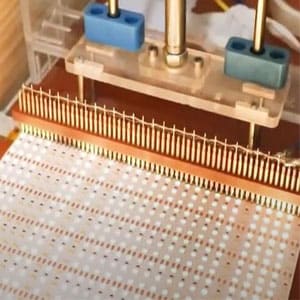
We usually get inquiries from contractors and wholesalers who need LED strips tailored to exact project specs — but feel lost about where to begin.
The OEM/ODM customization process for engineering LED strip lights typically follows a structured flow: consultation and spec definition, prototype development and testing, sample approval, mass production with integrated quality control, certification, and final delivery with after-sales support.
Below, we break down each stage so you know exactly what to expect, what to ask, and how to avoid common pitfalls CRI, CCT, and luminous flux 1. Let's walk through it together.
How do I start the OEM customization process for my specific project requirements?
Many buyers reach out to our sales team with a rough idea — a voltage, a color temperature 2, maybe a length — but no formal spec sheet. That uncertainty can slow everything down.
You start by sharing your project details — application type, desired brightness, color temperature, voltage, IP rating, length, and control protocol — with your chosen manufacturer, who then confirms feasibility, provides a quotation, and drafts a specification sheet for mutual approval.

Define Your Core Specifications First
Before contacting any supplier, gather the basics. Our engineering team always asks for these parameters upfront:
| Parameter | Common Options | Why It Matters |
|---|---|---|
| Voltage | 12V, 24V, 48V, AC220V | Determines driver selection and safety compliance |
| Color Temperature | 2700K, 3000K, 4000K, 6500K | Sets the mood and matches design intent |
| IP Rating 3 | IP20, IP54, IP65, IP67, IP68 | Dictates waterproofing method and installation environment |
| LED Density | 60, 120, 240 LEDs/m | Affects brightness and dot-free performance |
| Length per Run | 5m, 10m, 20m, 50m+ | Impacts voltage drop and PCB copper thickness |
| Control Protocol | Non-dim, TRIAC, 0-10V, DALI, DMX, SPI | Determines compatibility with existing systems |
The Consultation Flow
Once we receive your initial requirements, the process moves quickly:
- Requirement review. Our engineers assess feasibility. Can the spec be achieved with standard components, or does it need a custom PCB layout?
- Technical confirmation. We send back a detailed spec sheet. This includes LED chip brand, PCB width, copper weight, adhesive type, and connector style.
- Quotation. Pricing depends on complexity, volume, and certification needs. We typically quote within 48 hours.
- Contract signing. Both sides agree on specs, timeline, payment terms, and quality benchmarks.
OEM vs. ODM — Which Path Fits You?
This is a decision point many buyers overlook. If you already have a complete design — circuit layout, BOM, mechanical drawings — you want OEM. We manufacture to your exact blueprint. If you have a performance goal but no design, ODM is the better route. Our R&D team handles the engineering, and you approve the result.
| Factor | OEM | ODM |
|---|---|---|
| Design ownership | Buyer owns the design | Manufacturer owns or co-develops |
| Upfront effort | High — buyer provides all specs | Low — manufacturer proposes solutions |
| Differentiation | Maximum brand uniqueness | Moderate — shared platform possible |
| Speed to market | Slower (design validation needed) | Faster (proven designs available) |
| Best for | Experienced brands with engineering teams | New brands or project-based buyers |
The key takeaway: neither path is better. It depends on your resources and timeline. Most of our Australian and German clients start with ODM for the first project, then shift to OEM once they understand the product deeply.
How can I ensure my custom LED strips maintain color consistency across different production batches?
Color inconsistency is one of the most frustrating problems our clients face. One contractor told us he installed strips from two different batches side by side in a hotel lobby — the difference was visible to the naked eye.
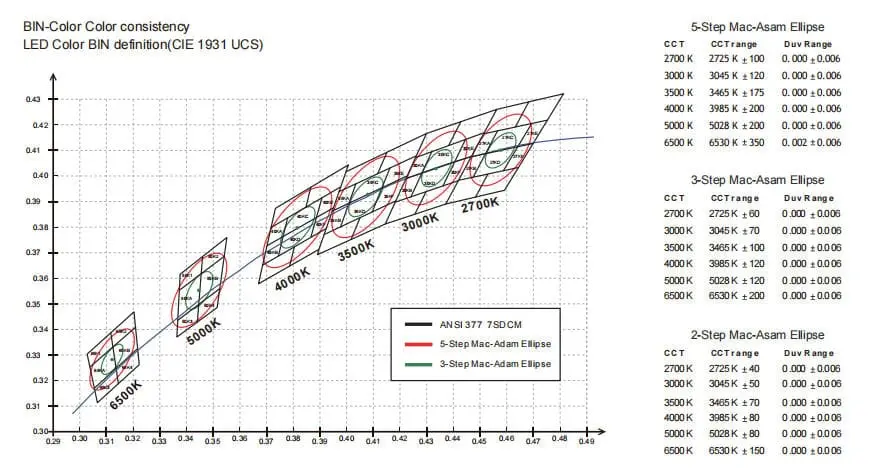
To maintain color consistency across batches, insist on binned LEDs from the same MacAdam ellipse (ideally 3-step or tighter), require your manufacturer to document bin codes per order, and implement incoming quality checks with a spectrophotometer before each production run.
What Causes Color Variance?
LED chips are not identical. Even chips from the same wafer vary slightly in color temperature, brightness, and forward voltage. Manufacturers sort these chips into "bins" — groups with similar characteristics. The tighter the bin, the more consistent the output.
The MacAdam ellipse 4 is the industry standard for measuring perceptible color difference. A 3-step MacAdam ellipse means most people cannot see the difference between two light sources. A 5-step ellipse is noticeable to trained eyes. Anything beyond 7 steps is obvious to everyone.
Practical Steps We Use in Production
When we run production for clients who demand visual uniformity — hotel projects, retail chains, museum lighting — we follow a strict protocol:
- Single-bin procurement. We purchase LED chips from a single bin code for the entire order. If the order spans multiple months, we reserve chips upfront.
- Incoming inspection. Every reel of LEDs is tested with a spectrophotometer 5 before it hits the SMT line. We record CRI, CCT, and luminous flux.
- Mid-production sampling. Every 500 meters, we pull a sample strip and test it under controlled conditions.
- Aging test. Finished strips run for 8–24 hours. We re-test color after aging because initial drift is normal.
- Batch documentation. Each shipment includes a test report with bin codes, CCT readings, and CRI values. This lets the client trace any future issues.
What to Ask Your Supplier
Not every factory follows these steps. Here are questions that separate serious manufacturers from assembly shops:
- What MacAdam step do you guarantee?
- Can you provide bin code traceability per order?
- Do you test with a spectrophotometer or just a visual check?
- How do you handle leftover chips between orders?
If a supplier cannot answer these questions clearly, color consistency will be a gamble.
| Quality Level | MacAdam Step | Typical Application | Price Impact |
|---|---|---|---|
| Standard | 5-step | General commercial | Baseline |
| High | 3-step | Hospitality, retail | +10–15% |
| Premium | 2-step | Museums, galleries | +20–30% |
Can I get a rapid prototype of my custom design before committing to a full production run?
Our clients — especially design firms and new private-label brands — rarely want to commit thousands of dollars to a full run without seeing and testing a sample first. That hesitation is completely reasonable.
Yes, most experienced LED strip manufacturers offer rapid prototyping, typically delivering 1–3 sample units within 5–10 working days. This allows you to test fit, light output, color accuracy, and compatibility with your drivers and controls before approving mass production.
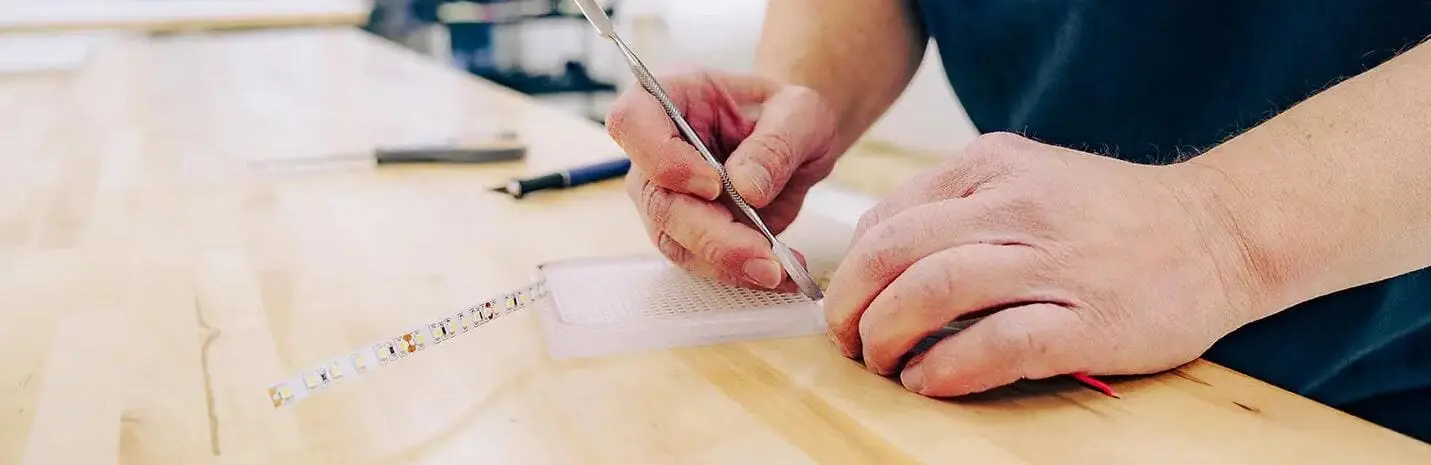
How Our Prototyping Process Works
When a client requests a prototype, we follow a streamlined flow. The goal is speed without sacrificing accuracy — because a prototype that does not represent the final product is worthless.
Step 1: Confirm the spec sheet. This must be locked before prototyping starts. Changes mid-prototype reset the clock.
Step 2: Source or allocate components. If we stock the required LED bin and PCB, prototyping can begin within one day. Custom PCBs add 3–5 days for fabrication.
Step 3: SMT and assembly. Our line runs the prototype using the same machines and processes as mass production. This is critical — a hand-soldered sample will not behave the same as a machine-assembled one.
Step 4: Testing. We test the prototype for CCT, CRI, lumen output, voltage drop across the full length, thermal performance 6, and waterproof integrity if applicable.
Step 5: Ship to client. We send the sample with a full test report. Clients typically need 1–2 weeks to evaluate on their end.
What About Cost?
Some factories offer free prototypes. We charge a modest sample fee that gets credited toward the bulk order. This ensures both sides are serious. Free samples sound attractive, but they sometimes come with less rigorous testing or use different components than the production run.
Iteration Is Normal
Most custom projects need one or two rounds of revision. Maybe the warm white is slightly too yellow. Maybe the adhesive does not hold on a specific surface. Each round typically takes 5–7 days. Budget for this in your timeline.
The biggest mistake buyers make is skipping the prototype to save time. In our experience, that decision costs far more when problems surface during installation on site. A two-week prototype phase can prevent a two-month project delay.
When Prototyping Is Not Needed
If you are reordering a product we have already produced for you — same spec, same components — a prototype is unnecessary. We simply reference the previous production file and run a pre-production sample for internal QC confirmation.
What are my options for private labeling and custom packaging for my wholesale brand?
Building a brand around LED strips you source from China is increasingly common. Several of our long-term partners in Australia and Germany sell under their own names, and their end customers never know the product was manufactured overseas.
Private labeling options typically include custom logo printing on the LED strip itself, branded labels on reels, custom packaging boxes with your brand design, printed installation guides, and co-branded certification labels — all configurable to match your brand identity and market requirements.
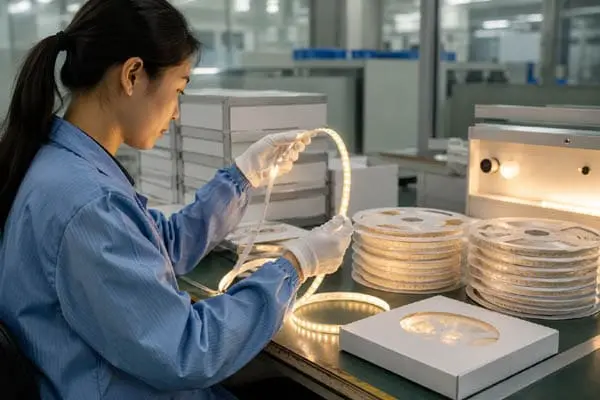
Branding Touchpoints
Every physical element the end customer sees is a branding opportunity. Here is what we commonly customize:
| Element | Customization Options | Typical MOQ |
|---|---|---|
| LED strip surface | Logo printed every 0.5m or 1m | 500m |
| Reel label | Full-color sticker with specs, logo, barcode | 100 reels |
| Inner box | Custom printed box with brand colors | 200 units |
| Outer carton | Branded or neutral, buyer's choice | 100 cartons |
| Installation guide | PDF or printed booklet, your brand | 500 copies |
| Certification label | UL/CE/SAA mark with buyer's file number | Per certification |
Packaging Design Support
Not every buyer has a design team. We offer layout templates for boxes and labels. You provide your logo, brand colors, and any required text. Our graphic team formats it for print. Proofs go through two rounds of approval before production.
For the Australian market specifically, SAA certification marks and RCM logos must appear on packaging. We handle the placement according to regulatory requirements so your product passes inspection at customs.
Certification Under Your Brand
This is a detail many new brands miss. If you want UL, CE, or SAA certification 7 under your own company name, you need to apply as the certificate holder. We support this process by providing test samples, factory audit documentation, and technical files. The certification belongs to you, which strengthens your brand credibility and protects your market position.
Alternatively, you can sell under our existing certifications with a co-branding arrangement. This is faster and cheaper but gives you less control.
Minimum Order Quantities
MOQs for private labeling 8 are lower than most buyers expect. Custom labels and stickers can start at 100 units. Custom printed boxes usually require 200–500 units. The LED strip itself often has a 500-meter minimum for a fully custom spec, but standard specs with custom branding can start at 100 meters.
The goal is to make private labeling accessible even for smaller distributors testing a new market. We have seen brands start with a single 500-meter order and grow to monthly shipments within a year.
Conclusion
The OEM/ODM process is straightforward when communication is clear. Define your specs, approve a prototype, confirm quality benchmarks, and scale to production with confidence.
Footnotes
- Defines and differentiates CRI, CCT, and luminous flux (lumens) in LED lighting. ↩︎
- Provides a comprehensive definition and explanation of color temperature. ↩︎
- Official source for the International Electrotechnical Commission (IEC) IP code standard. ↩︎
- Explains MacAdam ellipses and their significance for LED color consistency. ↩︎
- Replaced with a Wikipedia article providing a comprehensive overview of spectrophotometry and its working principles. ↩︎
- U.S. Department of Energy resource explaining the importance of thermal management for LEDs. ↩︎
- Explains the meaning and applicability of UL, CE, and CSA certification marks. ↩︎
- Provides a general definition and overview of private label products and manufacturing. ↩︎

 English
 Spanish
 German
 Russian
 Arabic
 French
 Portuguese