Every week, our sales team receives emails from contractors and distributors asking the same question: "Why is your quote different from the other three I got?" The frustration is real. You stare at two quotes for what looks like the same LED strip, but one is 30% cheaper copper PCB substrate 1. You can't tell if you're overpaying or if the cheaper option is cutting corners on copper weight or chip quality. Without a clear breakdown, you're making a decision in the dark — and that's where costly mistakes happen.
To properly evaluate supplier quotes, separate every line item into raw materials (LEDs, copper, PCB, silicone), direct labor (SMT assembly, soldering, testing), manufacturing overhead, packaging, logistics, and profit margin. Request itemized breakdowns, verify material specs against unit costs, and benchmark at least three quotes side by side to spot hidden trade-offs.
In this guide, I'll walk you through the exact process our procurement partners use to dissect quotes, catch inflated line items, and make confident purchasing decisions chromaticity coordinates (CIE x, y) 2. Let's dig in section by section.
How do I identify the true material costs versus labor fees in my LED strip quotes?
When we prepare quotes on our production line, we know exactly which cost drivers matter most — and which ones suppliers sometimes obscure Total Cost of Ownership (TCO) 3. The problem is that most buyers receive a single lump-sum price and never question what's inside it. That's a missed opportunity.
True material costs in LED strip quotes come from five core components: LED chips, copper PCB substrate, resistors, silicone or PU encapsulant, and connectors. Labor fees cover SMT placement, reflow soldering, quality inspection, cutting, and packaging. Always request a line-item breakdown separating these two categories before comparing any quotes.

The Five Core Material Cost Drivers
Understanding what goes into your LED strip at the component level is the single most effective way to evaluate a quote. Here's a quick reference:
| Material Component | What It Affects | Typical Cost Share |
|---|---|---|
| LED chips 4 (e.g., Cree, Lumileds, domestic) | Brightness, CRI, lifespan | 35–50% of material cost |
| Copper PCB (weight: 1oz, 2oz, 3oz) | Heat dissipation, current capacity | 15–25% of material cost |
| Resistors & ICs | Current regulation, dimming | 5–10% of material cost |
| Silicone / PU encapsulant | IP rating, flexibility | 10–20% of material cost |
| Connectors & solder paste | Reliability, ease of install | 5–8% of material cost |
When a supplier gives you a total price per meter, ask them to separate these items. If two quotes show the same wattage and LED count but differ by 20% in price, the answer almost always lies in the chip brand or the copper weight. A 1oz copper board is significantly cheaper than a 3oz board, but it also handles heat far worse. That trade-off matters for long-run installations where thermal management 5 determines lifespan.
Labor: More Transparent Than You Think
Labor in LED strip manufacturing is relatively standardized. SMT (Surface Mount Technology) 6 lines run at predictable speeds. Our SMT machines place thousands of components per hour, and the labor cost per meter is fairly stable. The real variables are:
- Manual steps: Hand-soldering connectors, applying waterproof coatings by hand, and custom cutting add labor time.
- Inspection labor: If your project requires 100% bin-level color testing instead of sampling, that adds direct labor.
- Skill level: Basic assembly workers cost less than trained QC technicians who operate spectrometers or integrating spheres.
A useful rule of thumb for LED strip production: materials typically account for 60–70% of the product cost, while labor sits at 15–25%, with overhead and margin filling the rest. This is the opposite of construction, where labor dominates. So when you negotiate LED strip pricing, focus your energy on understanding material specs rather than squeezing labor rates.
How to Reverse-Engineer a Quote
Take the quoted price per meter. Subtract the rough labor estimate (which you can ask the supplier for directly). What remains should align with the material specs they've promised. If a supplier quotes $2.00/m but claims to use Cree chips and 2oz copper — both of which we know cost more than $1.50/m in materials alone at current commodity prices — something doesn't add up. Either the specs aren't what they claim, or they're losing money (unlikely). This is what I mean by letting the numbers tell the story.
What hidden assembly and packaging charges should I look for in my custom OEM pricing?
Our team often sees buyers focus entirely on the strip itself and ignore everything that happens after the strip comes off the SMT line. That's exactly where hidden costs accumulate — silently inflating your project budget.
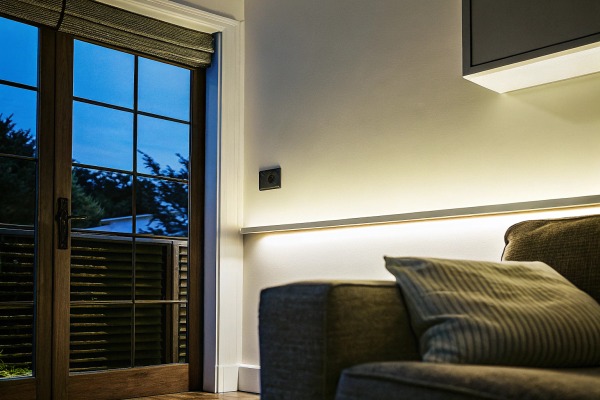
Hidden charges in custom OEM LED strip pricing commonly include waterproof potting or sleeving, custom cutting to non-standard lengths, private-label printing, specialized packaging (anti-static reels, retail boxes), soldered connectors or wired leads, and additional testing fees for color binning or burn-in. Always request these as separate line items.
Post-Production Costs That Add Up Fast
Once the bare LED strip is assembled, there's a chain of value-added steps that each carry a cost. Some suppliers bundle these into the unit price. Others list them separately. The problem occurs when they're bundled and you can't see what you're paying for — or when they're excluded and suddenly appear as surcharges after you place the order.
Here's a breakdown of common post-production charges:
| Service | Typical Cost Impact | Often Hidden? |
|---|---|---|
| IP65 silicone coating 7 (extrusion) | +$0.20–$0.50/m | Sometimes bundled |
| IP67/IP68 tube or potting | +$0.50–$1.50/m | Often quoted separately |
| Custom cut lengths (non-standard) | +$0.05–$0.15/cut point | Frequently hidden |
| Soldered pigtail wires / connectors | +$0.10–$0.30/unit | Often hidden in "assembly" |
| Private-label printing on PCB or sleeve | +$0.03–$0.10/m | Tooling fee sometimes extra |
| Anti-static reel packaging | +$0.05–$0.15/reel | Bundled or excluded |
| Retail box / custom carton | +$0.30–$2.00/unit | Usually separate quote |
| Color binning / burn-in testing | +$0.05–$0.20/m | Often hidden in "QC fee" |
Tooling and Setup Fees
For custom OEM projects, there's almost always a one-time tooling or setup cost. This covers things like creating custom silicone extrusion molds for unique profiles, printing plates for branded packaging, and programming SMT machines for non-standard layouts. We're transparent about these at Glowin because we believe you should know exactly where every dollar goes. But not all suppliers are. Ask directly: "Are there any NRE (Non-Recurring Engineering) or tooling fees?" If the answer is vague, push for specifics.
Packaging: The Overlooked Budget Killer
Packaging seems trivial until you're ordering 10,000 units. A basic ESD bag costs almost nothing. But if your project or retail channel requires individual boxes with printed inserts, barcodes, and custom reel labels, costs add up to $1–$2 per unit or more. For a 5-meter reel that costs $8 in product, that's a 12–25% increase just from packaging. When we quote for Australian distributors who need retail-ready packaging, we always separate the strip cost from the packaging cost so our partners can make informed decisions.
How to Protect Yourself
Request what's called an "open-book" or "cost-plus" quote structure. This means the supplier lists every material, labor step, and overhead item with its cost, then adds a transparent margin on top. It requires more trust and effort, but it eliminates surprises. If a supplier refuses to break out packaging and assembly charges, that's a red flag worth noting.
How can I compare quotes from different suppliers when my project requires strict color consistency?
Color consistency is one of the most painful issues our team deals with — not because it's unsolvable, but because so few buyers know how to specify it properly. When you need every reel to match visually across a hotel corridor or a retail display wall, a vague spec means vague results.
To compare quotes for color-consistent LED strips, require suppliers to specify the LED binning standard (e.g., 3-step MacAdam ellipse), the bin selection range, and whether they guarantee within-reel and reel-to-reel consistency. Ask for test reports showing chromaticity coordinates (CIE x, y) and verify that pricing reflects the tighter bin sorting required.
Why Color Consistency Costs More
LED chips come off the production line with natural variation. Manufacturers like Cree, Samsung, or Lumileds sort these chips into "bins" based on color temperature, brightness, and forward voltage. Tighter bins mean more chips get rejected — which drives up cost. A 5-step MacAdam ellipse 8 is visually acceptable for most general lighting. A 3-step ellipse is what architects and designers demand for uniform visual appearance. Going from 5-step to 3-step can increase chip cost by 10–20% because the yield of usable chips drops.
When we source chips for projects requiring strict consistency, we purchase from a single production lot and a single bin code. This costs more, but it eliminates the visible color shifts that ruin a project's aesthetic.
What to Ask Each Supplier
Here's a comparison framework you can use across quotes:
| Specification | Supplier A | Supplier B | Supplier C |
|---|---|---|---|
| LED chip brand & model | |||
| MacAdam ellipse step | |||
| CCT range guaranteed (e.g., 3000K ± 50K) | |||
| CRI guaranteed (e.g., ≥90) | |||
| Single bin code / lot? | |||
| Within-reel ΔCx, Δy tolerance | |||
| Reel-to-reel ΔCx, Δy tolerance | |||
| Test report included? | |||
| Price per meter |
Fill in this table for each supplier. If a supplier can't answer the MacAdam ellipse question or doesn't know what bin code they use, that tells you their level of quality control. Price means nothing without this context.
The Real Cost of Getting It Wrong
I've seen projects where a contractor installed 200 meters of LED strip across a lobby ceiling, only to discover that the last 50 meters were visibly warmer than the first 150. The rework cost — new product, new labor, project delays, unhappy clients — far exceeded the savings from choosing the cheapest quote. When our team quotes for projects like this, we include a "color consistency premium" that covers single-lot chip purchasing and 100% reel-level chromaticity testing. It adds roughly 8–15% to the product cost but eliminates the rework risk entirely.
Apples-to-Apples Comparison
If one supplier quotes $3.50/m with 5-step MacAdam and another quotes $4.20/m with 3-step MacAdam, the second isn't more expensive — it's offering a different product. Normalize specs before comparing prices. If you can't normalize, you're comparing apples to oranges, and the cheapest quote will almost certainly cost you more in the long run.
What additional logistics and QC costs should I include in my total project budget?
After working with contractors and wholesalers in Germany and Australia for years, our logistics team knows exactly where the "surprise" costs appear — customs clearance, palletization requirements, third-party inspections, and inbound freight that nobody budgeted for. These aren't trivial amounts.
Beyond product cost, include international freight (sea/air), customs duties and import taxes, third-party QC inspection fees, palletization and export packaging, insurance, local last-mile delivery, and a 3–5% contingency for currency fluctuation or commodity price changes. These logistics and QC costs typically add 12–25% to your landed cost.

Building a True Total Cost of Ownership (TCO)
The price on a supplier's quote is your FOB or Ex-Works cost 9. It's not your landed cost. It's not your project cost. To build a real budget, you need to add every cost layer from the factory gate to the installation site. Here's how we help our partners think about it:
Freight and Shipping: Sea freight from Shenzhen to Sydney currently runs approximately $800–$1,500 for a 1 CBM shipment of LED strips. Air freight is 4–6x more. Your choice depends on timeline. Rush orders for project deadlines almost always end up on a plane, and that cost can eat your entire margin if you didn't plan for it.
Customs and Duties: LED lighting products imported into Australia are generally subject to 5% customs duty plus 10% GST. In Germany, the EU tariff on LED products is typically 3.7%, plus 19% VAT (reclaimable for businesses). These are not optional costs — they must be in your budget.
Third-Party QC Inspection: If you're importing from any overseas supplier, a pre-shipment inspection by a firm like SGS, TÜV, or Bureau Veritas costs $250–$400 per inspection day. For large orders, this is a small price to pay for peace of mind. We encourage our partners to inspect, even when they trust us, because it protects both sides.
The Contingency Factor
Commodity prices for copper and silicone fluctuate. Currency exchange rates shift. A quote valid today might not hold in 60 days. We recommend adding a 3–5% contingency buffer to your total project budget. This covers:
- Copper price increases between quote date and production date
- Currency fluctuation (AUD/USD or EUR/USD)
- Minor spec adjustments discovered during sampling
- Unexpected re-testing or re-inspection fees
Putting It All Together
Here's a simplified example showing how a $3.00/m FOB quote becomes a very different landed cost:
| Cost Layer | Per Meter | % of Landed Cost |
|---|---|---|
| FOB product cost | $3.00 | 66% |
| Sea freight (allocated) | $0.25 | 5% |
| Customs duty (5%) | $0.15 | 3% |
| Import GST (10%) | $0.34 | 7% |
| QC inspection (allocated) | $0.08 | 2% |
| Local delivery | $0.10 | 2% |
| Insurance | $0.03 | 1% |
| Contingency (5%) | $0.15 | 3% |
| Landed cost | $4.10 | ~100% |
That $3.00 quote just became $4.10 — a 37% increase. If you quoted your client based on $3.00, you're in trouble. This is why Total Cost of Ownership matters far more than the number on a supplier's proforma invoice.
Geopolitical and Tariff Awareness
Trade policies change. The EU's CBAM (Carbon Border Adjustment Mechanism) 10 is evolving. US tariffs on Chinese goods have shifted multiple times. Australian anti-dumping duties have targeted certain lighting categories in the past. Stay current. Factor a geopolitical risk premium of 2–3% if your supply chain is sensitive to trade policy shifts. It's insurance you hope you never need.
Conclusion
Don't just compare total prices — break every quote down into materials, labor, assembly, packaging, QC, and logistics. That clarity is what separates smart procurement from expensive guesswork.
Footnotes
- Details materials used in PCB substrates, including copper, relevant to manufacturing. ↩︎
- Wikipedia article detailing the CIE 1931 color space and chromaticity coordinates. ↩︎
- IBM's definition and explanation of Total Cost of Ownership (TCO). ↩︎
- Explains what LED chips are, their composition, and importance in lighting. ↩︎
- Wikipedia article on thermal management specifically for high-power LEDs. ↩︎
- Defines SMT, its process, and significance in modern electronics manufacturing. ↩︎
- Explains the IP65 rating, its protection against dust and water jets. ↩︎
- Wikipedia article explaining MacAdam ellipses in color vision and LED binning. ↩︎
- Maersk's explanation of FOB Incoterms, relevant for shipping costs. ↩︎
- Official EU Commission page explaining the Carbon Border Adjustment Mechanism. ↩︎
 English
  Spanish
  German
  Russian
  Arabic
  French
  Portuguese