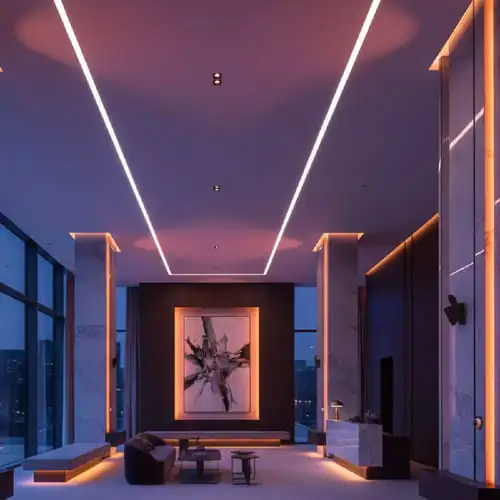
While testing new batches on production lines, we often see designers struggle with color-changing light MacAdam Ellipse 1. Choosing the wrong strip can ruin a high-end space with patchy or "fake" white light.
To choose the best COB LED strip, select RGB for purely decorative vibrant colors and RGBW for projects requiring functional, high-quality white light. Prioritize 24V systems for long runs and ensure the supplier provides consistent binning to maintain uniform color across your entire architectural installation.
Choosing the right technology requires a deep dive into how these chips actually perform in real-world scenarios IP ratings 2.
How do I decide between RGB and RGBW COB LED strips for my high-end architectural project?
In our experience exporting to Australia and Germany, high-end clients almost always regret picking standard RGB when they need a clean, sophisticated look. The decision depends on your ultimate lighting goals.
RGBW COB strips are superior for high-end projects because they include a dedicated white chip, offering true white light and pastel tones. Standard RGB mixes red, green, and blue to create a "muddy" bluish-white that lacks the color rendering needed for professional architectural environments.
The Core Difference: Purity vs. Mixing
When we manufacture COB (Chip-on-Board) strips, we coat the LEDs with a continuous phosphor layer. COB LED Strips 3 This creates that seamless "line of light." However, an RGB strip only has three diodes: Red, Green, and Blue. To get white, the controller turns all three on at max power. This results in a cold, artificial white that often feels uncomfortable in a residential or high-end commercial setting.
RGBW adds a fourth channel: a dedicated White diode. This diode has a specific color temperature (like 3000K warm white or 4000K neutral white). Because it is a real white LED, it has a high Color Rendering Index (CRI) 4. This means the objects it illuminates look natural, not distorted by a blue tint.
Performance Comparison Table
| Feature | RGB COB Strip | RGBW COB Strip |
|---|---|---|
| White Light Quality | Poor (Bluish/Grey) | Excellent (Dedicated Chip) |
| Color Complexity | 16 Million Colors | 16 Million + Pastel Tones |
| CRI (Color Rendering) | Low (Usually < 70) | High (90+ on White channel) |
| Power Consumption | Lower | Higher (4 channels) |
| Ideal Use Case | Bars, Clubs, Signage | Homes, Offices, Galleries |
Why "Pastels" Matter
Architects often want soft colors like lavender, mint, or pale rose. An RGB strip struggles with these because it can only desaturate a color by adding more of the other two primary colors. An RGBW strip desaturates the color by adding pure white light. This creates a much "cleaner" and more sophisticated palette that fits modern interior design trends.
How can I guarantee perfect color consistency across all the COB strips in my multi-phase installation?
We have seen many contractors face "checkerboard" effects where one room looks slightly more yellow than the next. This happens when suppliers mix different production batches without strict binning.
To guarantee color consistency, insist on "Single Bin" sourcing from your manufacturer and request MacAdam Ellipse 3-Step or 5-Step tolerance. Always order the entire project quantity at once to ensure all reels come from the same phosphor and chip production run.
Understanding LED Binning
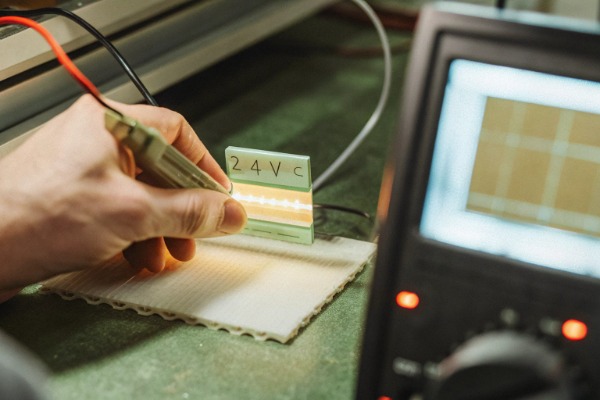
In our QC lab, we measure the "chromaticity" of every batch. LEDs are like fruit; even from the same tree, no two are identical. Manufacturers group LEDs into "bins" based on their exact color and brightness. If your supplier is just a middleman, they might send you Bin A today and Bin B next month. In a long hallway, the difference will be glaring.
Why COB is Different
COB strips use a phosphor glue over the chips. The consistency of this glue—its thickness and chemical mix—is just as important as the chips themselves. If the glue is 0.1mm thicker on one reel, the light will look warmer. We maintain strict control over the dispensing machines to prevent this.
Strategies for Multi-Phase Projects
For large projects, like a hotel renovation, phase one might be six months before phase two.
- Bulk Ordering: We suggest purchasing all materials upfront and storing them.
- Batch Recording: If you can't buy all at once, ask the manufacturer to record the specific bin code used in phase one.
- Reference Samples: Keep a "golden sample" from the first batch to compare with future deliveries.
| Consistency Level | Tolerance (SDCM) | Visual Result |
|---|---|---|
| Professional | < 3-Step MacAdam | Human eye cannot detect difference |
| Standard | 5-Step MacAdam | Very slight difference if side-by-side |
| Budget | No Binning | Obvious color shifts between reels |
What technical specs do I need to check to prevent voltage drop in my long-run color-changing strips?
When our technical team reviews project layouts, the biggest mistake we see is trying to run 10 meters of RGBW strip on a single 12V power feed. The end of the strip always looks dim and red.
To prevent voltage drop, always choose 24V COB strips over 12V and check the PCB copper thickness, which should be at least 3oz for long runs. For lengths exceeding 5-7 meters, power the strip from both ends or use a parallel wiring configuration.
The Science of Voltage Drop
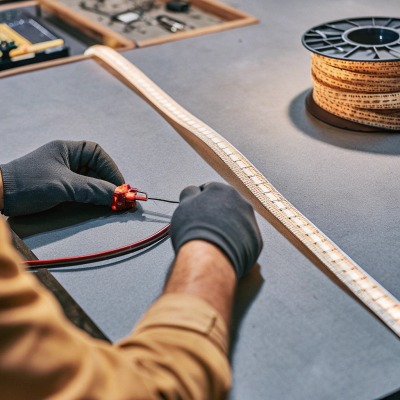
Electricity is like water in a pipe. The longer the pipe, the more pressure (voltage) you lose due to friction (resistance). In an RGBW strip, if the voltage drop 5s, the blue and green LEDs (which require higher voltage) stop working before the red ones. This causes the white light at the end of the strip to look pinkish or dim.
PCB Quality: The Hidden Factor
The "backbone" of the LED strip is the FPC (Flexible Printed Circuit 6). Most cheap strips use 1oz or 2oz copper. We use 3oz or even 4oz copper for our "Long Run" series. Thicker copper means less resistance, which allows the electricity to flow further without losing power. It also helps with heat dissipation, which extends the life of the COB chips.
Practical Installation Tips
- 24V is King: It carries current more efficiently than 12V. You can usually run 24V strips twice as far as 12V strips before seeing a drop.
- Wire Gauge: Use thick 18AWG or 16AWG wire between the power supply and the start of the strip.
- Dual-End Power: Feeding power into both the start and the end of a 10-meter run makes the brightness perfectly uniform.
| Voltage | Max Recommended Run (Single Feed) | Max Recommended Run (Double Feed) |
|---|---|---|
| 12V RGBW | 3 - 5 Meters | 8 Meters |
| 24V RGBW | 7 - 10 Meters | 15 - 20 Meters |
Can I get custom private labeling and specific IP ratings for my bulk RGBW COB strip order?
As we scale our operations to support global distributors, we realized that "off-the-shelf" products rarely fit every project. Customization is often the difference between winning a bid and losing it.
Yes, professional manufacturers offer private labeling through laser-printing your logo on the FPC and custom box designs. For IP ratings, you can specify IP20 for indoors, IP65 (silicone coating) for damp areas, or IP67/68 for full outdoor and underwater immersion.
Branding Your Light
For our clients in Australia who do private-label resale, branding is vital. We don't just put a sticker on a box. We can laser-etch your brand name every 50cm on the back of the LED strip itself. This prevents other contractors from swapping your high-quality product for a cheaper alternative and protects your reputation.
Mastering the IP Rating
Choosing the right waterproof rating is a balance of protection and aesthetics.
- IP20: No protection, best for heat dissipation in dry areas.
- IP65: A thin silicone layer. It protects against dust and splashes but can sometimes slightly shift the color temperature.
- IP67/68: These require a full silicone tube or glue filling. These are the most durable but require special connectors to maintain the seal.
Custom Lengths and Connectors
Instead of cutting and soldering on-site—which is where most failures happen—we can provide pre-cut lengths with waterproof "plug-and-play" connectors. This reduces installation labor by up to 50% for the contractor. We also offer custom PCB widths if your architectural channel is unusually narrow.
Customization Capability Checklist
- Logo Printing: Silk screen or laser etching on the strip.
- Packaging: Custom reel stickers, anti-static bags, and branded outer cartons.
- Technical Specs: Custom CRI, specific CCT for the "W" channel (e.g., 2200K ultra-warm).
- Environment Protection: From basic nano-coating to full submersible grade.
Conclusion
Choosing the right COB LED strip requires balancing visual quality, technical reliability, and customization needs. By prioritizing RGBW for architectural white light and 24V for stability, you ensure a professional result.
Footnotes
- Authoritative source explaining MacAdam Ellipse. ↩︎
- Explains IP ratings as an international standard for protection against solids and liquids. ↩︎
- Explains the fundamental technology and advantages of COB LED strips. ↩︎
- Authoritative source explaining Color Rendering Index. ↩︎
- Provides a comprehensive explanation of voltage drop in LED installations and its effects. ↩︎
- Describes the structure, advantages, and applications of Flexible Printed Circuits (FPCs). ↩︎