
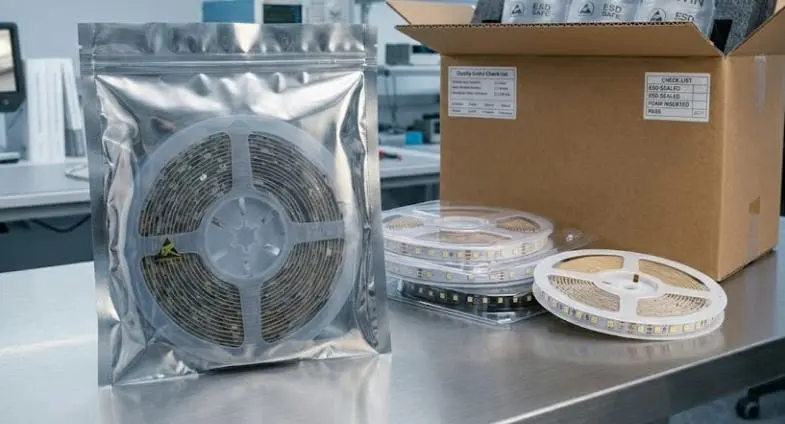
Our sales team sometimes handle complaints that trace back not to the LED strip itself, but to how it was packed before it left the warehouse. Bent PCBs, cracked solder joints 1, moisture-damaged adhesive — these problems cost buyers time, money, and trust. The frustrating part? Most of them are preventable.
LED strip light packaging directly affects product quality during sourcing because it serves as both a physical protection system and a reliability signal. Anti-static reels, moisture-proof sealing, proper labeling, and sturdy cartons preserve component integrity during transit while indicating disciplined manufacturing practices from the supplier.
Packaging is easy to overlook when you are focused on specs, lumens, and color temperature. But it can be the difference between a flawless install and a costly callback. Let me walk you through the key areas where packaging decisions impact your bottom line.
How can I tell if a supplier's packaging will protect my LED strips during long-distance shipping?
When we ship reels to contractors in Australia and Germany, every centimeter of the journey matters. A single bump or humidity spike can turn a perfect strip into a warranty claim.
You can evaluate a supplier's packaging by checking for anti-static reel winding, sealed moisture-proof bags with desiccants, foam-padded inner cartons, clear batch labeling, and drop-test certifications. Request sample shipments and inspect for physical damage, seal integrity, and component condition upon arrival.
What Good Shipping Packaging Actually Looks Like
Good packaging starts at the reel. The LED strip should be wound evenly on an anti-static reel 2 with no overlapping or loose sections. Overlapping causes pressure points. Pressure points crack solder joints. Cracked solder joints create dead spots after installation.
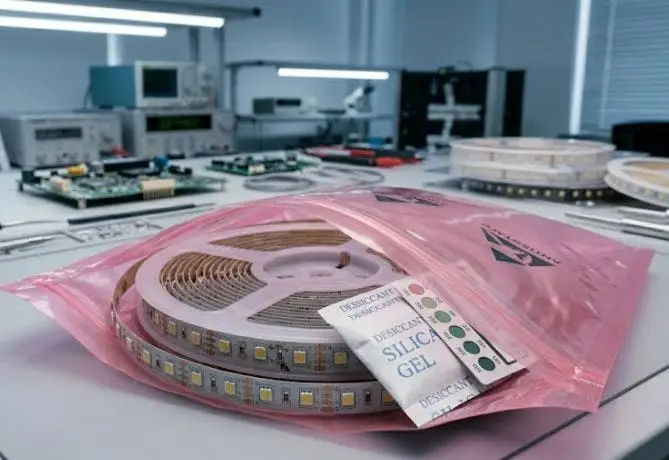
The reel then goes into an anti-static, moisture-proof bag. This bag should be heat-sealed, not just folded shut. Inside the bag, you should find a desiccant packet 3 — typically silica gel — to absorb any residual moisture. Without that desiccant, humidity can accumulate during long ocean freight crossings, especially on routes from China to Europe or Australia where containers sit in tropical ports.
The outer carton matters too. We use double-wall corrugated boxes 4 with foam inserts that hold each reel in place. A loose reel inside a box will bounce around during truck transfers and forklift handling. That bouncing causes edge damage to the FPC (flexible printed circuit 5), which weakens the strip mechanically even if it still lights up during a quick bench test.
Red Flags to Watch For
Here are some warning signs that a supplier's packaging will fail during transit:
| Red Flag | What It Means | Likely Result |
|---|---|---|
| Tape-sealed moisture bags instead of heat-sealed | Supplier is cutting corners on sealing equipment | Moisture ingress during ocean freight |
| No desiccant inside the bag | Humidity control is not part of the SOP | Solder joint oxidation, adhesive degradation |
| Single-wall thin carton | Cost reduction at the expense of protection | Crushed reels, bent FPC boards |
| Reels wound unevenly or too tightly | Winding process is not calibrated | Cracked LEDs, solder micro-fractures |
| No batch or date labels on bags | Traceability is absent | Cannot track defect origin or manage FIFO |
How to Test Before Committing to a Large Order
Ask for a trial shipment of two to three reels. When they arrive, do not just plug them in. Inspect the outer carton for dents. Check if the moisture-proof bag is intact and still sealed. Look at the reel edges for any signs of strip bending. Then power the strip on and check for dead LEDs, flickering, or color shifts. If the trial shipment arrives damaged, the bulk order will too.
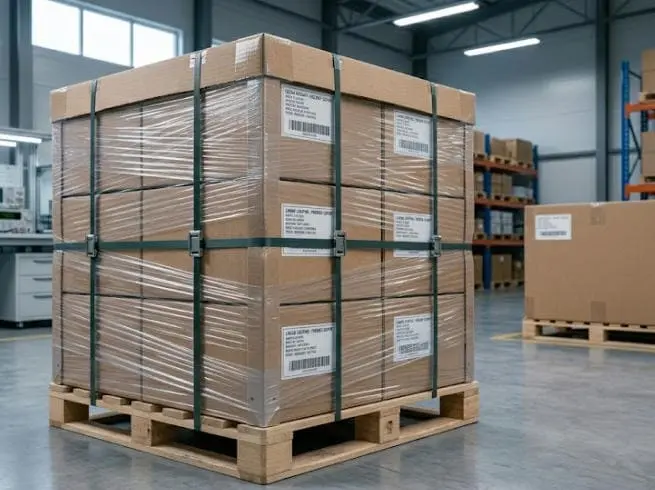
Our team photographs every outgoing pallet before it leaves our facility. We recommend asking your supplier if they do the same. Those photos become evidence if a freight claim is needed later.
Many of our distributors and private-label partners in Australia ask the same question: does the box really affect what the customer is willing to pay? The answer from our order data is consistently yes — but with a critical caveat.
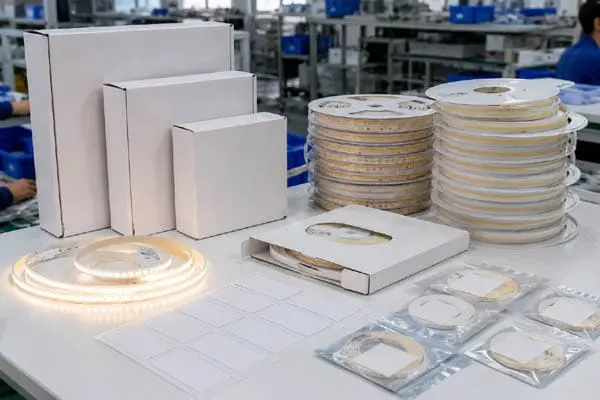
Custom private-label packaging helps justify premium pricing by building brand trust, improving the unboxing experience, and communicating professionalism. However, it works only when the product inside matches the promise outside. Premium packaging without premium strip quality will accelerate customer distrust, not loyalty.
Why Packaging Signals Value
When a contractor or end client opens a box of LED strips, the first thing they see is not the strip. It is the packaging. Clean printing, your logo, clear specifications, and a well-organized interior layout create an immediate impression of quality. Research in retail suggests that close to 85% of consumers cite color and visual presentation as a primary factor in their purchasing decisions. That principle applies even in B2B: a neatly branded reel box sitting on a distributor's shelf communicates reliability that a generic brown carton cannot.
One of our Australian partners rebranded his entire strip line with custom sleeves, printed inner trays, and QR codes linking to his own installation guides. Within two quarters, his average order value rose because his installer clients stopped questioning the price — the packaging matched the premium positioning he was aiming for.
What Custom Packaging Can and Cannot Do
| What Custom Packaging Can Do | What Custom Packaging Cannot Do |
|---|---|
| Build brand recognition and trust | Improve LED chip quality or binning |
| Differentiate your product on the shelf | Fix poor solder joints or weak FPC materials |
| Support premium price perception | Guarantee color consistency across batches |
| Provide clear specs and installation info | Replace the need for LM-80 or electrical testing |
| Create a professional unboxing experience 7 | Compensate for thermal design flaws |
This distinction matters. I have seen buyers invest heavily in beautiful packaging while sourcing the cheapest possible strip inside. That gap between perception and reality catches up fast. Installers notice. Return rates climb. Reviews suffer.
The Practical Steps to Custom Packaging
If you want to go the custom route, here is the typical process we follow with our OEM partners. First, we discuss the target market and price point. Then, our design team creates packaging mockups with your branding, color palette, and required certifications. After approval, we produce a small packaging run alongside a sample strip order. You test the full package — product and presentation — before committing to volume.
The key is treating packaging as part of your product specification, not an afterthought. When spec sheets, compliance marks, and contact information are printed directly on the box, your downstream customers feel supported. That support is part of the value they are paying a premium for.
How does the way my strips are spooled and labeled affect my project installation costs?
Our engineering team once visited an installation site in Melbourne where a contractor had to unspool, measure, and re-label twenty reels because the original supplier had marked them incorrectly. That single labeling error cost the project a full day of labor.
Spooling accuracy and clear labeling directly reduce installation costs by eliminating on-site measurement guesswork, preventing cutting errors, and enabling faster inventory management. Properly wound reels with precise length marks and specification labels let installers pull, cut, and connect strips without rework or waste.

How Spooling Affects the Installer's Workflow
LED strips for commercial projects are often ordered in long runs — 10 meters, 20 meters, sometimes custom lengths up to 50 meters. If the strip is wound too tightly, it retains a curl that makes it difficult to lay flat inside aluminum channels. If it is wound too loosely, it can tangle or develop kinks. Both problems slow down the installer.
We calibrate our winding machines to maintain consistent tension across the full reel. Every reel is also wound with the adhesive side facing inward to protect the 3M tape backing from premature exposure to dust and moisture. That small detail saves installers from having to clean the adhesive surface before sticking the strip down.
Why Labeling Precision Matters
Labels should include more than just a product name. For project-grade strips, the following information on each reel makes a real difference at the job site:
| Label Information | Why It Matters for Installation |
|---|---|
| Exact length (e.g., 10.0m ± 0.1m) | Prevents cutting errors and reduces waste |
| Color temperature and bin code | Ensures visual consistency across zones |
| Voltage and wattage per meter | Allows correct driver/transformer matching |
| Batch number and production date | Enables FIFO management and traceability |
| IP rating | Confirms suitability for wet or outdoor areas |
| Cutting interval (e.g., every 50mm) | Guides precise on-site trimming |
When these details are missing or inaccurate, the installer has to verify everything manually. That means pulling out a multimeter, measuring lengths by hand, and sometimes contacting the distributor mid-project. Every one of those steps adds labor cost.
The Hidden Cost of Poor Spooling
Poor spooling does not just affect installation speed. It can also cause physical damage that shows up only after the strip is mounted. A tightly wound reel can stress the copper traces on the FPC, creating micro-cracks that are invisible to the naked eye. These cracks may not cause immediate failure, but over months of thermal cycling — the strip heating up during use and cooling down when off — they widen. Eventually, a section of the strip goes dark.
We test spool tension on every production run and include that spec in our internal QC checklist. If you are sourcing from a new supplier, ask them what their winding tension specification is. If they cannot answer, that is a warning sign.
Can moisture-resistant packaging prevent the color consistency issues I've seen in previous batches?
Color inconsistency is the number one complaint we hear from lighting designers and repeat buyers. Some batches look warm white. The next batch leans slightly greenish. The instinct is to blame the LEDs — and sometimes the LEDs are the problem. But often, the damage happened between the factory and the job site.
Moisture-resistant packaging can prevent many color consistency issues caused by humidity exposure during transit and storage. Moisture degrades phosphor coatings on LED chips and oxidizes solder joints, both of which shift color temperature. However, packaging alone cannot fix color variance caused by poor LED binning or inconsistent manufacturing at the chip level.
How Moisture Damages Color Consistency
LED strips achieve their white color temperature through a blue LED chip coated with a phosphor layer 8. That phosphor converts some of the blue light into yellow, and the combination produces white. When moisture reaches the phosphor — either through a poorly sealed package or during prolonged humid storage — it can alter the phosphor's optical properties. The result is a subtle but visible color shift, often toward green or blue.
Moisture also attacks solder joints. Oxidized solder has higher electrical resistance, which changes the current flowing through each LED. Even a small current variation — a few milliamps — can shift the color temperature of an individual diode. Multiply that across a five-meter strip, and you get visible color banding that no amount of diffuser or channel cover can hide.
What Moisture-Resistant Packaging Should Include
A proper moisture barrier starts with the bag material itself. We use aluminum-laminated anti-static bags, which offer a much better vapor barrier than standard polyethylene. Inside each bag, a humidity indicator card 9 shows whether moisture levels have exceeded safe thresholds during shipping. If the indicator has changed color when the buyer opens the bag, that reel should be flagged for inspection before installation.
Desiccant packets — typically silica gel rated for the bag volume — absorb any residual moisture sealed inside. The heat-sealed closure ensures no new moisture enters. And the outer carton adds a secondary barrier against rain, condensation, and warehouse humidity.
Packaging Versus Binning: Know the Difference
Here is where honest assessment matters. Packaging protects against environmental damage, but it cannot fix a sourcing problem at the LED chip level. Color consistency across batches depends on tight LED binning — grouping chips by their measured color coordinates so every reel looks the same.
If your previous batches had color issues and the packaging arrived dry and intact, the problem likely started upstream, at the LED chip selection stage. In that case, the fix is tighter bin specifications in your purchase order, not just better bags.
The best approach combines both. We specify a 3-step MacAdam ellipse 10 for color consistency on our project-grade strips, and we package every reel in moisture-proof bags with desiccants and humidity indicators. That way, we control what we can at the chip level and protect it through the supply chain.
When to Suspect Packaging Versus Manufacturing
| Symptom | Likely Cause: Packaging | Likely Cause: Manufacturing |
|---|---|---|
| Color shift in some reels but not others from same batch | Inconsistent sealing or missing desiccant | Mixed LED bins used in production |
| Slight greenish tint across all reels | Moisture exposure during long storage | Phosphor formulation or curing issue |
| Dead LEDs scattered randomly | ESD damage from missing anti-static protection | Weak wire bonding inside the LED package |
| Color difference between two batches | Different storage or transit conditions | Different LED chip lots used |
| Adhesive failure on the strip backing | Humidity softened the adhesive | Wrong adhesive type for the application |
Understanding which symptom points where helps you have the right conversation with your supplier. Blaming packaging when the issue is binning wastes time. And blaming the LEDs when the issue was a two-week dwell in a humid port warehouse misses the real fix.
Conclusion
Packaging is not decoration. It is the final layer of quality control between your supplier's factory and your installation site. Evaluate it with the same rigor you apply to LED specs, and your projects — and your margins — will reflect the difference.
Footnotes
- Explains causes of solder joint failure, including mechanical and thermal stresses. ↩︎
- Replaced with an authoritative application report from Texas Instruments detailing intrinsically static-dissipative reels for ESD protection. ↩︎
- Explains how desiccants prevent moisture damage and condensation in electronic packaging. ↩︎
- Describes the enhanced strength and protection offered by double-wall corrugated boxes. ↩︎
- Defines flexible printed circuit boards and their advantages in electronic design. ↩︎
- Explains what electrostatic discharge is and how it causes damage to electronics. ↩︎
- Discusses how packaging and the unboxing experience influence consumer perception and brand trust. ↩︎
- Explains the function of the phosphor layer in LEDs to produce white light. ↩︎
- Explains the function and chemical principle behind humidity indicator cards in packaging. ↩︎
- Defines MacAdam ellipses and their significance for LED color consistency and binning. ↩︎


 English
 Spanish
 German
 Russian
 Arabic
 French
 Portuguese