
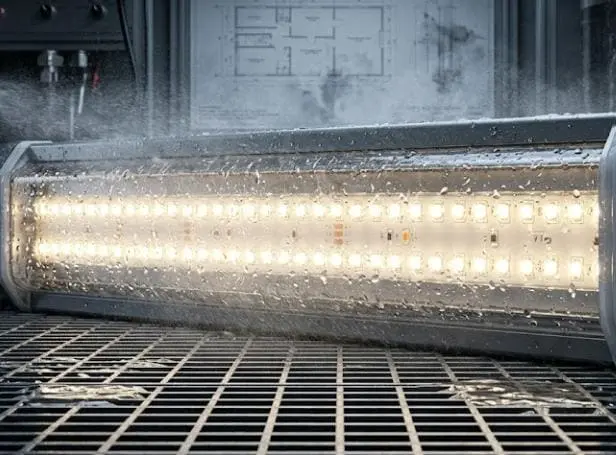
A few years ago, our team received an urgent inquiry from a petrochemical facility 1 in Australia. They had installed standard commercial LED strips in a storage area near volatile solvents. Within weeks, an inspection shut the entire lighting system down IECEx scheme 2. The strips were not rated for the environment. That single mistake cost them weeks of downtime and thousands of dollars in rework.
LED strip lights in flammable and explosive environments must carry hazardous-area certifications such as ATEX, IECEx, or Class/Division ratings. They need controlled surface temperatures, sealed enclosures, intrinsically safe power supplies, and professional installation. Standard consumer LED strips are never acceptable in classified explosive atmospheres.
This article breaks down the exact safety precautions you need, from choosing the right certifications to installing and maintaining your lighting system T-rating (temperature class) 3. Whether you are a contractor bidding on a hazardous-area project or a distributor sourcing products for industrial clients, these details matter. Let us walk through each step.
How do I determine which explosion-proof certifications are required for my hazardous area project?
Every week, our sales team fields calls from contractors who know they need "something explosion-proof" but are unsure which exact certification their project requires. The confusion is understandable. Different countries, different industries, and different hazard types all demand different ratings.
Start by identifying the hazard classification of your location — whether it involves flammable gas, combustible dust, or ignitable fibers — then match the required certification framework (ATEX, IECEx, or Class/Division) and the specific zone or division rating to that classification.
Know Your Hazard Classification First
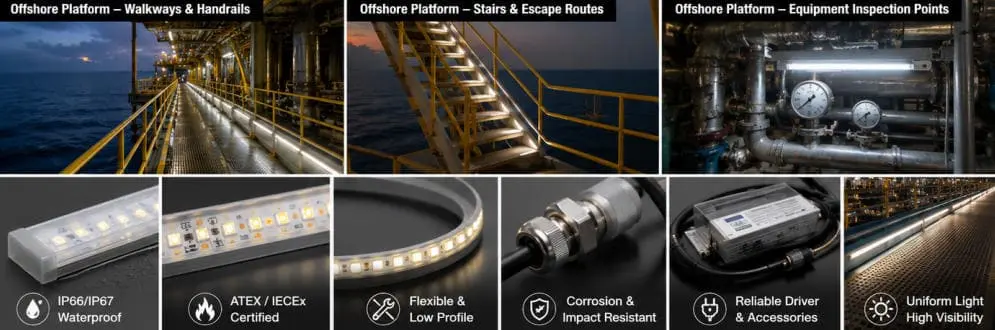
Before you even look at a product catalog, you need to define the hazard present in your environment. Is it a flammable gas or vapor? Combustible dust? Or ignitable fibers and flyings? Each of these falls under a different group in every major certification system. A paint booth with solvent vapors is classified differently from a grain elevator full of combustible dust. The certification your LED strip needs depends entirely on this classification.
In Europe and much of the world, the ATEX directive 4 and IECEx scheme are the standard. In North America, the NEC Class/Division system 5 is most common, though Zone-based classification is also accepted. Australia typically recognizes IECEx and often accepts ATEX-certified equipment with local verification.
Key Certification Frameworks Compared
| Framework | Region | Hazard Type Covered | Zone/Division System |
|---|---|---|---|
| ATEX (Directive 2014/34/EU) | European Union | Gas, dust, mining | Zones 0, 1, 2 (gas); Zones 20, 21, 22 (dust) |
| IECEx | International (60+ countries) | Gas, dust | Zones 0, 1, 2 (gas); Zones 20, 21, 22 (dust) |
| NEC Class/Division (UL 844) | North America | Gas, dust, fibers | Class I/II/III, Division 1 or 2 |
Zones and Divisions Explained
Zone 0 or Division 1 means the hazardous atmosphere is present continuously or frequently. Zone 1 means it is likely to occur during normal operations. Zone 2 or Division 2 means the hazard is only present under abnormal conditions. The higher the risk, the stricter the certification requirement.
Our experience working with contractors in Germany and Australia has taught us one critical lesson: the certification must match the exact zone and gas group of your site. A product rated for Zone 2 cannot be installed in a Zone 1 area. A strip certified for gas groups IIA and IIB may not cover group IIC gases like hydrogen. Always check the specific marking on the product certificate, not just the general label.
Do Not Confuse "Explosion-Proof" with "Intrinsically Safe"
These are two different protection concepts. Explosion-proof (Ex d) 6 means the enclosure can contain an internal explosion and prevent it from igniting the surrounding atmosphere. Intrinsically safe (Ex i) 7 means the circuit is designed so it cannot release enough energy to cause ignition, even under fault conditions. Both are valid, but they serve different zones and applications. LED strip lights in hazardous areas often use intrinsically safe designs because of their low-voltage nature, but the power supply and wiring must also be part of the certified system.
If your project requires ATEX or IECEx certification and you are sourcing from a supplier in China, ask for copies of the actual certificates — not just claims on a product page. We always provide full certification documentation to our clients because we know that project approvals depend on it.
What heat management features should I look for to prevent my LED strips from igniting flammable gases?
When we design LED strips for industrial projects, thermal performance is one of the first engineering parameters we lock down. In normal indoor settings, heat from an LED strip is a comfort issue. In an explosive atmosphere, it is an ignition risk. The difference is life and death.
Look for LED strips with a T-rating (temperature class) that keeps the maximum surface temperature below the auto-ignition temperature of the gases or dusts in your environment. Features like aluminum heat sinks, thermally conductive encapsulation, low-power-density chip layouts, and thermal cutoff protection are essential.
Understanding T-Ratings
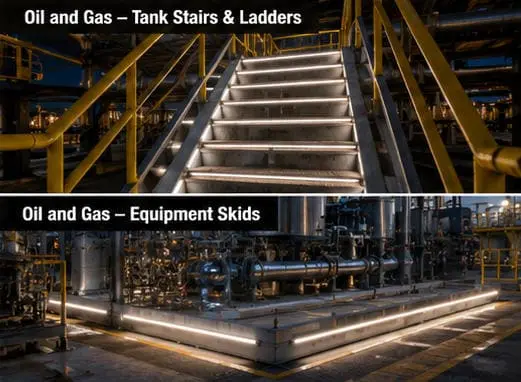
T-ratings classify the maximum surface temperature a device can reach under worst-case conditions. Every flammable gas and combustible dust has an auto-ignition temperature 8. The T-rating of your LED strip must be lower than the auto-ignition temperature of anything present in the environment.
| T-Rating | Maximum Surface Temperature | Example Substances |
|---|---|---|
| T1 | 450°C | Methane, propane |
| T2 | 300°C | Ethanol, acetone |
| T3 | 200°C | Gasoline, diesel vapor |
| T4 | 135°C | Acetaldehyde, diethyl ether |
| T5 | 100°C | Carbon disulfide |
| T6 | 85°C | Certain specialty chemicals |
A T6-rated LED strip has a maximum surface temperature of just 85°C. This is the strictest common rating. If your environment contains substances with very low ignition temperatures, you need a strip rated T5 or T6. Most standard industrial applications with common hydrocarbon vapors can use T3 or T4 rated products, but you must verify this against your site's hazard assessment.
How Good Thermal Design Works
Quality hazardous-area LED strips use several strategies to manage heat. First, the LED chips are spaced to avoid concentrated heat zones. Second, the strip is mounted on or encased in aluminum profiles that act as heat sinks. Third, the encapsulation material — often a specialized silicone — is chosen for its thermal conductivity, not just its sealing properties. Fourth, some systems include thermal cutoff circuits that shut the strip down if the temperature exceeds a safe threshold.
In our production line, we test thermal performance under simulated worst-case conditions. We run strips at full power in enclosed housings with restricted airflow for extended periods. This is how you find out whether a product will stay within its T-rating in real-world conditions, not just on a datasheet.
Ventilation and Mounting Matter Too
Even the best thermally managed strip can overheat if it is installed wrong. Mounting the strip in a sealed, unventilated enclosure without a heat sink will trap heat. Running the strip at maximum brightness continuously in a high-ambient-temperature environment increases the risk. The installation design must account for airflow, ambient temperature, and the duty cycle of the lighting.
One common mistake we see: contractors choose a certified strip but then mount it on a wooden beam or a thermally insulating surface. The heat has nowhere to go. The surface temperature rises. The T-rating is exceeded. The certification is effectively voided.
Low-voltage operation (12V, 24V, or 48V DC) also helps with thermal management. Lower voltage systems generate less heat in the wiring and connections, reducing the overall thermal load of the installation. This is why most hazardous-area LED strip systems are designed around low-voltage architectures paired with remotely located, certified power supplies.
How can I verify that my supplier's custom LED solutions will meet strict safety standards in explosive environments?
Sourcing hazardous-area lighting from overseas can feel risky. When we work with distributors and contractors in Australia and Germany, one of their biggest concerns is this: "How do I know your custom product will actually pass inspection on site?" It is a fair question, and the answer goes beyond just asking for a certificate.
Verify your supplier's hazardous-area compliance by requesting original certification documents (ATEX, IECEx, or UL 844), confirming the certificates cover the specific product configuration you are ordering, checking that the testing lab is accredited, and ensuring the supplier's quality management system covers production consistency for certified products.

Certificates Are Not One-Size-Fits-All
A certificate applies to a specific product configuration. If you order a custom length, a different LED color temperature, a modified connector, or a different IP rating, that change may not be covered by the existing certificate. This is a critical point. Any modification to a certified product can void its certification.
When our clients request custom LED strips for hazardous-area projects, we are transparent about what can and cannot be changed within the scope of the existing certification. If the customization requires a new test, we coordinate with the testing lab to get it done before production. Skipping this step is how projects get shut down at final inspection.
What to Ask Your Supplier
Here is a practical checklist for verifying supplier compliance:
- Request the original certificate, not a summary or a marketing document. The certificate should list the specific product model, protection type (Ex d, Ex e, Ex i, etc.), zone rating, gas group, and T-rating.
- Check the issuing body. Is the testing lab accredited by a recognized authority? For IECEx, the lab must be an IECEx Certification Body. For ATEX, it must be a Notified Body within the EU.
- Confirm the scope. Does the certificate cover the exact configuration you are ordering? Ask specifically about length, voltage, color temperature, IP rating, and connector type.
- Ask about the quality management system. Does the supplier hold ISO 9001 or an equivalent? quality management system 9 For IECEx, the manufacturer must have a Quality Assessment Report (QAR). This ensures that every unit produced matches the tested sample.
- Request test reports. Beyond the certificate, ask for the underlying test reports that show thermal testing, ingress protection testing, and any impact or chemical resistance testing.
Red Flags to Watch For
Be cautious if a supplier offers "explosion-proof" LED strips at prices similar to standard commercial products. Genuine hazardous-area certification involves significant engineering, testing, and ongoing quality audits. The cost is real. If the price seems too low, the certification may be superficial or fabricated.
Also watch for suppliers who claim "CE marking" as equivalent to ATEX certification. CE marking for general electrical safety and ATEX certification for explosive atmospheres are completely different. A product can carry the CE mark for electromagnetic compatibility and low-voltage safety without having any ATEX or IECEx certification whatsoever.
The Value of Co-Development
For complex projects, the safest approach is co-development with a supplier who understands hazardous-area requirements from the start. At Glowin, we have worked through multiple iterations with clients to develop custom strip configurations that meet both their lighting performance needs and their site's hazard classification. This is not something you can do with a supplier who only offers off-the-shelf products.
| Verification Step | What to Check | Why It Matters |
|---|---|---|
| Certificate authenticity | Original document, issuing body, certificate number | Fake or expired certificates will fail site inspection |
| Product scope match | Model, voltage, IP, length, connectors on the certificate | Any uncovered configuration voids the certification |
| Quality management | ISO 9001, IECEx QAR, production audit records | Ensures every unit matches the certified prototype |
| Test reports | Thermal, ingress, impact, chemical resistance tests | Proves the product was actually tested, not just labeled |
| Modification policy | Written confirmation of what can/cannot be changed | Prevents accidental certification voiding during customization |
What installation precautions must my team take to avoid electrical sparking in high-risk zones?
We have seen projects where the product was perfect — fully certified, correct T-rating, proper IP rating — but the installation created the hazard. A loose connector. An unapproved junction box. A power supply mounted inside the classified zone instead of outside it. Safe equipment becomes unsafe equipment when installed incorrectly.
Your installation team must disconnect all power before work begins, use only certified explosion-proof or intrinsically safe junction boxes and conduit, follow approved wiring diagrams, ensure proper grounding, and have all work performed by personnel trained and certified in hazardous-area electrical installation.
Power Isolation Is Non-Negotiable
Before any installation, maintenance, or inspection work begins in a classified area, all electrical circuits must be de-energized and locked out. This is not just best practice — it is a legal requirement in most jurisdictions. In explosive atmospheres, even a small spark from connecting or disconnecting a wire can ignite flammable gases or dust.
Hot work permits may be required if any energized testing must be performed during commissioning. Your team must coordinate with the site's safety officer and follow the facility's hot work procedures exactly.
Wiring and Conduit Requirements
All wiring in a classified zone must be run through approved conduit systems or use cables specifically rated for the hazard class. In explosion-proof (Ex d) installations, conduit fittings must be sealed to prevent flame propagation through the conduit. In intrinsically safe (Ex i) installations, the wiring for intrinsically safe circuits must be physically separated from non-intrinsically safe wiring to prevent energy from leaking into the protected circuit.
Junction boxes must also be certified for the zone. A standard weatherproof junction box is not the same as an explosion-proof junction box. The difference is in the construction: explosion-proof boxes are designed to contain any internal ignition and prevent it from reaching the surrounding atmosphere.
Grounding and Bonding
Proper grounding and bonding are critical in hazardous areas. Static electricity buildup can create sparks. All metallic components — conduit, enclosures, mounting hardware, and the LED strip housing — must be bonded together and connected to an effective ground. This is especially important in dust environments, where static discharge is a common ignition source.
Where to Place the Power Supply
In most hazardous-area LED strip installations, the power supply should be located outside the classified zone. The low-voltage output is then routed into the hazardous area through certified cable glands and conduit. This approach keeps the highest-energy component — the power supply — in a safe location and minimizes the risk inside the classified zone.
If the power supply must be located inside the hazardous area, it must be separately certified for that zone. This is more expensive and more complex. Whenever possible, remote mounting is the better choice.
Ongoing Inspection and Maintenance
Installation is not the end of the safety story. Hazardous-area lighting systems require regular inspection. Seals degrade. Gaskets age. Cable glands can loosen from vibration. Corrosion can compromise enclosure integrity. Any of these failures can break the protection that keeps the system safe.
Set up a scheduled inspection program. Check for:
- Cracked or damaged enclosures
- Loose cable glands or connectors
- Signs of overheating or discoloration
- Seal or gasket deterioration
- Corrosion on metallic components
- Accumulation of dust or debris on the strip surface
If any damage is found, the affected component must be replaced with certified parts before the system is re-energized. Using non-certified replacement parts voids the entire system's hazardous-area rating.
A Practical Safety Checklist for Installers
Here is a quick reference your team can use on site:
- Identify the hazard class, zone, and gas/dust group
- Confirm all products carry the correct certification for that classification
- Match the T-rating to the ignition risk of substances present
- Select the correct IP rating for the environmental conditions
- Use only certified power supplies, junction boxes, and conduit
- Ensure all work is performed by qualified hazardous-area electricians
- Disconnect and lock out power before starting any work
- Follow approved wiring diagrams exactly
- Bond and ground all metallic components
- Inspect regularly for damage, heat buildup, or seal failure
Conclusion
Safety in flammable and explosive environments is not about choosing a single product — it is about building a complete, certified, and properly maintained system. Use the right certifications, manage heat with correct T-ratings, verify your supplier thoroughly, and install with discipline. Every link in the chain matters.
Footnotes
- Explains safety practices and regulations in the petrochemical industry. ↩︎
- Describes the international certification system for equipment in explosive atmospheres. ↩︎
- Details how temperature ratings classify equipment for safe use in explosive atmospheres. ↩︎
- Official source for the European Union directive on equipment in explosive atmospheres. ↩︎
- Explains the North American classification system for hazardous electrical locations. ↩︎
- Defines the flameproof protection concept for containing internal explosions. ↩︎
- Explains the protection technique of limiting energy to prevent ignition in hazardous areas. ↩︎
- Defines the lowest temperature at which a substance spontaneously ignites without a spark. ↩︎
- Explains the framework for consistently meeting customer requirements and improving satisfaction. ↩︎
- Provides an overview of essential certifications for equipment in hazardous locations. ↩︎


 English
 Spanish
 German
 Russian
 Arabic
 French
 Portuguese