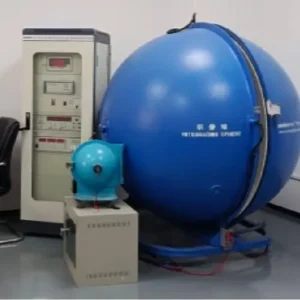
There is nothing more frustrating for a contractor than powering up a newly installed cove light only to discover that the last five meters cast a slightly pinkish hue compared to the rest of the room. In our testing facility, we frequently analyze these "failed" samples sent to us by distressed project managers. The issue rarely stems from a single defective chip; rather, it is usually a systemic failure to manage binning and installation variables. When we calibrate our production lines, we know that achieving a seamless, dot-free line of light with COB technology requires more than just picking a Kelvin number from a catalog. It demands a rigorous approach to sourcing and deployment.
To ensure color consistency in COB LED strips, you must request products from the same manufacturing bin and specify a MacAdam Ellipse (SDCM) of 3 steps or lower. Additionally, manage voltage drop using 24V systems and ensure adequate heat dissipation to prevent thermal color drift during operation.
Achieving this level of precision requires understanding the technical standards that govern LED manufacturing. Below, we break down the specific metrics and strategies you need to discuss with your supplier to guarantee a uniform installation.
technical standards 1
What SDCM step binning standards should I request from my supplier?
When we discuss specifications with engineering contractors, the conversation often stops at "3000K" or "4000K," but this is where the risk begins. In our experience supplying high-end commercial projects, relying solely on CCT (Correlated Color Temperature) is insufficient because a 3000K LED can lean towards green or magenta while still technically being "3000K." We always advise our clients to look beyond the Kelvin rating and focus on the chromaticity tolerance standards.
CCT (Correlated Color Temperature) 2
For high-end architectural projects, request a 2-step or 3-step SDCM binning standard to ensure deviations are invisible to the human eye. Standard commercial projects can accept 3-5 SDCM, while industrial applications may tolerate up to 5 steps where color precision is less critical.

Understanding the MacAdam Ellipse (SDCM)
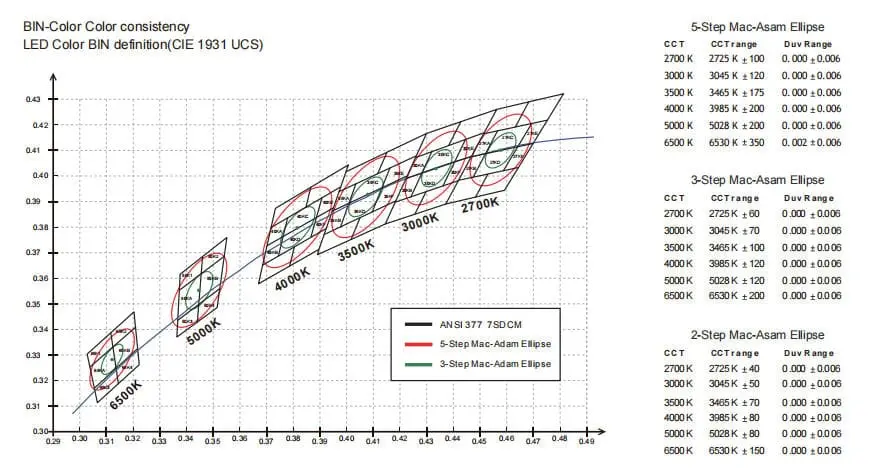
To truly control consistency, you must understand the Standard Deviation Colour Matching (SDCM) ellipses, also known as MacAdam Ellipses. In our production process, we sort LED chips into "bins" based on how close they are to a target color coordinate.
MacAdam Ellipses 3
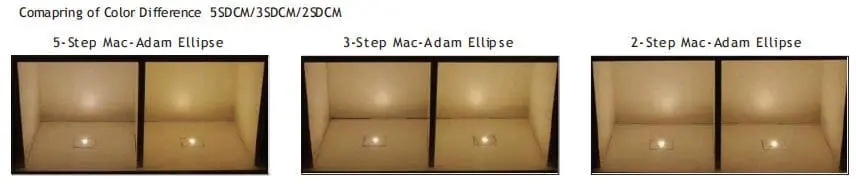
The human eye is incredibly sensitive to color differences, especially when two light sources are placed side-by-side, such as in a continuous run of COB LED strips. If you are working on a luxury hotel lobby or a museum, a 5-step SDCM strip will likely result in visible color banding.
human eye is incredibly sensitive 4
- 1-Step SDCM: Practically impossible to distinguish any color difference. This is extremely rare and expensive to manufacture.
- 2-3 Step SDCM: The gold standard for professional lighting. Variations are virtually unnoticeable to the human eye.
- 5-Step SDCM: Acceptable for general lighting where the source is hidden or not directly compared to another source, but risky for linear applications.
Recommended Standards by Project Type
We have compiled a guideline based on our export data to Germany and Australia, helping you decide which standard to enforce based on your project requirements.
| Project Application | Recommended SDCM | Why this standard? | Cost Implication |
|---|---|---|---|
| High-End Hospitality | ≤ 2 SDCM | Guests perceive lighting quality as part of the luxury experience. Visible joints break the immersion. | High (Premium selection required) |
| Museums & Galleries | ≤ 2 SDCM | Color accuracy is critical for artwork; deviations can distort the artist's intent. | High |
| Commercial Office | ≤ 3 SDCM | Good balance between cost and visual comfort. Minor variations are usually masked by ambient light. | Moderate |
| Retail & Residential | ≤ 3 SDCM | Direct view applications (like under-cabinet lighting) require tight consistency. | Moderate |
| Industrial / Warehouse | ≤ 4-5 SDCM | Functionality outweighs aesthetics. High ceilings make minor deviations invisible. | Low |
| Outdoor Landscape | ≤ 5 SDCM | Environmental factors and viewing distances make strict binning less critical. | Low |
The "One Bin" Policy
Even if you order 3-step SDCM products, there can be visible differences if the strips come from different "bins" within that 3-step ellipse (e.g., one leans slightly yellow, the other slightly blue). When we fulfill orders for large-scale engineering contractors, we ensure that the entire order is pulled from a single bin code.
If your project requires 500 meters of strip light, do not accept mixed batches. Explicitly state on your purchase order: "All reels must be from the same Bin Code." This simple instruction eliminates 90% of on-site consistency issues.
How do I guarantee the same color temperature for repeat orders next year?
One of the most difficult conversations we have is with customers who need to match a lighting setup installed twelve months ago. Phosphor recipes and LED chip batches change over time. When we manage long-term supply chains for our distributors, we emphasize that "3000K" today is not chemically identical to "3000K" from a year ago unless specific inventory measures were taken.
Guaranteeing identical color temperature requires recording the specific Bin Code from the original batch and requesting "One Bin Only" production. Alternatively, purchase 10-20% extra "attic stock" upfront, as phosphor variations make exact matching across different production years technically difficult without strict pre-agreement.
The Challenge of Phosphor Variation
LEDs produce white light by covering a blue LED chip with a phosphor coating. The thickness and composition of this phosphor determine the color temperature. In our factory, even with advanced automated dispensing, slight variations occur between production runs. A difference of just a few nanometers in the blue chip's wavelength or a micro-gram difference in phosphor can shift the color output.
For a distributor or a project owner planning a multi-phase construction, relying on a standard part number is a recipe for disaster. You might order "GL-COB-3000K" in Phase 1 and Phase 2, but if they are manufactured six months apart, they will likely look different if installed next to each other.
Strategy 1: The "Attic Stock" Method
The most reliable method we recommend to our Australian partners is the "Attic Stock" strategy. When calculating your project requirements, add 10% to 20% to the total quantity.
- Immediate Use: This covers installation waste and cuts.
- Future Proofing: Store the remaining reels in a climate-controlled environment. If a driver fails or a strip is damaged two years later, you have an exact color match ready to install.
- Cost vs. Benefit: The cost of buying 10% extra strip is significantly lower than the cost of ripping out and replacing an entire cove because the replacement section doesn't match.
Strategy 2: Fixed Bin Management
For our large OEM partners who buy continuously, we implement "Fixed Bin" management. We agree on a specific chromaticity coordinate (x, y) and a strict tolerance box. We then reserve specific chip inventory for that client.
However, this is often not feasible for one-off projects. If you cannot hold stock, you must record the Bin Code printed on the bag of your LED strips.
Data Management for Consistency
We suggest using a simple tracking table for your projects to ensure you have the data needed for re-ordering or maintenance.
| Project Phase | Order Date | Product Model | CCT | Bin Code (Crucial) | Batch / Lot Number |
|---|---|---|---|---|---|
| Phase 1 (Lobby) | Jan 2024 | GL-COB-480-24V | 3000K | 30A-3 | 20240115-01 |
| Phase 2 (Hallway) | Jun 2024 | GL-COB-480-24V | 3000K | 30A-3 (Requested) | 20240602-05 |
| Maintenance | N/A | N/A | N/A | 30A-3 (From Stock) | N/A |
By providing the Bin Code (e.g., "30A-3") to us when re-ordering, we can search our inventory for matching stock or tune a new production run to match that specific coordinate as closely as possible. Without this code, we are shooting in the dark.
Does a high CRI rating help maintain color consistency across different batches?
There is a common misconception among the designers we work with that a high CRI (Color Rendering Index) automatically equates to high color consistency. In our R&D lab, we often demonstrate that this is not the case. You can have two LED strips that both boast a CRI of 95, yet one looks pinkish and the other looks greenish.
A high CRI rating improves color rendering accuracy but does not guarantee color temperature consistency across batches. Two strips with CRI 95 can still have visible tint differences (green or pink) if their chromaticity coordinates fall into different quadrants of the standard color space.

Differentiating Quality (CRI) from Consistency (SDCM)
It is vital to separate these two metrics.
- CRI (Color Rendering Index): Measures how accurately the light source reveals the true colors of objects compared to a natural light source. It is about the quality of the light spectrum.
- CCT Consistency (SDCM/Binning): Measures how closely the light color matches a specific standard (like 3000K) and how similar it is to other strips.
We have seen competitors supply "CRI 97" strips that have terrible consistency. One reel is 2900K and the next is 3100K. Both render red apples beautifully (High CRI), but the strips themselves look different on the ceiling.
The Role of "Duv" and Tint
The hidden variable here is Duv. This metric measures the distance of the color point from the Planckian Locus (the black body curve).
- Positive Duv: The light looks slightly greenish.
- Negative Duv: The light looks slightly pinkish (often preferred in hospitality).
If Batch A has a Duv of +0.003 (Greenish) and Batch B has a Duv of -0.003 (Pinkish), they might both measure exactly 3000K and have a CRI of 90+. However, placed side-by-side, the difference will be glaring.
Critical Metrics Comparison Table
To help you specify the right product, use this comparison to understand what each metric actually controls.
| Metric | What it Measures | Does it ensure Consistency? | What to specify for best results |
|---|---|---|---|
| CRI (Ra) | Color fidelity of objects | No | CRI > 90 for high-end; CRI > 80 for standard. |
| CCT (Kelvin) | Warmth or Coolness | No (It's just a target) | Specific target (e.g., 3000K ± 75K). |
| SDCM | Deviation from target | Yes | < 3 Steps (MacAdam Ellipse). |
| Duv | Green/Pink Tint | Yes | Duv ± 0.003 (or specify "negative Duv" for pinkish bias). |
Why High CRI is Still Important
While CRI doesn't fix consistency, we still recommend high CRI (90+) for architectural projects. Why? Because high CRI phosphors are generally higher quality and manufactured with tighter controls. Manufacturers who invest in expensive high-CRI phosphors usually invest in better binning processes as well. However, do not rely on the CRI number alone as your safety net for consistency. You must specify SDCM and Bin Codes.
Why is strict binning control crucial for my high-end architectural projects?
When we supply lighting for luxury retail stores or 5-star hotels, the margin for error is zero. In these environments, the lighting is not just functional; it is part of the architecture. We have seen projects delayed by weeks because a contractor tried to save money on "un-binned" strips, resulting in a zebra-stripe effect on the walls.
Strict binning control is crucial because COB strips provide a continuous line of light where even slight hue mismatches become immediately visible joints. Precise binning prevents the "patchwork" effect, reduces installation rework costs, and ensures the lighting aligns perfectly with the architectural design intent.

The "Seamless" Nature of COB Highlights Flaws
COB (Chip on Board) technology is designed to create a dot-free, continuous neon-like effect. Because the light is so uniform, any break in color consistency is far more obvious than with traditional SMD strips where individual dots break up the visual field.
Heat affects phosphor performance 5
If you join two 5-meter COB reels together and they are from different bins, the joint will look like a distinct line where the color shifts. In high-end architecture, this is considered a defect and will likely lead to the client rejecting the handover.
voltage drops at the end 6
Voltage Drop and Thermal Drift
Strict binning is the first step, but we also advise our clients on installation factors that ruin consistency after the product leaves our factory. Even perfectly binned strips can show color deviation due to physics.
Planckian Locus 7
- Voltage Drop: If you run a 12V strip too long (e.g., over 5 meters) without power injection, the voltage drops at the end. This often causes a "Red Shift," where the end of the strip looks warmer and dimmer than the start.
- Solution: We recommend using 24V COB strips for runs up to 10 meters and ensuring proper power injection points.
- Thermal Management: Heat affects phosphor performance. If one section of the strip is mounted on metal (good heat sink) and another on wood (poor heat sink), the hotter section may degrade faster or shift color temporarily.
- Solution: Always install COB strips in aluminum profiles to ensure uniform operating temperature along the entire run.
The Cost of "Cheap" Consistency
We often analyze the "Total Cost of Ownership" with our buyers. Buying un-binned or loose-bin LED strips might save $1.00 per meter upfront. However, consider the cost of failure:
- Cost of the electrician returning to site.
- Cost of ripping out the strip (and potentially damaging the drywall/paint).
- Cost of rushing a replacement air-freight shipment.
- Reputational damage with the project owner.
Color Rendering Index 8
Checklist for Project Success
To ensure your high-end project succeeds, we recommend this pre-installation checklist:
sort LED chips into 9
- Pre-Order: Specify SDCM < 3 and "One Bin Only" on the PO.
- Receipt: Check all bag labels for matching Bin Codes before opening.
- Bench Test: Power up all reels side-by-side on the floor before sticking them to the ceiling. This "burn-in" test of 24-48 hours can identify any early failures or color mismatches.
- Installation: Use 24V systems and aluminum profiles to maintain electrical and thermal stability.
Conclusion
Ensuring color consistency in COB LED strips is not a matter of luck; it is a matter of specification and process. By demanding strict SDCM binning (≤3 steps), managing your "attic stock" for future repairs, and understanding the difference between CRI and color consistency, you can deliver flawless lighting projects. At Glowin, we help our partners navigate these technical details every day to ensure that the light you design is exactly the light you get. If you need assistance specifying the right binning for your next project, feel free to reach out to our engineering team.
chromaticity tolerance standards 10
Footnotes
- Official ANSI/NEMA standard governing LED chromaticity specifications. ↩︎
- US Department of Energy overview of LED color metrics. ↩︎
- Definition from the Illuminating Engineering Society (IES). ↩︎
- Academic research on visual perception of color differences. ↩︎
- Whitepaper discussing thermal factors causing LED color shift. ↩︎
- Technical guide addressing voltage drop in LED power systems. ↩︎
- Definition of the black body curve used in colorimetry. ↩︎
- General encyclopedic definition of the CRI metric. ↩︎
- Manufacturer guide explaining the binning process for LED chips. ↩︎
- Government requirements for color consistency in certified lighting. ↩︎