
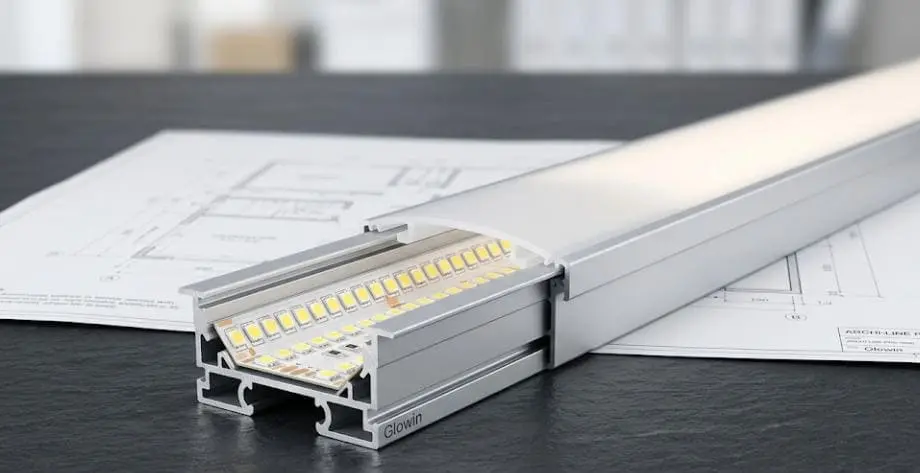
Our sales team fields the same question from contractors and wholesalers placing bulk LED strip orders: do I really need to add aluminum channels to my purchase?
Aluminum channels are not strictly required for LED strip lights to function, but they are highly recommended for most professional projects. Channels improve heat dissipation, extend strip lifespan, eliminate visible LED dots, and protect against dust and physical damage, making them a smart sourcing choice whenever appearance, durability, or thermal performance matters.
The real question is not whether channels are mandatory heat dissipation 1. It is whether the gains in performance, protection, and finish justify the added cost for your specific project. Let me walk you through the key factors so you can make a confident sourcing decision.
How do aluminum channels affect the lifespan of my high-output LED strips?
When we test high-output strips on our production line, heat is always the number one factor that shortens LED life IP-rated strips 2. Ignoring thermal management can cost you warranty claims and unhappy end users.
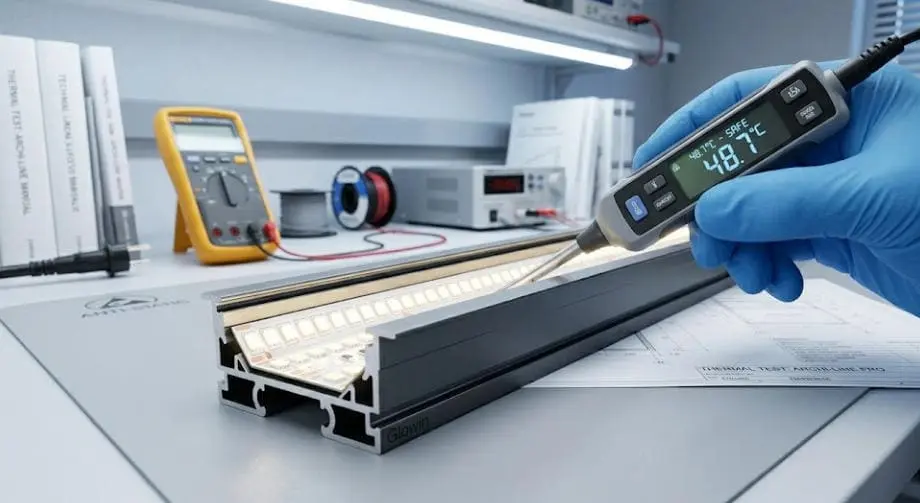
Aluminum channels act as passive heat sinks that spread heat away from LED chips, lowering junction temperatures and significantly extending strip lifespan. For high-output strips running above 14 W/m, channels can reduce operating temperatures by 10–20 °C, which may double or triple the useful life of the LEDs.
Why Heat Matters More Than You Think
LEDs do not burn out like incandescent bulbs. They fade. The higher the junction temperature, the faster the lumen output drops moisture ingress 3. This process is called lumen depreciation 4. Industry data shows that every 10 °C rise in LED junction temperature roughly halves the rated lifespan. So a strip rated for 50,000 hours at 25 °C might only last 25,000 hours at 35 °C project timelines 5.
When you mount a bare strip directly onto drywall or wood, the heat has nowhere to go. Drywall is an insulator. Wood is an insulator. The strip sits in its own heat, and the adhesive backing slowly degrades, causing the strip to sag or detach.
Aluminum, on the other hand, is one of the best thermal conductors 6 among common metals, second only to copper. An aluminum channel spreads the heat across a much larger surface area, letting it dissipate into the surrounding air. This keeps the LED junction cooler and the adhesive intact.
When Channels Become Essential for Thermal Reasons
Not every strip needs a channel for heat management. A 4.8 W/m decorative strip hidden inside a cove will generate minimal heat. But once you move into task lighting or accent lighting with higher power densities, channels become much more relevant.
| Strip Power (W/m) | Typical Use Case | Channel Recommended? |
|---|---|---|
| 4.8 – 7.2 | Accent lighting, closets, shelving | Optional |
| 9.6 – 14.4 | Under-cabinet, cove lighting | Recommended |
| 18 – 24 | Task lighting, retail displays | Strongly recommended |
| 28+ | High-bay linear, outdoor façades | Essential |
From our experience shipping to contractors in Australia and Germany, most project-grade installations fall in the 9.6–24 W/m range. At that power level, an aluminum channel is not just a nice accessory. It is a practical heat sink that protects your investment.
The Hidden Cost of Skipping the Channel
If a strip fails early because of heat, the replacement cost is not just the strip itself. It includes labor to remove the old strip, clean the surface, reapply the new strip, and potentially repair the mounting surface. For a commercial project with dozens of meters of strip, that cost adds up fast. A channel that costs a few dollars per meter can prevent hundreds of dollars in callbacks.
One thing I always recommend to our wholesale partners: if you are sourcing strips above 14 W/m, include channels in the same purchase order. It simplifies logistics and ensures the channel width matches the PCB width perfectly.
Can I achieve a dot-free lighting effect in my project without using a profile?
Lighting designers and architects we work with in Germany are especially particular about this. Visible LED dots are one of the fastest ways to make a high-end space look cheap.
Achieving a truly dot-free, uniform lighting effect without an aluminum profile and diffuser is extremely difficult. While recessing strips deep inside a cove or bouncing light off a surface can reduce dot visibility, a frosted diffuser inside an aluminum channel is the most reliable and repeatable method to eliminate individual LED hot spots and create smooth, continuous light.
What Causes the "Dotting" Effect
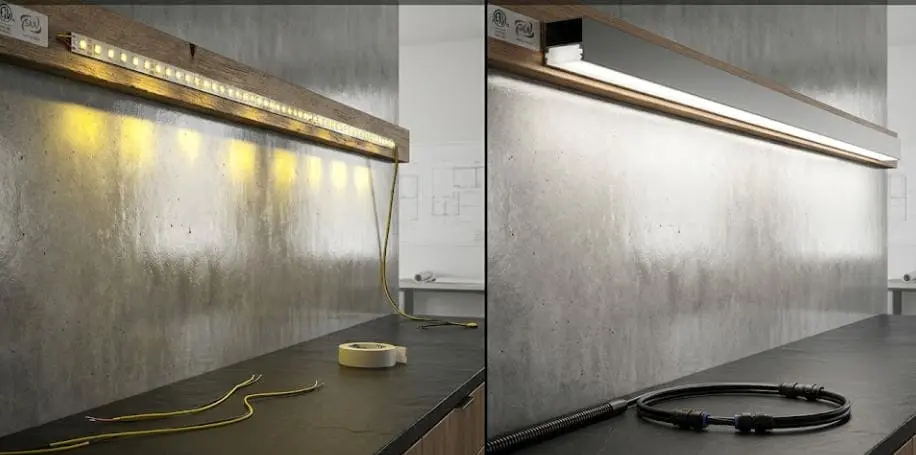
LED strips use individual diodes spaced at regular intervals along a flexible PCB 8. Common spacings are 60 LEDs/m, 120 LEDs/m, or even 240 LEDs/m. At lower densities, the gap between each LED creates a visible bright spot followed by a dim spot. This pattern is what the industry calls "dotting" or the "polka dot" effect.
Even at 120 LEDs/m, if the strip is mounted close to a visible surface—say, under a glass shelf or inside a shallow channel—you can still see individual points of light. The human eye is surprisingly good at detecting brightness variations, especially on reflective surfaces.
Methods to Reduce Dotting Without a Channel
There are a few workarounds, but each has trade-offs.
| Method | Effectiveness | Limitations |
|---|---|---|
| Use 240 LED/m or COB strips | High | Higher cost per meter; more heat generated |
| Recess strip deep in a cove (>80 mm setback) | Moderate | Requires architectural depth; reduces usable light output |
| Bounce light off a wall or ceiling | Moderate | Indirect light only; not suitable for task lighting |
| Use a standalone clip-on diffuser | Moderate | Can look unfinished; limited diffuser options |
| Mount behind frosted glass or acrylic | High | Adds material cost; requires custom fabrication |
COB (Chip-on-Board) strips 9 are one alternative we produce that can achieve a near-dot-free look without a diffuser, because the LEDs are packed so tightly that the light appears continuous. However, COB strips tend to run hotter and cost more. For most projects, a standard 120 LED/m strip inside an aluminum channel with a frosted diffuser 10 remains the most cost-effective solution for clean, even light.
The Diffuser Makes the Difference
The aluminum channel itself does not eliminate dots. It is the frosted diffuser cover that does the optical work. The diffuser scatters the light from each LED, blending it into a smooth wash. However, the diffuser needs a rigid housing to sit in—and that is where the aluminum profile earns its place. Without the channel, a diffuser has nothing to mount to. With the channel, you get a complete, fixture-like assembly.
One important trade-off to note: a frosted diffuser absorbs some light. Depending on the diffuser quality, you may lose 10–15% of total lumen output. This means you might need a slightly higher-output strip to achieve the same brightness at the surface. When we help clients spec their orders, we always factor this optical loss into the strip selection so the end result meets the target lux level.
Matching Strip to Profile Width
A common sourcing mistake is ordering a 12 mm wide strip and a 10 mm internal-width channel. The strip simply will not fit. Always confirm the PCB width of your strip and the internal width of the channel before placing a bulk order. Our standard strips come in 8 mm, 10 mm, and 12 mm widths, and we match each to a compatible channel profile to avoid this issue.
Will my LED strips be protected from dust and moisture if I skip the aluminum housing?
Our team often ships to project sites in coastal Australia where salt air, humidity, and construction dust are everyday realities. Protection is not optional in those environments.
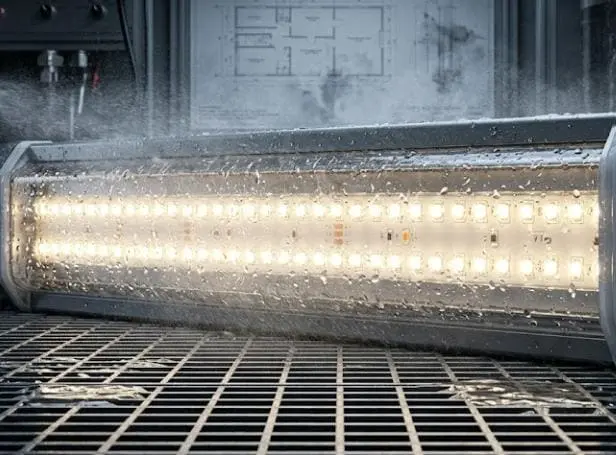
Without an aluminum housing, LED strips are exposed to dust accumulation, moisture ingress, and physical contact, all of which degrade performance over time. While IP-rated strips offer some moisture resistance on their own, an aluminum channel with a sealed diffuser adds a critical second layer of protection that keeps the strip clean, dry, and safe from accidental damage.
Understanding IP Ratings vs. Physical Protection
Many buyers assume that an IP65 or IP67 strip does not need any additional protection. That is partially true—the silicone coating or tube does resist water splashes and dust. But IP ratings address moisture and particle ingress at the strip level. They do not address mechanical damage, UV exposure, or the long-term buildup of grease and grime on the strip surface.
In a kitchen, for example, cooking grease settles on every surface over time. A bare strip mounted under a cabinet will collect a thin film of oil and dust. This film acts as an insulator, trapping heat against the LEDs and reducing light output. Inside a channel with a snap-on diffuser cover, the strip stays sealed away from airborne contaminants. When the diffuser gets dirty, you can simply wipe it clean or pop it off and wash it.
Real-World Damage Scenarios
Here are common ways strips get damaged when installed without a channel:
- Accidental contact: A technician bumps the strip while servicing HVAC equipment above a cove. Without a channel, the PCB flexes and a solder joint cracks.
- Tool drops: During construction, a screw or bracket falls onto an exposed strip and dents an LED.
- Pet or child contact: In residential settings, curious hands or paws can pull a bare strip off the wall.
- Insect nesting: In outdoor or semi-outdoor installations, small insects can nest on or near warm LED strips, leaving residue that blocks light and traps heat.
An aluminum channel is not armor, but it provides a rigid shell that absorbs minor impacts and keeps the strip out of reach.
Choosing the Right Protection Level
| Installation Environment | Bare Strip | Strip + Channel | Strip + Channel + IP-Rated Strip |
|---|---|---|---|
| Indoor, hidden (closet, cove) | Acceptable | Better | Unnecessary |
| Indoor, visible (under-cabinet, shelf) | Risky | Recommended | Optional |
| Kitchen or bathroom | Not recommended | Good | Best |
| Outdoor, covered (soffit, porch) | Not recommended | Good | Best |
| Outdoor, exposed (façade, landscape) | Not acceptable | Not sufficient alone | Required with additional sealing |
For our partners who distribute to contractors, I usually recommend bundling IP65 strips with sealed aluminum channels for any kitchen, bathroom, or outdoor project. It is a simple upsell that dramatically reduces warranty returns.
Long-Term Maintenance Benefits
Channels also make future maintenance easier. If a section of strip fails, you can slide out the old strip, clean the channel, and drop in a replacement without damaging the mounting surface. Without a channel, removing a failed strip often means peeling off old adhesive, cleaning residue, and sometimes repainting or refinishing the surface. This modular approach is one reason professional contractors prefer channels—they save time on callbacks and make the installation feel like a proper fixture rather than a temporary tape-on solution.
Should I include custom-cut channels in my bulk order to simplify on-site installation?
When we prepare shipments for large commercial projects, one of the most impactful things we can do is pre-cut channels to the exact lengths specified in the lighting plan. It saves hours of on-site labor.
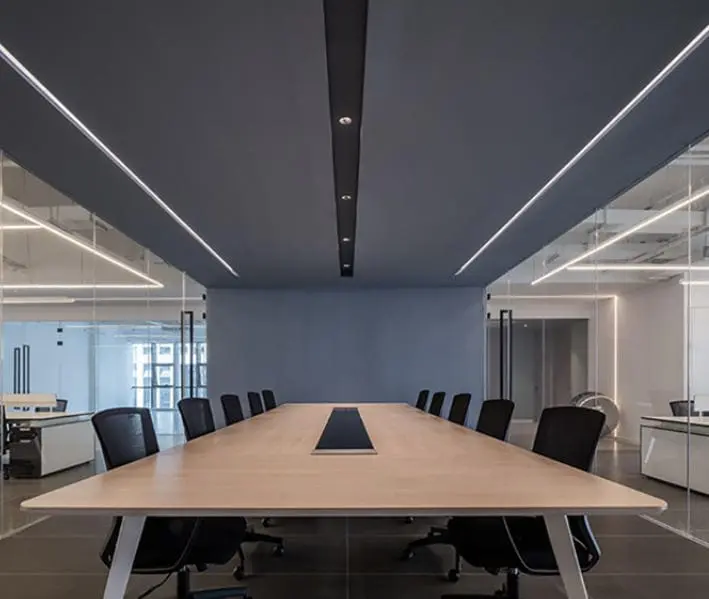
Yes, including custom-cut aluminum channels in your bulk order is one of the most effective ways to simplify installation, reduce on-site waste, and speed up project timelines. Pre-cut channels matched to your strip lengths eliminate the need for field cutting, ensure clean joints, and allow installers to focus on mounting rather than fabrication.
The Problem with Field Cutting
Cutting aluminum channels on-site sounds simple, but it introduces several issues. Construction sites are messy. A miter saw or hacksaw produces metal burrs and aluminum shavings that can get inside the channel and scratch the strip or the diffuser. The cuts are rarely as clean or square as factory cuts. And every minute an electrician spends cutting and deburring channels is a minute they are not installing them.
For a project with 200 meters of channel in 15 different lengths, field cutting can easily add a full day of labor. At contractor rates in Australia or Germany, that is a meaningful cost.
What Custom-Cut Channels Include
When we process a custom-cut order, we typically handle the following:
- Cut channels to specified lengths with clean, burr-free ends
- Match each channel to the correct strip PCB width
- Include the appropriate diffuser type (clear or frosted) cut to the same length
- Package channels by room, zone, or section with clear labeling
- Include mounting clips, end caps, and joining connectors as needed
This turns the channel from a raw material into a ready-to-install component. The installer opens a labeled box, snaps the strip into the channel, mounts it, and moves on.
Cost-Benefit Analysis of Custom Cutting
| Factor | Field-Cut Channels | Factory Custom-Cut Channels |
|---|---|---|
| Cut quality | Variable, depends on tools and skill | Consistent, clean, burr-free |
| On-site labor time | High | Low |
| Material waste | 5–10% typical scrap | Under 2% with optimized nesting |
| Packaging and labeling | None | Organized by zone or room |
| Risk of damage to strip/diffuser | Higher (metal shavings, rough edges) | Lower |
| Upfront unit cost | Lower per meter | Slightly higher per meter |
| Total installed cost | Often higher due to labor | Often lower overall |
Sourcing Tip: Order Channels and Strips Together
One piece of advice I give to every procurement manager we work with: order your channels and strips in the same purchase order. This guarantees width compatibility, simplifies logistics, and often qualifies for better pricing. When channels come from one supplier and strips from another, mismatches happen. A 10.2 mm strip in a 10.0 mm channel is a headache nobody wants to deal with at midnight before a handover deadline.
We maintain a compatibility matrix for every strip and channel SKU we offer. If you send us a lighting layout with quantities and lengths, we can provide a single quotation that covers strips, channels, diffusers, end caps, and mounting hardware. That one-stop approach is exactly what contractors and distributors tell us saves them the most time and coordination effort.
Practical Considerations for Large Orders
For orders above 500 meters of channel, we recommend submitting a cut list at least two weeks before the desired ship date. This gives our production team time to optimize the cutting sequence, minimize waste, and arrange packaging by project phase. For smaller orders or fast-turnaround prototypes, we can usually process custom cuts within a few business days.
If your project has curved sections or unusual mounting angles, let us know early. We offer flexible and bendable channel profiles that can follow gentle curves without kinking. These specialty profiles are harder to source after the fact, so including them in the initial order avoids delays.
Conclusion
Aluminum channels are rarely mandatory, but they are almost always worth it for professional LED strip projects. Choose them when you need better thermal performance, cleaner aesthetics, physical protection, or faster installation.
Footnotes
- Explains the process and importance of heat dissipation in LED lighting. ↩︎
- Explains the IEC standard for Ingress Protection (IP) ratings. ↩︎
- Replaced HTTP 404 with an authoritative Wikipedia article on IP codes, specifically the section on water ingress protection. ↩︎
- Replaced HTTP 404 with an authoritative Wikipedia article explaining lumen maintenance and depreciation. ↩︎
- Discusses factors influencing and the importance of project timelines in construction. ↩︎
- Compares thermal conductivity of various metals, including aluminum and copper. ↩︎
- Details how junction temperature affects LED performance and lifespan. ↩︎
- Replaced HTTP unknown with a detailed guide on flexible PCBs. ↩︎
- Explains the technology and advantages of Chip-on-Board (CoB) LEDs. ↩︎
- Describes how optical diffusers, including frosted types, scatter light for even illumination. ↩︎

 English
 Spanish
 German
 Russian
 Arabic
 French
 Portuguese