
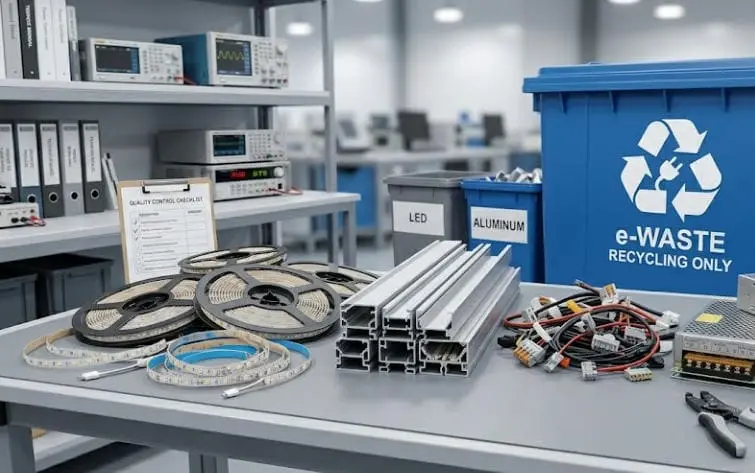
Every year, our production line ships thousands of reels of LED strip lighting to projects around the world e-waste recycling center 1. But what happens when those strips reach the end of their useful life? Too many end up in landfills.
Old LED strip lights should be treated as electronic waste, not tossed in regular trash or curbside recycling bins. The proper disposal method is to separate all components, then take them to a certified e-waste recycling center, retailer take-back program, or specialized lighting recycler in your area.
This guide walks you through every step of the process e-Stewards 2. Whether you are a contractor pulling out a long commercial run or a homeowner replacing a kitchen accent strip, you will know exactly what to do by the end of this article.
Where can I find a certified recycling center for my old project-grade LED strips?
When our team helps clients in Germany and Australia plan large-scale strip replacements, this is always the first question that comes up. Finding the right recycling partner can feel overwhelming.
You can find certified recycling centers for old LED strips by contacting your local municipal waste authority, searching national e-waste directories, checking retailer take-back programs, or asking your LED strip manufacturer or supplier about dedicated lighting recycling initiatives in your region.
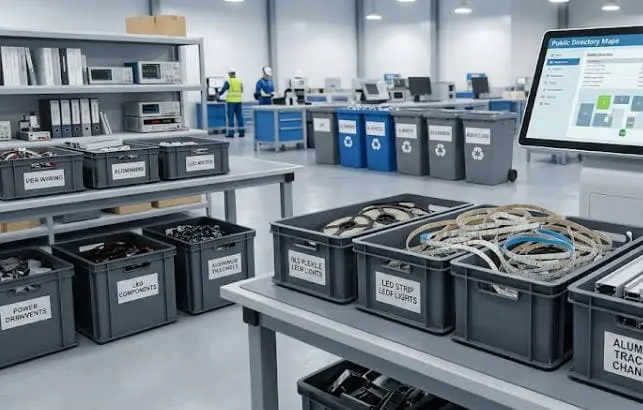
Start With Your Local Municipality
The fastest way to find a proper recycling point is to check your local council or municipal waste authority website. Most cities in Australia, Germany, and across the EU maintain searchable databases of e-waste drop-off locations. In Australia, programs like the National Television and Computer Recycling Scheme 3 have expanded over the years, and many local councils now accept lighting products at designated depots. In Germany, the ElektroG regulation 4 requires municipalities to accept electronic waste 5 at collection points free of charge. Simply search your city name plus "e-waste drop-off" to find the nearest location.
Retailer and Manufacturer Take-Back Programs
Many large lighting retailers and electrical wholesalers offer take-back services. Some accept any brand of LED lighting product, while others only take back products they originally sold. It is always worth asking. On the manufacturer side, some brands participate in industry recycling programs. For example, the LED Lighting Recycling Program (L2RP) is one such initiative. When we ship orders to our wholesale partners, we include disposal guidance in our documentation so end users know their options from day one.
Online E-Waste Directories
Several online tools make this search easier. Here is a quick reference table:
| Resource | Region | What It Covers |
|---|---|---|
| Earth911.org Recycling Search | United States | E-waste, lighting, batteries, and more |
| Recycling Near You (Planet Ark) | Australia | E-waste drop-off points by postcode |
| WEEE Registers / Local Wertstoffhof | Germany / EU | Electronic and electrical waste collection |
| Retailer websites (e.g., Bunnings, IKEA) | Multiple | In-store take-back for lighting products |
| Manufacturer take-back pages | Varies | Brand-specific recycling programs |
What If No Local Option Exists?
In rural areas, options can be limited. In that case, look for mail-in recycling programs. Some e-waste recyclers provide prepaid shipping boxes. You fill the box with old electronics and lighting, seal it, and send it back. The cost is usually modest. Another option is to hold items until a scheduled household hazardous waste collection event runs in your area. Many councils host these once or twice a year.
A Note on Certification
Not all recyclers are created equal. Look for facilities that hold recognized certifications like R2 (Responsible Recycling) 6 or e-Stewards. These certifications mean the recycler follows strict environmental, health, and data security standards. For commercial quantities, this matters even more. Contractors and distributors replacing long runs of project-grade strip lighting should request a certificate of recycling or a waste transfer note for compliance records.
How do I properly separate the electronic components from my LED strip waste?
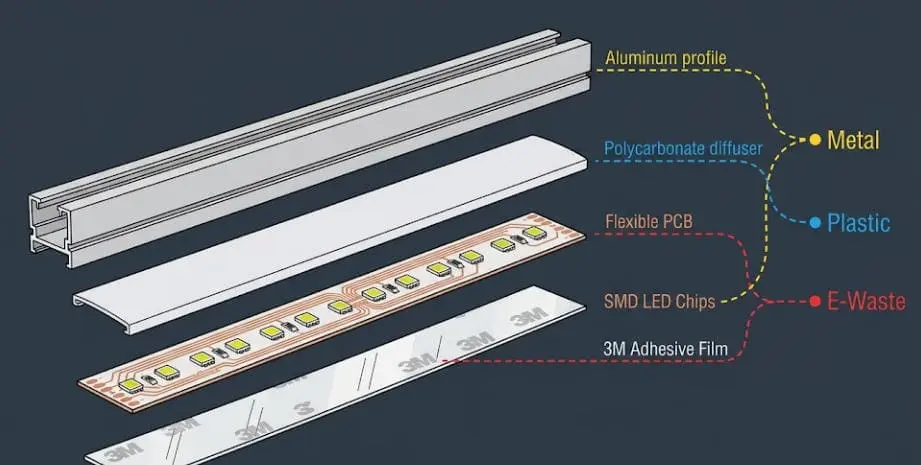
On our factory floor, we see the full anatomy of an LED strip every day. Copper traces, solder joints, adhesive layers, silicone coatings, connectors, controllers, and power supplies. Each material needs different handling at the recycling stage.
To properly separate LED strip components, first disconnect all power. Then remove the power supply, controller, and any connectors. Peel the strip from its mounting surface. Cut it into manageable sections. Group metal, plastic, and electronic parts separately before taking them to your recycler.
Step-by-Step Separation Process
This process is straightforward, but it matters. Recyclers process materials more efficiently when you do some basic sorting first. Here is a practical workflow:
- Disconnect power completely. Unplug the power supply from the wall. Disconnect any dimmer, controller, or smart hub.
- Remove the power supply unit. This is a separate electronic device. It contains a transformer, capacitors, and wiring. Set it aside for e-waste recycling on its own.
- Detach controllers and dimmers. Whether it is a simple inline dimmer or a Wi-Fi-enabled smart controller, remove it. Smart controllers may store network credentials. Reset them to factory settings before disposal.
- Remove connectors and clips. Solderless connectors, mounting clips, aluminum channels, and diffuser covers should all be separated. Aluminum channels are highly recyclable on their own.
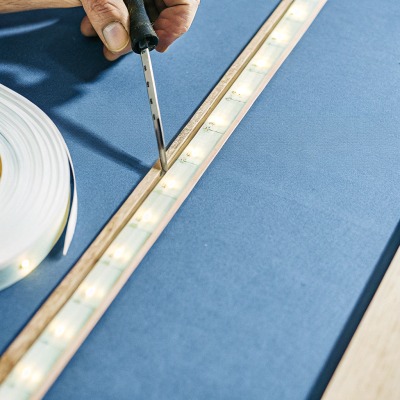
- Peel the strip from the surface. Use a heat gun on low or a hairdryer to soften the adhesive if the strip is stuck to a cabinet or wall. Pull slowly to avoid tearing.
- Cut strips into manageable lengths. Use scissors at the designated cut marks. Sections of 30–60 cm are easy to handle and pack.
- Group by material type. Keep metal parts together, plastic parts together, and the LED strip PCB sections together.
Understanding What Each Component Is Made Of
This table breaks down the typical materials in a project-grade LED strip system:
| Component | Primary Materials | Recycling Category |
|---|---|---|
| LED strip (flexible PCB) | Copper, fiberglass, solder, LED chips, silicone | E-waste / lighting recycler |
| Adhesive backing (3M VHB or similar) | Acrylic foam tape | Usually non-recyclable; discard with general waste |
| Silicone or PU waterproof coating | Silicone, polyurethane | Separated during processing; usually non-recyclable |
| Power supply / driver | Steel casing, copper wiring, PCB, capacitors | E-waste |
| Controller / dimmer | Plastic housing, PCB, microchips | E-waste |
| Aluminum extrusion channel | Aluminum alloy | Metal recycling (highly valuable) |
| Plastic diffuser cover | Polycarbonate or acrylic | Plastic recycling if accepted locally |
| Wire connectors and clips | Plastic, copper, tin | E-waste or metal recycling |
The Adhesive Challenge
One detail that trips people up is the adhesive backing. Many LED strips use strong 3M VHB tape. This tape bonds tightly to surfaces and to the back of the PCB. Most recyclers cannot process adhesive-contaminated materials in their standard stream. The good news is that the adhesive layer is thin. Specialized e-waste processors have methods to handle it. Your job is simply to avoid mixing adhesive-heavy strips into regular plastic or metal recycling bins.
Smart Strips and Data Security
This is a newer concern. If your LED strips were connected to a smart home system via Wi-Fi or Bluetooth, the controller may store your network name and password. Before recycling, perform a factory reset on any smart controller or hub. This is a small step, but it protects your network security.
Which environmental regulations must I follow when disposing of bulk lighting from my project?
When we prepare export shipments to Australia and Germany, regulatory compliance is already built into our process. But the disposal side of compliance is just as important, especially for contractors and distributors handling large quantities of old strip lighting.
Environmental regulations for bulk LED strip disposal vary by country, but most jurisdictions classify LED lighting as electronic waste under laws like the EU WEEE Directive, Germany's ElektroG, or Australia's state-level e-waste bans. Businesses must use licensed waste carriers and maintain disposal documentation.
Key Regulations by Region
Understanding which rules apply to your project saves you from fines and liability. Here is a summary of the major frameworks:
| Region | Key Regulation | Core Requirement |
|---|---|---|
| European Union | WEEE Directive (2012/19/EU) 7 | Producers and importers must finance collection and recycling of electronic waste, including lighting |
| Germany | ElektroG (Elektro- und Elektronikgerätegesetz) | All electronic products must be registered; free municipal collection required; retailers over 400 m² must accept small e-waste |
| Australia | National Waste Policy + state e-waste landfill bans (e.g., Victoria, South Australia) | E-waste banned from landfill in several states; must use licensed e-waste recyclers |
| United States | No single federal law; state-level rules vary | Some states (California, Washington) have e-waste recycling mandates; others rely on voluntary programs |
| United Kingdom | WEEE Regulations 2013 | Similar to EU WEEE; producer responsibility for collection and recycling |
What Counts as "Bulk"?
For most regulations, the distinction between household and commercial waste matters. A homeowner replacing a 5-meter kitchen strip is generating household waste. A contractor pulling out 200 meters of strip lighting from a hotel lobby is generating commercial or industrial waste. Commercial waste typically requires:
- Use of a licensed waste carrier for transport.
- A waste transfer note or duty of care documentation.
- Records kept for a minimum period (often two years or more).
- Disposal at a facility licensed to accept commercial e-waste.
Producer Responsibility and Extended Producer Responsibility (EPR)
In the EU and increasingly in Australia, the concept of Extended Producer Responsibility means that the company that manufactured or imported the LED product has a legal obligation to contribute to its end-of-life recycling. Extended Producer Responsibility (EPR) 8 This is why many manufacturers, including brands we supply on an OEM basis, register with national compliance schemes and fund collection infrastructure. If you are a distributor or contractor, you can often leverage these schemes to access free or low-cost recycling for the products you are replacing.
Penalties for Non-Compliance
Ignoring e-waste disposal rules can be costly. Fines vary widely, but in Germany, improper disposal of electronic waste can result in penalties up to €100,000 for businesses. In Australia, state-level fines for illegally dumping e-waste in landfill can also be substantial. Beyond fines, there is reputational risk. Clients, especially in the architecture and interior design space, increasingly ask for sustainability documentation. Being able to show that you disposed of old lighting responsibly is a competitive advantage.
Practical Compliance Checklist
Here is a quick checklist for contractors and distributors:
- Identify the waste classification for LED strips in your jurisdiction.
- Confirm whether your state or country bans e-waste from landfill.
- Use a licensed waste carrier if transporting commercial quantities.
- Request a waste transfer note or certificate of recycling from the recycler.
- Keep records for the required retention period.
- Ask your LED strip supplier whether they participate in a take-back or EPR scheme.
Can I recycle the copper and PCB materials from my damaged LED strips?
In our engineering lab, we test strip durability under extreme conditions. Heat cycling, UV exposure, moisture ingress. When strips fail, we see exactly what is inside them. And what is inside is worth recovering.
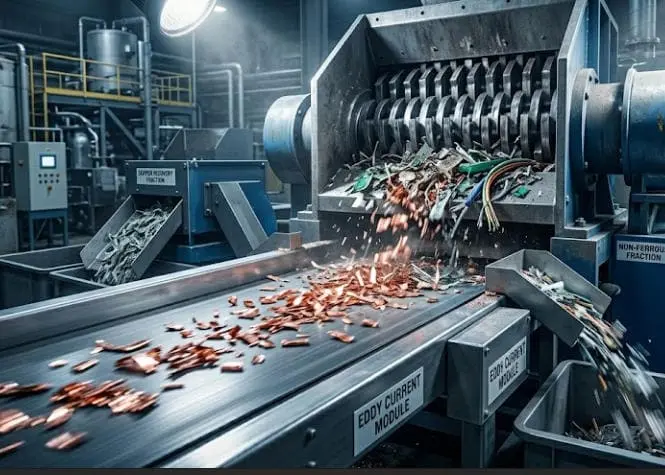
Yes, the copper traces and PCB substrate in damaged LED strips can be recycled. Specialized e-waste recyclers use mechanical shredding, magnetic separation, and chemical processes to recover copper, tin, and other metals from printed circuit boards. These recovered materials re-enter the manufacturing supply chain.
What Valuable Materials Are Inside an LED Strip?
A typical project-grade LED strip contains more recoverable material than most people realize. The flexible PCB is the backbone of the strip, and it is made from copper-clad polyimide or fiberglass. The copper traces carry current to each LED chip. Solder points contain tin, and sometimes small amounts of silver. The LED chips themselves contain semiconductor materials. Even the silicone waterproof coating, while not easily recyclable, can be separated during processing.
How PCB Recycling Works
The recycling of printed circuit boards 9 is a well-established industrial process. Here is a simplified overview:
- Collection and sorting. PCBs are gathered and sorted by type. LED strip PCBs are typically classified as low-grade boards because they contain less precious metal than, say, computer motherboards.
- Shredding. The boards are mechanically shredded into small pieces.
- Separation. Magnetic, eddy current, and density-based separation techniques pull apart metals from non-metals.
- Refining. Recovered metals, especially copper, are sent to smelters for refining. Copper recovery rates 10 from PCBs can reach 95% or higher in modern facilities.
- Residual processing. Non-metallic fractions (fiberglass, resin, adhesive) are processed further or disposed of responsibly.
Is It Worth Recycling Small Quantities?
For a homeowner with a single 5-meter strip, the copper content is very small, perhaps a few grams. The value of that copper alone does not justify a special trip. But here is the point: you are not recycling for the commodity value of one strip. You are recycling to keep electronic materials out of landfill and to contribute to a circular economy. When thousands of strips are collected together, the material recovery becomes meaningful.
For contractors and event production teams replacing large lighting installations, the math changes. Hundreds of meters of strip lighting contain a meaningful amount of copper. Some commercial e-waste recyclers will even pick up bulk quantities at no charge because the material value offsets their processing costs.
What About Damaged or Corroded Strips?
Damaged strips are still recyclable. Corrosion, burn marks, or partial failure do not disqualify a strip from the recycling stream. The key is to package them safely. Wrap strips with sharp edges or exposed solder points in cardboard or thick paper. Label the package as e-waste. Recyclers expect to receive imperfect materials. That is the whole point.
Reuse Before Recycling
Before you recycle, consider whether any section of the strip is still functional. LED strips are designed to be cut and reconnected at designated cut points. A 5-meter strip with a dead section in the middle may yield two shorter but fully functional segments. In our experience, contractors often salvage working sections for smaller jobs, touch-up work, or sample boards. Reuse always beats recycling from an environmental perspective.
Conclusion
Proper disposal of old LED strip lights comes down to treating them as electronic waste, separating components, and using a certified recycler. Check your local rules, reuse what still works, and recycle the rest responsibly.
Footnotes
- Explains certified e-waste recyclers and their benefits. ↩︎
- Details the e-Stewards certification for ethical e-waste management. ↩︎
- Describes Australia's scheme for recycling televisions and computers. ↩︎
- Provides official information on Germany's Electrical and Electronic Equipment Act. ↩︎
- Defines electronic waste and its environmental impact. ↩︎
- Explains the R2 standard for responsible electronics recycling. ↩︎
- Official text of the European Union's Waste Electrical and Electronic Equipment Directive. ↩︎
- Defines Extended Producer Responsibility (EPR) and its role in circular economy. ↩︎
- Provides a comprehensive overview of printed circuit board composition and function. ↩︎
- Highlights high copper recovery rates from waste printed circuit boards. ↩︎


 English
 Spanish
 German
 Russian
 Arabic
 French
 Portuguese