
We usually see containers arrive at ports with LED strips that looked perfect on production line but failed at the customer's warehouse.
To prevent damage to bulk LED strip lights during long-distance shipping, you must build a layered protection system: coil strips loosely to avoid PCB stress, use antistatic and moisture-barrier packaging, choose rigid outer cartons with proper void fill, and run a receiving inspection on arrival.
Shipping damage is almost always a packaging and handling problem, not a product problem layered protection system 1. The good news is that every major risk — bending, static, moisture, heat, and crushing — has a practical fix. Below, we walk through the full system so your next bulk shipment arrives in the same condition it left the factory.
How can I ensure my bulk LED strip order is packed securely for international transit?
We ship hundreds of reels per month to Australia and Germany, and the lessons we have learned about international packing came from real damage claims, not textbooks antistatic and moisture-barrier packaging 2.
To pack bulk LED strips securely for international transit, use antistatic bags as the first layer, coil strips loosely with a minimum bend radius of 5 cm, add silica gel for moisture control, and place reels in double-wall corrugated cartons with foam inserts to prevent movement.
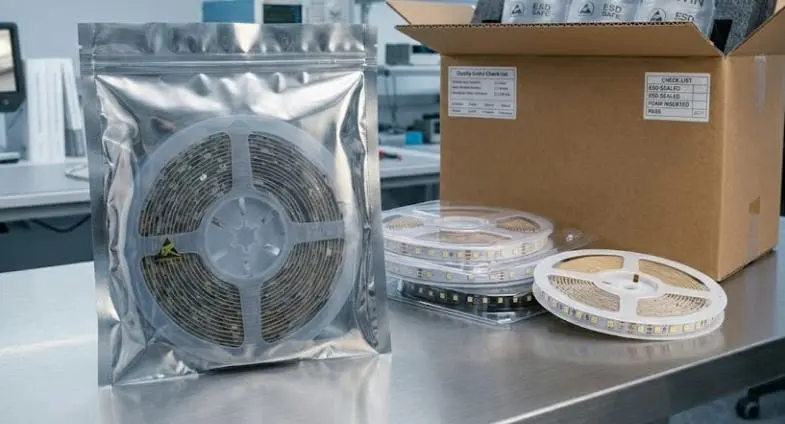
International transit is harsh. A shipment from Shenzhen to Melbourne can spend 15–20 days on the ocean, pass through tropical humidity zones, and get loaded and unloaded multiple times. Each of those stages introduces a different threat to your LED strips. Let me break them down.
The Five Damage Modes You Must Guard Against
Before you pick a single roll of bubble wrap, you need to understand what actually kills LED strips in transit. Here is a quick reference:
| Damage Mode | What Happens | Root Cause |
|---|---|---|
| Bending / Kinking | PCB traces crack, solder joints break, adhesive backing delaminates | Tight coiling or folding during packing |
| ESD (Static) 3 | LED chips or driver ICs fail silently | Plastic wrap or ungrounded handling without antistatic materials |
| Moisture / Condensation | Contacts corrode, adhesive weakens, LEDs flicker after install | Unsealed packaging in humid containers |
| Heat / Cold Extremes | Adhesive melts or becomes brittle, electronics degrade | Sun-exposed containers, freeze-thaw cycles |
| Physical Crushing | Reels deform, connectors snap, micro-cracks form | Undersized boxes, no void fill, poor palletization |
Start With the Right Inner Packaging
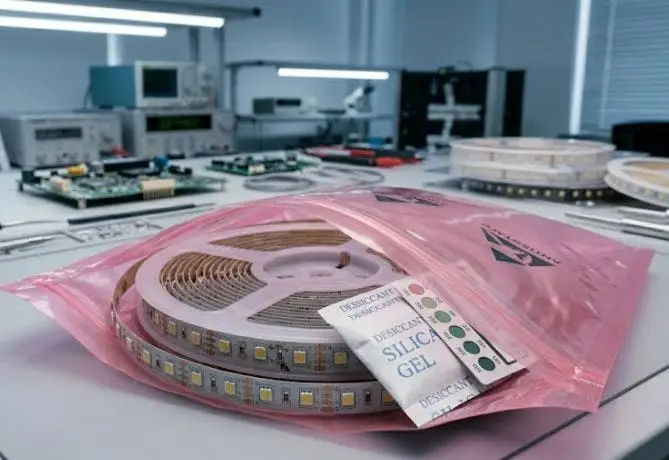
The strip itself needs direct protection before it goes into any box. On our production line, every reel is sealed in an antistatic shielding bag with a small silica gel packet inside. This handles two risks at once — ESD and moisture. If you are receiving strips without antistatic bags, that is a red flag about your supplier's quality standards.
When coiling, the rule is simple: follow the strip's natural curve. Never force a tight loop. The minimum bend radius 4 should be about 5 cm (2 inches). For longer or heavier strips — like 10-meter runs with dense SMD components — use a wider reel core so the inner coils are not stressed.
Separate Vulnerable Components
Power supplies, controllers, and connectors should never share the same compartment as the LED strip reels. A metal power supply bouncing against a reel during 20 days of ocean vibration will scratch the strip, damage the coating, and stress solder joints. We pack these accessories in their own foam-lined compartments or separate small cartons within the master carton.
Build the Outer Box Right
Use double-wall corrugated cartons 5. Single-wall boxes collapse under stacking pressure in a shipping container. Size the box so the reels fit snugly with foam inserts or molded pulp trays — not so loose that they slide around, and not so tight that you have to force them in. Fill every void with air pillows or crumpled kraft paper. The goal is zero movement inside the box.
What packaging standards should I demand from my China supplier to prevent shipping damage?
When we onboard a new wholesale client, one of the first conversations is about packaging specs — because what leaves our factory door determines what arrives at their warehouse.
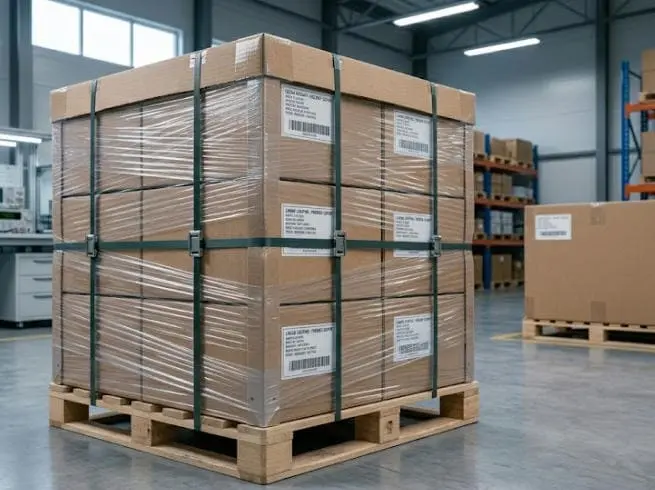
Demand antistatic inner bags, silica gel desiccants, humidity indicator cards, double-wall cartons with foam inserts, clear carton markings including voltage and batch info, and palletization with corner boards, top caps, and stretch wrap. These are minimum standards for bulk LED strip exports.
Many buyers focus entirely on the product spec sheet — lumens, CRI, wattage — and treat packaging as an afterthought. That is a costly mistake. Here is what you should put into your purchase agreement.
Packaging Specification Checklist
| Layer | Requirement | Purpose |
|---|---|---|
| Layer 1: Strip contact | Antistatic shielding bag, sealed | ESD protection |
| Layer 2: Moisture barrier | Silica gel packet (min. 5 g per reel) + humidity indicator card 6 | Moisture and condensation control |
| Layer 3: Reel protection | Rigid plastic reel or cardboard reel core ≥ 10 cm diameter | Prevents tight bending |
| Layer 4: Inner cushion | Foam insert, molded tray, or bubble wrap | Shock absorption |
| Layer 5: Carton | Double-wall corrugated, burst strength ≥ 1,200 kPa | Crush resistance |
| Layer 6: Void fill | Air pillows, kraft paper, or foam peanuts | Prevents internal movement |
| Layer 7: Pallet | Corner boards, top cap, stretch wrap, banding | Stacking and load stability |
Insist on Humidity Indicator Cards
Silica gel alone is not enough for long ocean shipments. A humidity indicator card (HIC) inside the sealed bag gives you proof of what conditions the strip experienced. When you open the bag and the HIC shows the dots have turned pink, you know moisture got in — even if the strip looks fine on the surface. This is critical for warranty claims and root-cause analysis.
Carton Labeling That Actually Helps
A carton marked only "LED Strip" is useless in a busy warehouse. We print each carton with the product SKU, voltage, wattage per meter, color temperature, reel length, batch number, production date, and handling icons — "Fragile," "This Side Up," and "Keep Dry." This is not just for your receiving team. It also helps freight handlers treat the carton correctly and lets you trace any quality issue back to a specific production run.
Ask for Photos Before Shipment
A good supplier will send you packing photos before the container is sealed. You should see the inner packaging, the carton packing layout, and the pallet configuration. If your supplier resists this, ask yourself what else they might be cutting corners on.
The Cost Tradeoff Is Real — But Worth It
Premium packaging adds cost. Antistatic bags, double-wall cartons, foam inserts, and proper palletization can add 3–8% to your per-unit landed cost. But a single damaged shipment — with the cost of returns, re-orders, project delays, and lost client trust — will cost you far more. One of our Australian clients estimated that a single damaged pallet cost him over AUD 4,000 in rework and delay penalties. That paid for two years of upgraded packaging.
Which shipping method will best protect my high-end LED strips during long-distance transport?
Our team has shipped LED strips by air, sea, rail, and express courier — and each method has a very different risk profile for the product inside.
For high-end bulk LED strips, sea freight in a climate-managed container offers the best balance of cost, capacity, and protection. Air freight is faster and avoids ocean humidity but costs significantly more. The best method depends on order value, urgency, and your packaging quality.

There is no single "best" shipping method. The right choice depends on your order size, product value, timeline, and how well the shipment is packed. Here is how to think through it.
Shipping Method Comparison for Bulk LED Strips
| Factor | Sea Freight (FCL/LCL) | Air Freight | Express Courier (DHL/FedEx/UPS) |
|---|---|---|---|
| Transit Time | 15–35 days | 3–7 days | 3–5 days |
| Cost per kg | Low ($0.5–$2/kg) | High ($4–$10/kg) | Very High ($6–$15/kg) |
| Humidity Risk | High (ocean environment) | Low | Low |
| Temperature Swings | Moderate to High | Low | Low to Moderate |
| Vibration / Shock | Moderate (long duration) | Moderate (short bursts) | High (frequent handling) |
| Best For | Large bulk orders, cost-sensitive | High-value or urgent orders | Samples, small/urgent shipments |
Sea Freight: The Default for Bulk
Most of our bulk orders go by sea. It is cost-effective and can handle full pallets. But sea containers face the longest exposure to humidity and temperature swings. A container sitting on the deck in the tropics can reach 60°C inside. That will soften adhesive backings and stress electronic components.
The fix is not to avoid sea freight — it is to pack for it. Use moisture barrier bags, desiccants, and ensure proper ventilation inside the container. If your order value justifies it, request a temperature and humidity data logger inside one of the cartons. The data it captures will tell you exactly what your shipment went through, and you can use it to optimize future packaging.
Air Freight: Fast but Not Damage-Free
Air freight avoids the long moisture exposure of ocean shipping, but it introduces rapid pressure changes and rough tarmac handling. Cartons get tossed, stacked, and compressed in cargo holds. If your outer packaging is weak, air freight can actually cause more physical damage than a well-packed sea shipment.
Express Courier: Highest Handling Risk
Courier services like DHL or FedEx are excellent for speed, but your carton passes through the most hands and sorting systems. Every transfer point is a chance for a drop or a squeeze. For small sample orders, this is fine if the packaging is robust. For bulk orders, the cost is prohibitive and the handling risk is high.
Climate-Controlled vs. Standard Containers
For very high-value shipments or temperature-sensitive adhesive products, a climate-controlled (reefer) container is an option. climate-controlled container 7 It holds a constant temperature and humidity throughout the voyage. The cost is higher — sometimes 30–50% more than a standard container — but it eliminates the biggest environmental risks. For most mid-to-high-end LED strip orders, a standard container with proper internal packaging and desiccants is sufficient.
Vibration Dampening for Premium Orders
Long-distance transport exposes products to continuous low-frequency vibration, especially by sea and road. Over days or weeks, this vibration can loosen solder joints and cause micro-fractures. For premium or sensitive orders, consider vibration-dampening pads under the pallets or foam cradles for individual cartons. Shock indicators 8 — small adhesive devices on the outside of the carton — can also tell you whether the shipment was dropped or subjected to excessive G-forces.
What should I do if my bulk LED strip shipment arrives with visible damage?
We tell every new client the same thing: what you do in the first 48 hours after delivery determines whether you can recover your losses or not.
If your bulk LED strip shipment arrives damaged, document everything immediately with timestamped photos and videos before moving any cartons. Note damage on the carrier's delivery receipt, notify your supplier and freight forwarder within 24 hours, and test sample strips from affected cartons to assess hidden electrical damage.
Receiving a damaged shipment is stressful, but a calm, systematic response protects your claim rights and speeds up resolution. Here is exactly what to do.
Step 1: Inspect Before You Sign
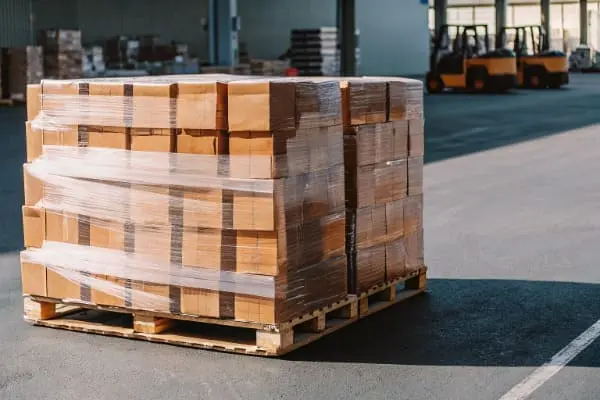
When the truck or container arrives, walk the load before you accept it. Look for crushed cartons, water stains, torn stretch wrap, shifted pallets, or broken banding. If you see any of these, write "Damaged — subject to inspection" on the carrier's proof of delivery or bill of lading 9. Do not sign a clean receipt if the shipment looks compromised. That signature is your leverage for freight insurance claims.
Step 2: Document Everything
Take photos and video of the exterior condition, the pallet layout, and every damaged carton — before you open anything. Then, as you open each carton, photograph the inner packaging state. Check the humidity indicator cards. Are the silica gel packs still dry? Is the antistatic bag intact? Record everything with timestamps. This documentation is what your supplier, your insurance company, and your freight forwarder will need.
Step 3: Test Samples From Affected Cartons
Visual inspection is not enough. A strip can look fine but have micro-cracks in the PCB traces or damaged solder joints that cause flickering, hot spots, or early failure. Pull samples from the damaged cartons and run them on a test bench. Check for color consistency, brightness uniformity, and any dead or flickering LEDs. If you have a lux meter or spectrometer, use it. The more data you collect now, the stronger your claim.
Step 4: Notify the Right Parties Quickly
Contact your supplier, your freight forwarder, and your cargo insurance provider within 24 hours. Most marine cargo insurance policies 10 have strict notification windows — some as short as 3 days. Missing that window can void your claim entirely. Send them the photos, the delivery receipt notes, and your test results.
Step 5: Segregate Damaged Goods
Do not mix damaged reels with your good inventory. Set them aside in a clearly marked area. Your supplier or insurer may request a third-party inspection, and you need the damaged goods intact and accessible for that process.
Common Mistakes During Receiving
Many buyers make errors that weaken their position. Here are the most common ones:
- Signing a clean delivery receipt without inspecting the load
- Opening and testing strips days or weeks after delivery, losing the timeline connection to transit damage
- Discarding damaged packaging before documenting it
- Failing to check humidity indicator cards, which are the best evidence of moisture breach
- Not communicating with the supplier promptly, which delays replacement or credit resolution
Working With Your Supplier on Resolution
A reliable supplier will work with you on damaged shipments. At Glowin, we review the documentation, compare it against our outgoing quality inspection records and packing photos, and determine whether the damage occurred during production, packing, or transit. If the fault is on our side — packaging failure or production defect — we issue replacements or credits. If the fault is on the carrier's side, we help the buyer file a freight claim with the supporting evidence from our end. This kind of partnership matters more than the cheapest unit price.
Conclusion
Shipping damage to bulk LED strips is preventable when you treat packaging, carrier selection, and receiving inspection as one connected system — not three separate afterthoughts.
Footnotes
- Explains a multi-layered approach to cargo security, relevant to protecting shipments. ↩︎
- Details how antistatic moisture barrier bags protect electronics from ESD and moisture. ↩︎
- Provides a comprehensive overview of electrostatic discharge and its impact on electronics. ↩︎
- Discusses the importance of minimum bend radius for LED strips to prevent damage. ↩︎
- Describes the construction and benefits of double-wall corrugated boxes for shipping protection. ↩︎
- Explains the function and use of humidity indicator cards for monitoring moisture levels. ↩︎
- Provides a guide to climate-controlled shipping containers for temperature-sensitive goods. ↩︎
- Details how shock indicators monitor and record impacts during product transportation. ↩︎
- Explains the bill of lading as a crucial document in shipping, serving as a contract and receipt. ↩︎
- Replaced HTTP 403 with an authoritative source (Insurance Information Institute) explaining marine cargo insurance. ↩︎


 English
 Spanish
 German
 Russian
 Arabic
 French
 Portuguese