Fire compliance failures in Australian commercial projects can cost you the entire contract ISO 5660 testing. When our production team works on orders bound for Australia, the conversation always starts with material fire ratings—not brightness, not color temperature. One non-compliant LED strip hidden behind a timber ceiling can trigger insurance rejection, failed inspections, or worse.
COB LED strips destined for Australian projects must use FR4-grade PCB substrates and flame-retardant silicone encapsulation that achieve Group 1 or Group 2 fire classification under AS 5637.1, verified through AS ISO 9705 or ISO 5660 testing, to satisfy National Construction Code requirements for wall and ceiling linings.
This guide walks you through the exact material specs, test standards, certification paths, and thermal management strategies you need FR4-grade PCB substrates. Whether you are a contractor sourcing strips for a high-rise fit-out or a distributor building a fire-compliant product line, the details below will save you from costly compliance gaps.
How do I ensure the COB LED strip materials I source meet Australian AS/NZS fire safety standards?
Every year, we field inquiries from Australian buyers who discover—sometimes mid-project—that their imported LED strips lack the right fire documentation Limiting Oxygen Index 3. The problem is rarely the light output. It is almost always the base material.
To meet AS/NZS fire safety standards, your COB LED strip must have its PCB substrate (preferably FR4 or halogen-free FPCB) and encapsulant independently tested to AS 5637.1, achieving Group 1 or Group 2 classification with smoke production below 25 MW/kg under cone calorimeter testing per ISO 5660.
Understanding the NCC Fire Classification System
Australia's National Construction Code 4 (NCC) governs fire hazard properties for materials used as wall and ceiling linings. Volume 1 covers Class 2–9 buildings (apartments, offices, hospitals), while Volume 2 covers Class 1 (houses) Halogen-free certification 5. The relevant clause is C1.10 for fire hazard properties.
The NCC references AS 5637.1 to classify materials into fire groups. Here is a clear breakdown:
| Fire Group | Test Condition | Flashover Requirement | Smoke Limit | Typical Use |
|---|---|---|---|---|
| Group 1 | AS ISO 9705 at 300 kW | No flashover | ≤25 MW/kg | High-rise linings, hospitals |
| Group 2 | AS ISO 9705 at 300 kW | Flashover allowed, but >120s at 100 kW | ≤25 MW/kg | Commercial offices, schools |
| Group 3 | AS ISO 9705 at 100 kW | Flashover >120s | ≤25 MW/kg | Low-risk residential |
For most commercial lighting projects, Group 1 or Group 2 is required. Group 3 may suffice for residential, but many specifiers default to Group 2 for liability protection.
FR4 vs. FPCB: Which PCB Substrate Passes?
Our engineering team has tested both substrates extensively. The difference is significant.
FR4 is a rigid, glass-reinforced epoxy laminate. It is inherently flame-retardant and typically achieves UL94 V-0 rating, which means a vertical flame self-extinguishes within 10 seconds. This maps well to Group 1 or Group 2 under AS 5637.1.
Standard FPCB (flexible printed circuit board 8) uses a polyimide base. Polyimide is heat-resistant but not always flame-retardant to the same degree. Under unventilated conditions, standard polyimide FPCB can fall into Group 3 or Group 4 territory, which fails most commercial NCC requirements.
The solution? If your project demands flexible COB strips (for curved installations, cove lighting, or radius bends), specify halogen-free flame-retardant FPCB with documented UL94 V-0 classification. Alternatively, use silicone-coated FPCB, which we will cover in the next section.
Key Steps for Verification
Do not accept vague claims like "heat resistant" or "fire safe." Instead, follow this checklist:
- Request the UL94 classification for the PCB substrate—V-0 is the target.
- Ask for AS 5637.1 test results or equivalent cone calorimeter data (ISO 5660) showing heat release rate and smoke production.
- Confirm the encapsulant material is separately rated—epoxy is weaker than silicone in flame retardancy.
- Check whether the adhesive backing (3M VHB or equivalent) has its own fire classification.
- Verify compliance with AS/NZS 60598 for the complete luminaire system, not just the strip.
When we prepare Australian-bound orders, our quality control team attaches these documents to the shipment file. Any supplier unwilling to provide them is a red flag.
Which flame-retardant silicone coatings should I specify to pass fire inspections for my Australian commercial projects?
Choosing the wrong encapsulant is one of the most common mistakes we see in project orders. The silicone coating is the first material fire inspectors encounter—it is the outer layer. If it burns, nothing else matters.
Specify platinum-cured, flame-retardant silicone encapsulation rated UL94 V-0 or better, with verified halogen-free composition, low smoke density, and heat resistance above 200°C. This outperforms epoxy and PU coatings for Australian fire inspections and satisfies NCC lining requirements in concealed ceiling and wall installations.
Why Silicone Outperforms Epoxy and PU
Three main encapsulant types are used in COB LED strips: epoxy resin, polyurethane (PU), and silicone. Each behaves differently under fire conditions.
| Property | Epoxy Resin | Polyurethane (PU) | Silicone (Platinum-Cured) |
|---|---|---|---|
| UL94 Rating | HB to V-2 | HB to V-1 | V-0 (standard for fire-grade) |
| Flame Behavior | Burns, drips | Burns, may drip | Self-extinguishes, no drip |
| Smoke Production | High, dark smoke | Moderate | Very low, white ash |
| Heat Resistance | ~120°C | ~100°C | ~200–250°C |
| Halogen Content | Often contains | Varies | Halogen-free available |
| Yellowing Over Time | Yes | Yes | Minimal |
| Cost Premium vs. Epoxy | Baseline | +10–15% | +25–40% |
For Australian projects governed by the NCC, silicone is the clear winner. In our production facility, we switched our Australian-destined product lines to platinum-cured silicone three years ago. The upfront cost is higher, but it eliminates re-testing, re-ordering, and failed inspections.
What "Flame-Retardant Silicone" Actually Means
Not all silicone is fire-rated. Standard silicone (used in many IP65/IP67 strips) provides moisture protection but may only achieve UL94 HB—which is the lowest, most lenient classification.
Flame-retardant silicone uses ceramic-forming fillers or alumina trihydrate (ATH) additives. When exposed to flame, these fillers create a ceramic-like residue that insulates and smothers combustion. The key specifications to request:
- UL94 V-0 minimum on the silicone compound itself (not just the assembled strip).
- Limiting Oxygen Index (LOI) ≥ 30%—this means the material needs at least 30% oxygen to sustain combustion, well above the 21% in normal air.
- Halogen-free certification—halogenated flame retardants produce toxic fumes banned in many Australian building codes.
- Cone calorimeter data showing peak heat release rate below 100 kW/m².
Silicone Coating Thickness Matters
Thin coatings (0.5 mm or less) may crack or degrade under thermal cycling, exposing the PCB beneath. For fire-rated Australian projects, we recommend a minimum 1.0 mm silicone wall thickness around the COB strip. This ensures the coating maintains its protective barrier even after years of thermal expansion and contraction.
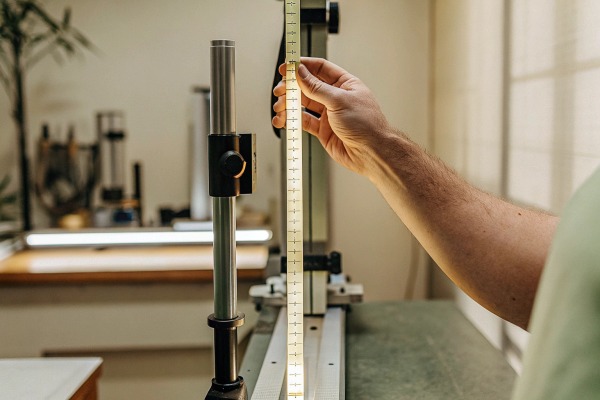
One practical tip: request a cross-section photo from your supplier showing the actual coating thickness. We provide this as part of our standard QC documentation for commercial project orders.
Long-Term Degradation Risks
Even the best silicone degrades over time under UV exposure or sustained high temperatures. In outdoor or semi-exposed Australian installations (awnings, covered terraces), UV-stabilized silicone formulations are essential. Without UV stabilizers, the silicone can become brittle within 3–5 years, losing its fire-retardant integrity. Specify UV-stable grades and confirm the supplier's accelerated aging test data.
Can I get a certified fire rating report from my supplier to satisfy my project's building code requirements?
We have seen projects stall for weeks because the contractor could not produce fire rating documentation during inspection. The lighting was installed, the ceiling was closed up, and then the building certifier asked one question: "Where is the fire test report for these strips?"
Yes, you can and should demand certified fire rating reports. Request third-party test certificates referencing AS 5637.1, ISO 5660 cone calorimeter data, or UL94 classifications from accredited laboratories. Reputable suppliers maintain these documents and can provide them within days of your request as part of project documentation packages.

What a Valid Fire Rating Report Looks Like
A legitimate fire test report is not a one-page letter from the manufacturer. It is a detailed document issued by an accredited testing laboratory (NATA-accredited in Australia, or ISO 17025 labs internationally). It should include:
- Test standard referenced (e.g., AS 5637.1, ISO 5660-1, UL94).
- Sample description matching your exact product—SKU, PCB type, encapsulant, dimensions.
- Test results with numerical data: heat release rate (kW/m²), time to ignition, smoke production rate, mass loss rate.
- Fire group classification (Group 1, 2, or 3).
- Laboratory accreditation number and signatory details.
- Date of testing—reports older than 3–5 years may not reflect current production materials.
The Difference Between Self-Declaration and Third-Party Certification
This distinction trips up many buyers. A self-declaration is the manufacturer saying "our product is fire rated." It carries no legal weight in an Australian building compliance audit.
Third-party certification means an independent lab tested the actual material and issued a report. In Australia, NATA (National Association of Testing Authorities) accreditation is the gold standard. For imported products, reports from UL, TÜV, SGS, or Intertek are generally accepted, but confirm with your building certifier first.
When our customers ask for fire documentation, we provide the raw material test certificates (PCB substrate, silicone compound) plus any assembled-product-level testing. We also assist with CodeMark or WaterMark certification pathways if the project requires them.
Building a Compliance File
Smart contractors build a compliance file for every project. Here is what to include for your LED strip installation:
- Fire test report for the COB strip (PCB + encapsulant).
- Fire test report for the aluminum extrusion profile (if used).
- AS/NZS 60598 electrical safety certificate for the luminaire.
- Installation method statement referencing NCC C1.10.
- Supplier's declaration of conformity with material traceability.
This file protects you during inspections, insurance claims, and post-construction audits. Our team helps Australian buyers compile these files as part of our project support service.
How to Audit Your Supplier
Ask these five questions before placing your order:
- Can you provide a UL94 test report for the PCB substrate used in this COB strip?
- Do you have cone calorimeter (ISO 5660) data for the silicone encapsulant?
- Is the test report from an ISO 17025 or NATA-accredited laboratory 10?
- Does the tested sample match the exact product I am ordering (same materials, same dimensions)?
- Can you provide updated test data if the materials or manufacturing process change?
If your supplier hesitates or offers generic certificates that do not match the specific product, consider that a warning sign. In our experience, suppliers who invest in proper testing are also the ones who maintain consistent production quality.
How does the thermal management of my COB strips impact the overall fire safety of my lighting installation?
Even perfectly fire-rated materials can become a hazard if heat builds up. Our R&D team has tested COB strips in sealed cavities, behind plasterboard, and inside timber joinery. The results are clear: installation context changes everything.
Thermal management directly impacts fire safety because COB strips exceeding 50°C surface temperature can degrade encapsulants, weaken adhesives, and ignite adjacent combustible materials. High-power COB strips above 20W/m require aluminum extrusion profiles, adequate ventilation, and compatible drivers to maintain safe operating temperatures in enclosed Australian installations.
Temperature Thresholds You Must Know
COB LED strips generate heat proportional to their wattage per meter. Low-power strips (8–14W/m) typically run at 30–45°C. High-power strips (20–30W/m) can reach 60–80°C without proper heat sinking.
| Power Rating | Typical Surface Temp (No Profile) | Typical Surface Temp (With Aluminum Profile) | Fire Risk Level |
|---|---|---|---|
| 8–14 W/m | 30–45°C | 25–35°C | Low |
| 15–20 W/m | 45–60°C | 35–45°C | Moderate |
| 20–30 W/m | 60–80°C | 40–55°C | High without profile |
| 30+ W/m | 80–100°C+ | 50–65°C | Mandatory profile + ventilation |
For Australian commercial projects, the NCC does not specify a maximum LED strip temperature directly, but AS 1670.1 (fire detection wiring) and general duty-of-care principles require that no electrical component raises adjacent material temperatures to ignition point. Timber ignites around 250–300°C, but adhesives and plastics degrade much sooner—some as low as 80°C.
Why Aluminum Extrusions Are Non-Negotiable Above 20W/m
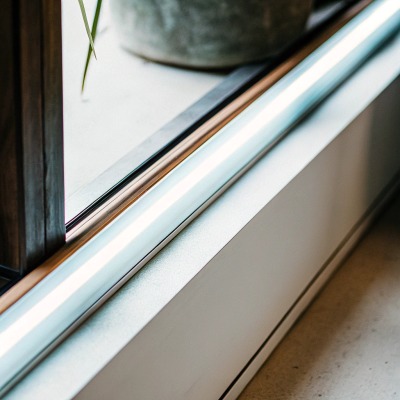
Aluminum profiles serve two functions: they dissipate heat away from the COB strip, and they create a non-combustible barrier between the strip and the mounting surface.
Our standard recommendation for Australian commercial projects is a minimum 1.5 mm wall-thickness aluminum extrusion for any COB strip above 15W/m. For 20W/m and above, we specify profiles with integrated heat fins or wider channel designs that increase surface area for passive cooling.
The profile also protects the silicone encapsulant from direct contact with timber or MDF substrates. This separation is critical in recessed installations where air circulation is limited.
Ventilation in Concealed Spaces
The biggest thermal risk we see is sealed cavity installation. When a COB strip runs inside a closed bulkhead or behind a shadow gap with no airflow, heat accumulates. Over weeks and months, this sustained heat degrades the silicone coating, weakens the adhesive bond, and can cause the strip to detach and contact combustible material.
Best practices for concealed installations:
- Leave a minimum 10 mm air gap between the strip (or profile) and any combustible surface.
- Provide ventilation openings at both ends of linear runs exceeding 2 meters.
- Use drivers with thermal cutoff protection—these dim or shut down the strip if junction temperature exceeds a set threshold (typically 85–95°C).
- Avoid daisy-chaining multiple high-power strips without separate driver circuits.
Smart Thermal Monitoring
An emerging trend in the Australian market is driver-integrated thermal monitoring. These intelligent drivers use NTC thermistors to continuously measure strip temperature. If the temperature exceeds the safe threshold, the driver automatically reduces output or shuts off entirely. This is not a replacement for proper passive thermal management, but it adds a crucial safety net.
When we configure orders for Australian commercial projects, we pair our high-power COB strips with drivers that include this thermal protection feature. It adds a small cost but delivers significant peace of mind—especially for installations that will be inspected under stringent NCC requirements.
The Real-World Consequence
In 2023, a commercial fit-out in Sydney was flagged during final inspection because the lighting contractor had installed 24W/m COB strips directly onto painted MDF without profiles or ventilation gaps. The strips were fire-rated. The silicone was V-0. But the installation method created a heat trap that pushed surface temperatures above 70°C. The certifier rejected the installation. The contractor had to remove the ceiling lining, retrofit aluminum profiles, and re-close—at a cost of over AUD $15,000 for a single floor.
Material fire ratings protect you from the material catching fire. Thermal management protects you from the material starting a fire in everything around it. Both are essential.
Conclusion
Fire compliance for COB LED strips in Australia comes down to three things: the right materials, the right certifications, and the right installation. Do not treat any of them as optional.
Footnotes
- Details the international cone calorimeter test method for heat release and smoke production. ↩︎
- Describes the properties and common use of FR4 material in printed circuit boards. ↩︎
- Found an authoritative definition on Wikipedia. ↩︎
- Official source for Australian building regulations and performance requirements. ↩︎
- Defines the importance of halogen-free materials for environmental and safety compliance. ↩︎
- Official standard for fire hazard properties of wall and ceiling linings in Australia. ↩︎
- Explains the widely recognized standard for plastic flammability and self-extinguishing properties. ↩︎
- Provides general information about flexible PCB technology, materials, and applications. ↩︎
- Official standard for luminaires, covering general safety requirements and tests. ↩︎
- Explains the role of NATA in ensuring testing competence and credibility in Australia. ↩︎

 English
 Spanish
 German
 Russian
 Arabic
 French
 Portuguese